CutBay: An AI Video Agent That Turns Anything into Video via Chat
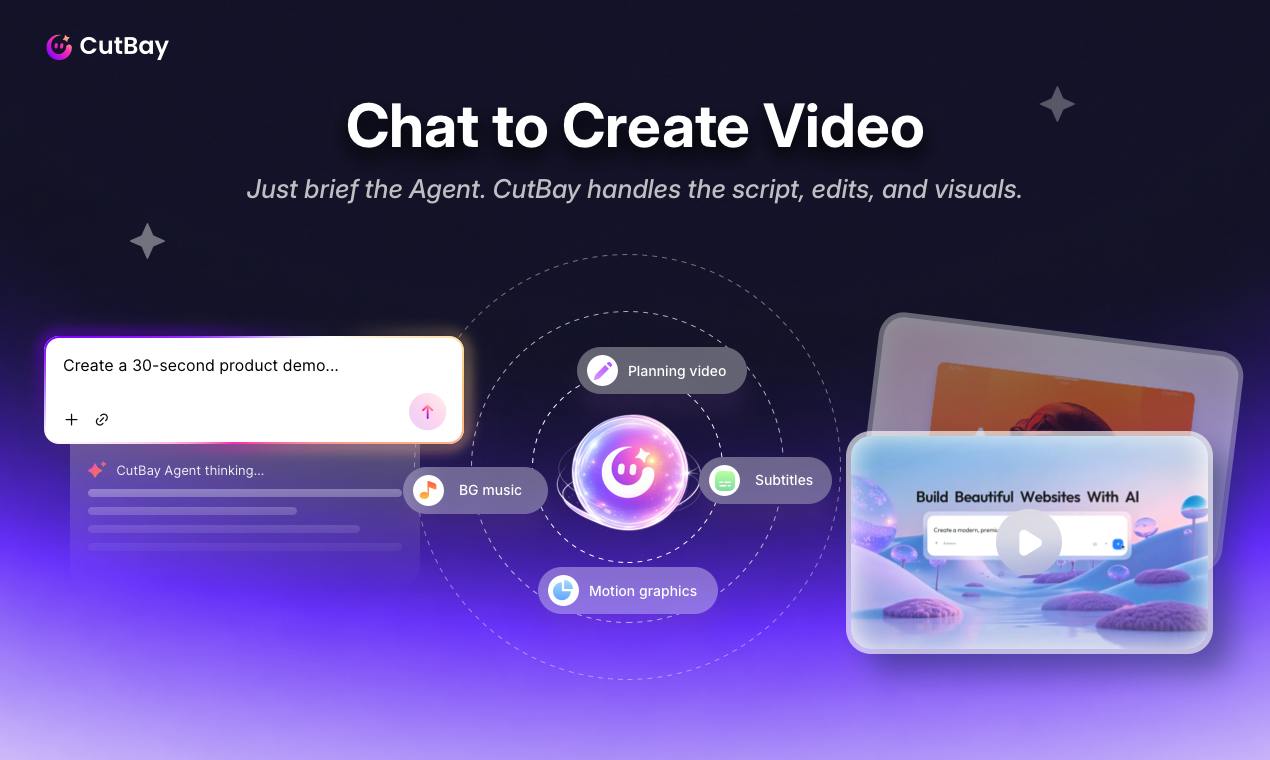
CutBay uses a conversational Agent to turn multiple content sources directly into finished videos, aiming to replace traditional timeline editing.
CutBay is a conversational AI video Agent on Product Hunt that claims to complete planning, scripting, visuals, voiceover, subtitles, and editing from natural language. It supports prompts, URLs, documents, PDFs, presentations, spreadsheets, and media assets. Its core value is reorganizing structured content into video narratives, not generating visuals. It launched with 92 upvotes, 3 comments, and 9th place for the day, still in early exposure. Full pipeline quality, export specs, and commercial licensing remain unverified.
From "Timeline Editing" to "Conversational Creation"
Video production has long been trapped in the timeline: dragging clips, aligning audio tracks, adjusting subtitles, and exporting over and over. CutBay tries to compress this workflow into a single conversation—users simply describe what they want, and the Agent handles planning, scripting, visuals, voiceover, subtitles, and editing. Its positioning isn't an "AI editing plugin" but a video Agent that accepts multiple input types and can be continuously modified through natural language.
On Product Hunt, CutBay launched with the tagline "AI Video Agent: Turn Anything into Videos via Chat," earning 92 upvotes and 3 comments, ranking 9th for the day under the Productivity, Artificial Intelligence, and Video categories. The vote count isn't explosive, but the direction is worth unpacking: it hands all the intermediate steps between "content source" and "finished video" over to an Agent.
Input Defines the Ceiling: What It Can Ingest
The input types listed in CutBay's official description are quite broad: prompts, URLs, documents, PDFs, presentations, spreadsheets, and media assets. This means its core capability isn't "generating a flashy clip" but reorganizing structured or semi-structured information into a video narrative.
This design philosophy is fundamentally different from pure text-to-video tools. Text-to-video solves "where do the visuals come from," while CutBay solves "how does content become a watchable film." For teams that need to convert blog posts, product docs, quarterly reports, or web content into video, the latter pain point is more real—they don't lack assets; they lack the labor to organize those assets into video.
The Difference Between Text-to-Video and Video Agents
Text-to-video models (such as Sora, Runway Gen-3, Kling, etc.) have the core task of directly synthesizing video footage from a prompt. The output is typically a continuous shot lasting a few to a dozen seconds, without a complete narrative structure, voiceover, subtitle track, or edit points. It solves the problem of "where do the pixels come from."
A video Agent, by contrast, treats video as an orchestratable engineering project: first understanding the input content, planning the narrative structure, generating or retrieving assets, organizing audio-visuals and subtitles, then iterating through multiple rounds of conversation. The two can be layered—an Agent can call a text-to-video model at some stage to produce a shot, but what the Agent delivers is a finished film, not a piece of footage. Understanding this layering is essential to judging which stages CutBay's claimed "full pipeline" actually covers.
Conversational Refinement: The Agent's Iteration Loop
CutBay emphasizes "refining videos through natural conversation." The product logic behind this is: the first version is not the endpoint but the starting point. Users can say "speed up this voiceover a bit," "change the subtitles in the second segment to the brand color," or "this transition is too flashy," and the Agent makes incremental modifications to the existing project rather than starting from scratch each time.
This interaction style is friendlier to non-professional editors, but it also places higher demands on the Agent's state management—it must remember what the previous version did, what was changed, and which constraints cannot be touched. The official documentation doesn't disclose the specific technical implementation, but from the product description it looks closer to a combination of "multi-step task orchestration + editable project" rather than one-shot generation.
Agent State Management and "Editable Projects"
The technical difficulty of multi-turn conversational modification lies not in single-shot generation but in state persistence and rollback. A usable video Agent typically needs to maintain three types of information: a structured description of the current project (timeline, layers, asset references, parameters), a history of modifications (for undo and comparison), and constraints explicitly or implicitly stated by the user (such as brand colors, duration limits, forbidden assets).
If the entire video is regenerated with every conversation, modifications will "drift"—the user only wants to change one line of voiceover, but the visuals all change. Therefore, the common industry practice is to represent video as a programmatically editable project file (similar to a Jianying draft or Premiere project), with the Agent outputting only operation instructions (diffs) on the project, which are then executed by the rendering pipeline. This is also the prerequisite for the product logic of "the first version is the starting point" to hold.
Real-World Concerns Worth Noting
The data of 92 upvotes and 3 comments indicates that CutBay is still in an early exposure stage, with limited community discussion and a lack of in-depth feedback from independent users. The official claim covers the full pipeline of planning, scripting, visuals, voiceover, subtitles, and editing, but the actual quality of each stage, export specifications, commercial licensing, and team collaboration capabilities have not been publicly detailed.
Another point to watch is the boundary of "turning anything into video." The broader the input, the more critical the Agent's understanding and selection of content becomes—which information in a PDF should go into the video and which should be cut directly determines whether the finished film is usable. This is both CutBay's opportunity and where it's most vulnerable to criticism.
Who Should Try It First
If your workflow repeatedly involves "converting documents/web pages/report materials into video" and your team has no dedicated editor, CutBay's conversational path is worth adding to your candidate list. Conversely, if your needs are finely crafted, film-grade editing or batch production with strict brand guidelines, the safer approach at this stage is to wait for more user testing and official documentation before making a judgment.
The video Agent category is moving from "generating clips" to "delivering finished films," and CutBay is a sample on this path. Whether it can hold its ground depends on the precision of conversational modification and the reliability of input parsing—two things that can currently only be verified through actual use.
Background Notes
What Product Hunt Rankings Mean
Product Hunt ranks launched products daily by upvotes. "9th for the day" means the vote count was among the top of all new products that day, but it doesn't represent long-term popularity. 92 upvotes is a moderate-to-low exposure level—popular products can reach hundreds or even thousands of upvotes in a single day. The 3 comments are especially worth noting: comment count often reflects the depth of real user trials better than vote count, because voting costs almost nothing while leaving specific feedback requires actual use. Therefore, such data is only suitable as a signal of an "early-stage project" and should not be used as a basis for evaluating product capability.
One-line Summary
CutBay uses a conversational Agent to turn multiple content sources directly into finished films, attempting to replace traditional timeline editing.
Paragraph Summary
CutBay is a conversational AI video Agent launched on Product Hunt that claims users only need to describe their needs in natural language, and the Agent completes the entire workflow of planning, scripting, visuals, voiceover, subtitles, and editing. It supports multiple input types including prompts, URLs, documents, PDFs, presentations, spreadsheets, and media assets. Its core value isn't generating visuals but reorganizing structured content into video narratives. The product emphasizes continuous refinement through conversation, with the first version being a starting point rather than an endpoint, which requires the Agent to have engineering state management and incremental modification capabilities. It currently launched with 92 upvotes, 3 comments, and 9th place for the day, placing it in an early exposure stage. The actual quality of the full pipeline, export specifications, and commercial licensing still lack independent verification.
Related articles
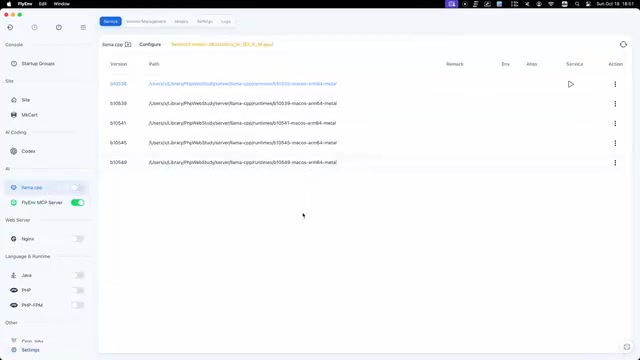
FlyEnv Plugin Review: Visually Running llama.cpp and Managing GGUF Models
FlyEnv launches the official llama.cpp plugin with side-by-side Metal runtime management, public GGUF repository indexing with file type labels, and visual configuration of context, threads, and GPU layers—saving templates and speculative decoding with each model for one-click local LLM inference.
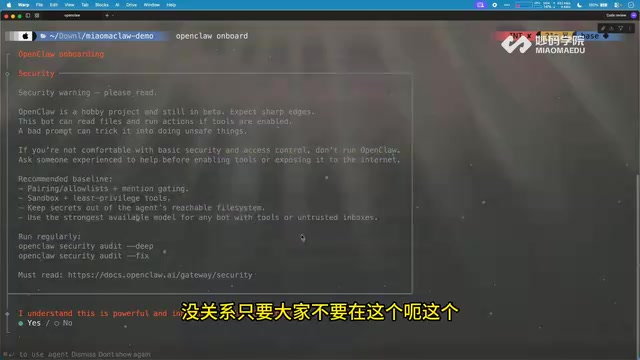
How Can Frontend Developers Advance into AI Agent Development? Deconstructing System-Level Agent Architecture from OpenClaw
Starting from the OpenClaw demo in a Bilibili open class, this article breaks down the three-layer architecture and universal formula of system-level AI agents, and analyzes the path for frontend developers to enter agent development based on TypeScript, including plugin-based design and security/memory layer challenges, with an interview answer framework.
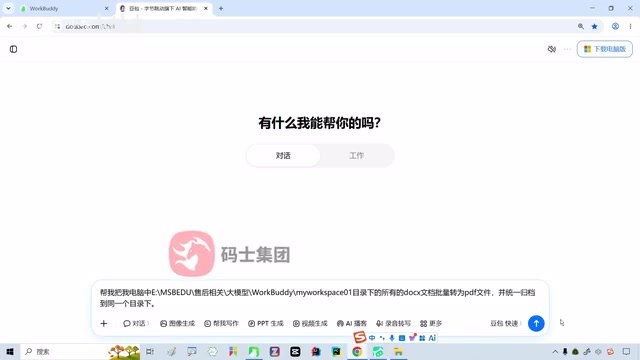
WorkBuddy in Action: How AI Agents Automate Batch File Conversion and Archiving
Bilibili creator Teacher Shanyao tests WorkBuddy vs. Doubao on batch file conversion, showing how AI Agents move from "giving solutions" to "direct execution," with a full workflow and credit cost reference.