CVE-2026-53361 Vulnerability Analysis: Linux Kernel AF_UNIX Container Escape Mechanism and Defenses

CVE-2026-53361 exploits an AF_UNIX GC vs MSG_PEEK race condition for kernel UAF-based container escape.
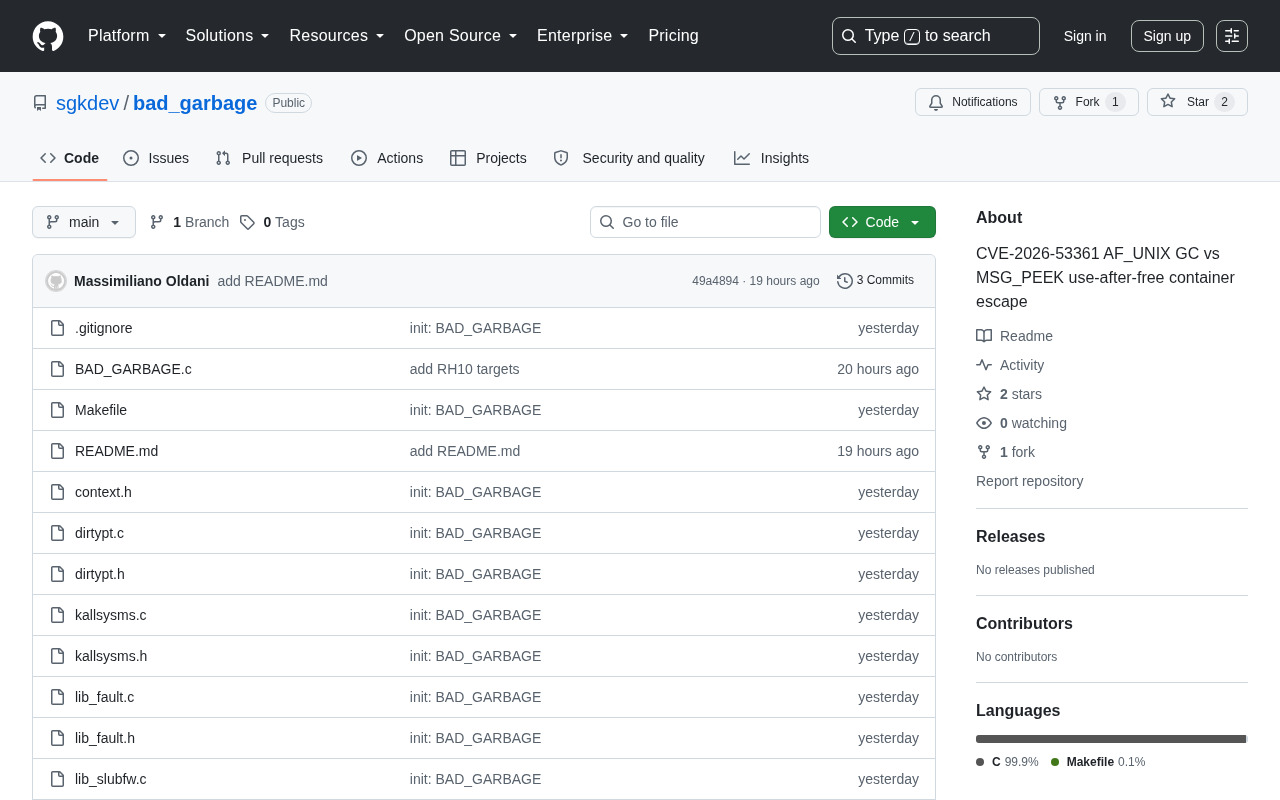
CVE-2026-53361 is a Linux kernel vulnerability in the AF_UNIX socket subsystem where a race condition between the garbage collector and MSG_PEEK operations causes a Use-After-Free. Attackers can exploit this from unprivileged containers to achieve host-level escape. The article details the technical mechanism, exploitation chain involving heap spraying and credential overwrite, and recommends kernel patching, seccomp, runtime monitoring, and kernel hardening as defenses.
Introduction: Yet Another Kernel-Level Container Escape
The security community recently disclosed CVE-2026-53361, a Linux kernel vulnerability located in the AF_UNIX socket subsystem. It involves a race condition between the garbage collection (GC) mechanism and MSG_PEEK operations, leading to a Use-After-Free (UAF) issue that can ultimately be exploited to achieve container escape.
For cloud-native environments that rely on container isolation, kernel-level UAF vulnerabilities often mean attackers can breach namespace boundaries and escalate from a restricted container context to host-level privileges. These vulnerabilities are typically rated as critical because containers share the same kernel instance. Linux container isolation relies on six primary namespaces (PID, Network, Mount, UTS, IPC, User) plus cgroups resource limits—however, all these mechanisms are implemented and enforced within the same kernel. This is fundamentally different from the hardware-level isolation provided by virtual machines. Once an attacker gains arbitrary code execution through a kernel vulnerability, they can directly manipulate kernel data structures to switch namespaces (modify task_struct->nsproxy), escalate credentials (overwrite the cred structure), or directly access the host filesystem.
AF_UNIX Sockets and File Descriptor Passing Mechanism
The Unique Nature of AF_UNIX Sockets
AF_UNIX (Unix domain sockets) is one of the core inter-process communication (IPC) mechanisms on Linux. Unlike network sockets, it supports passing file descriptors between processes via SCM_RIGHTS ancillary messages. This capability means AF_UNIX sockets can form complex reference relationships—one socket holding a reference to another.
SCM_RIGHTS is an ancillary message type defined by the POSIX standard, allowing file descriptors to be passed between processes through sendmsg/recvmsg system calls. Its underlying implementation relies on the kernel's struct file reference counting mechanism: the sender increases the reference via fget, and the receiver installs it into its own file descriptor table via fd_install. This mechanism is widely used in container runtimes (e.g., containerd passes container stdio file descriptors via Unix sockets), systemd's socket activation, and IPC frameworks like D-Bus. It is precisely because of this cross-process reference passing capability that AF_UNIX socket lifecycle management is far more complex than ordinary network sockets.
Why Garbage Collection Is Needed
Due to file descriptor passing, AF_UNIX sockets can form circular references. For example, socket A's receive queue carries a reference to socket B, while B in turn references A. Ordinary reference counting cannot reclaim such cycles, so the Linux kernel implements a dedicated garbage collector for AF_UNIX to detect and clean up these "zombie" sockets that cannot be freed through reference counting alone.
This GC mechanism has historically been a hotspot for kernel vulnerabilities because it needs to traverse, mark, and reclaim objects under complex concurrent scenarios—any synchronization oversight can lead to memory safety issues. The AF_UNIX garbage collector code resides in net/unix/garbage.c and dates back to the Linux 2.0 era. Its core algorithm resembles mark-and-sweep: it first subtracts the internal reference counts in queues from the reference counts of all inflight (in-transit) Unix sockets; if the result is zero, the socket is marked as garbage. This code has historically caused multiple security issues, including CVE-2021-0920 (GC and close race) and CVE-2024-1086 (nf_tables-related but involving similar skb lifecycle issues). In 2024, the kernel community performed a major refactoring of GC, introducing a new SCM-marking-based scheme, but legacy paths in older kernel versions remain part of the attack surface.
CVE-2026-53361 Vulnerability Mechanism: The Race Condition Between GC and MSG_PEEK
MSG_PEEK Semantics
MSG_PEEK is a flag for socket receive operations. When reading data with this flag, the data is not removed from the receive queue—it merely "peeks" at a copy. This means during a peek operation, the kernel needs to access the skb (socket buffer) in the queue and its carried references without modifying the queue structure.
sk_buff (commonly abbreviated as skb) is the core data structure of the Linux kernel's network subsystem, used to represent network packets or socket messages. In the AF_UNIX scenario, each message sent via sendmsg is encapsulated in an skb and stored in the receiver socket's sk_receive_queue linked list. When a message carries SCM_RIGHTS ancillary data, the skb's control buffer (skb->cb) contains a pointer to struct scm_fp_list, which holds an array of struct file pointers being passed. The MSG_PEEK operation needs to traverse these skbs without dequeuing them, meaning the skb and the file objects it references must remain valid during the peek—and this is precisely the leverage point for the race condition.
How the Race Window Emerges
The core of the vulnerability lies in this: when one thread accesses a message carrying file descriptor references in the receive queue via MSG_PEEK, the garbage collector may concurrently determine the related socket as reclaimable and free it in another context.
Since the MSG_PEEK path and the GC path lack sufficient synchronization protection when accessing the same set of objects, a classic TOCTOU (Time of Check to Time of Use) race condition is formed:
- T1 (peek thread): Reading/referencing the socket object carried in the skb
- T2 (GC thread): Determining the object is unreachable and executing the free
When T1 continues to access the memory after T2 has freed the object, a Use-After-Free (UAF) is triggered. As long as the attacker can precisely control this race window and immediately reclaim the memory block with controlled data after the object is freed, they can manipulate kernel memory contents.
TOCTOU (Time of Check to Time of Use) is one of the most classic patterns in concurrency vulnerabilities. In the kernel context, TOCTOU is particularly dangerous because kernel code typically runs at the highest privilege level and multiple CPU cores may simultaneously execute different kernel paths. Standard defenses against TOCTOU include: using spinlocks or mutexes to protect critical sections, using RCU (Read-Copy-Update) for lock-free safe reads, and using reference counting to ensure objects are not freed while in use. The fix for CVE-2026-53361 likely involves adding reference count holds on related objects in the MSG_PEEK path, or checking whether objects are being peek-accessed during the GC marking phase.
Exploitation Chain Analysis: From UAF to Container Escape
Basic Exploitation Strategy
A bare UAF does not directly grant system control. Attackers typically need to construct a complete exploitation chain:
- Trigger the free: Through carefully orchestrated multi-threaded operations, cause GC to free the target socket object during peek access.
- Heap spray for reclaim: Rapidly occupy the freed memory region with controllable kernel objects of the same size, redirecting the dangling pointer to attacker-controlled data.
- Privilege escalation/escape: Leverage corrupted kernel structures (such as function pointers, credential structure
cred, etc.) to overwrite permissions or hijack control flow, ultimately breaking through the container's namespace restrictions.
Kernel heap spraying is a critical step in UAF exploitation. The Linux kernel uses the SLAB/SLUB allocator to manage small object memory, where objects of the same size class (slab cache) share memory pages. Attackers exploit this property by allocating large numbers of controllable kernel objects of the same size (such as msgsnd messages, pipe buffers, setxattr attributes, etc.) after the target object is freed to fill the released memory slot. If successful, the dangling pointer will point to an object with attacker-controlled content, enabling arbitrary read/write or control flow hijacking. In recent years, the emergence of cross-cache attack techniques means that even if the target object and spray objects are not in the same slab cache, attackers may achieve cross-cache reclaim through page-level reclamation and reallocation, further expanding the range of exploitable vulnerabilities.
Special Risks in Container Scenarios
It's worth emphasizing that AF_UNIX socket operations are typically allowed under default container configurations and do not require privileged capabilities. This means an ordinary process running in an unprivileged container theoretically has the prerequisites to trigger this vulnerability. Once exploitation succeeds, the isolation between container and host is completely breached.
This is also why kernel UAF vulnerabilities are especially dangerous in container environments: container isolation fundamentally still shares the same kernel, and any kernel-level memory corruption can potentially be used to cross isolation boundaries. This is why projects like gVisor and Kata Containers adopt additional kernel isolation layers—gVisor uses a user-space kernel (Sentry) to re-implement the system call interface, intercepting application system calls in user space and drastically reducing direct exposure to the host kernel; Kata Containers launches a lightweight virtual machine for each container, providing an additional isolation layer through hardware virtualization. While these solutions introduce performance overhead, they are necessary supplements for security-sensitive multi-tenant environments.
Defensive and Mitigation Recommendations
Timely Kernel Patching
The most fundamental response is to upgrade to a kernel version that has fixed this vulnerability. After disclosing such race conditions, the upstream community typically introduces stricter locks or reference protections to ensure GC does not free objects that are currently being peek-accessed.
Defense-in-Depth Measures
In scenarios where immediate patching is not possible, consider the following mitigations:
- seccomp filtering: Use seccomp-bpf to restrict available system calls within containers, reducing the attack surface. However, completely disabling socket-related calls is often impractical. seccomp-bpf allows processes to install system call filters, and Docker's default seccomp profile already prohibits approximately 44 system calls. However, for vulnerabilities like CVE-2026-53361, the trigger path only requires basic network system calls such as socket, sendmsg, and recvmsg, which are essential for the vast majority of container workloads and cannot be easily disabled. More granular protection can be achieved through BPF LSM (Linux Security Module), which allows custom security policies to be executed at LSM hook points—for example, rate-limiting SCM_RIGHTS message sending or prohibiting file descriptor passing in specific contexts.
- Principle of least privilege: Avoid running containers as root, enable user namespace isolation, and reduce the blast radius after successful exploitation.
- Runtime monitoring: Deploy eBPF or runtime security tools to detect anomalous socket operation patterns and potential heap spray behavior.
- Kernel hardening options: Enable KASLR, CONFIG_SLAB_FREELIST_RANDOM, and other compile options to increase exploitation difficulty. KASLR (Kernel Address Space Layout Randomization) increases exploitation difficulty by randomizing kernel code and data load addresses, but multiple studies have shown its entropy is limited (typically only 9-15 bits) and can be bypassed via side channels. CONFIG_SLAB_FREELIST_RANDOM randomizes freelist pointer ordering to counter deterministic heap spraying, while CONFIG_SLAB_FREELIST_HARDENED detects corruption through XOR-encrypted freelist pointers. More aggressive hardening includes CONFIG_INIT_ON_FREE_DEFAULT_ON (zeroing memory on free, preventing UAF reads from obtaining meaningful residual data) and Control Flow Integrity (CFI), which effectively prevents exploitation techniques that hijack control flow through function pointers.
Conclusion
CVE-2026-53361 once again reminds us that the AF_UNIX garbage collection path remains a sensitive area for Linux kernel memory safety. Race condition vulnerabilities are difficult to fully discover through static analysis and often only manifest under concurrent stress.
For operations and security teams, the lesson from this class of vulnerability is clear: container isolation is not the endpoint of security boundaries. Under a shared-kernel architecture, kernel patch management, least-privilege configuration, and runtime monitoring are all indispensable. As cloud-native scales expand, the value of such kernel-level escape vulnerabilities will only increase, making it worthwhile to continuously monitor upstream kernel security advisories.
Key Takeaways
Related articles

Apple HomeView Hands-On Review: Is the $300 Smart Home Hub Worth It?
Apple HomeView hands-on: a $300 smart home hub with facial recognition for quick account switching, but no App Store or voice recognition. Is the wall-mounted version worth it? Should you buy the first generation?

Meta Muse Wonder Launch: What It Means for Meta's Return to the Frontier AI Race
Meta releases Muse Wonder and WonderFull, benchmarks reach the frontier, community feedback is polarized. An in-depth look at Meta's return to the frontier AI race, its personal agent strategy, and Zuckerberg's different path.

Apple Home Smart Home Lineup Leaked: LG and Schneider Team Up, UWB Door Lock on Board
Apple Home ecosystem gains new LG and Schneider devices: UWB smart lock with proximity unlock, 2.5K dual-camera doorbell, privacy indoor camera, and AirPods-like seamless pairing.