CVPR Paper Dataset Never Released: A Crisis of Academic Integrity and Reproducibility

A CVPR paper's promised dataset was never released, exposing gaps in academic accountability.
A CVPR 2026 paper whose core contribution was a dataset never actually released it—the GitHub repository remained empty before, during, and after the conference, with no response from the authors. This article examines why unreleased dataset papers undermine academic integrity, explores the reproducibility crisis in AI research, and outlines practical complaint channels including contacting program chairs, IEEE publication ethics, and platforms like PubPeer.
An Unfulfilled Promise: Where Is the CVPR Paper's Dataset?
Recently, a researcher sparked a thought-provoking discussion on Reddit. They encountered a rather thorny situation: a paper accepted and officially published at CVPR 2026 whose core contribution was a dataset that was never publicly released at any point.
CVPR (IEEE/CVF Conference on Computer Vision and Pattern Recognition) is a universally recognized top-tier academic conference in computer vision, alongside ICCV and ECCV as the three premier venues in the field. CVPR receives thousands of submissions each year with an acceptance rate typically around 25%, making competition extremely fierce. A paper accepted at CVPR is widely regarded as high-quality research, carrying significant weight for an author's academic reputation and career development. For this reason, every acceptance slot is precious, and the community holds exceptionally high expectations for the quality and contributions of accepted papers.
According to the researcher's description, the situation was quite clear: the dataset was not released before the conference, was not released during the conference, and still showed no signs of appearing even after the conference concluded. While the paper included a GitHub link, opening it revealed an empty repository—and from their observation, the repository had been empty from the very beginning.
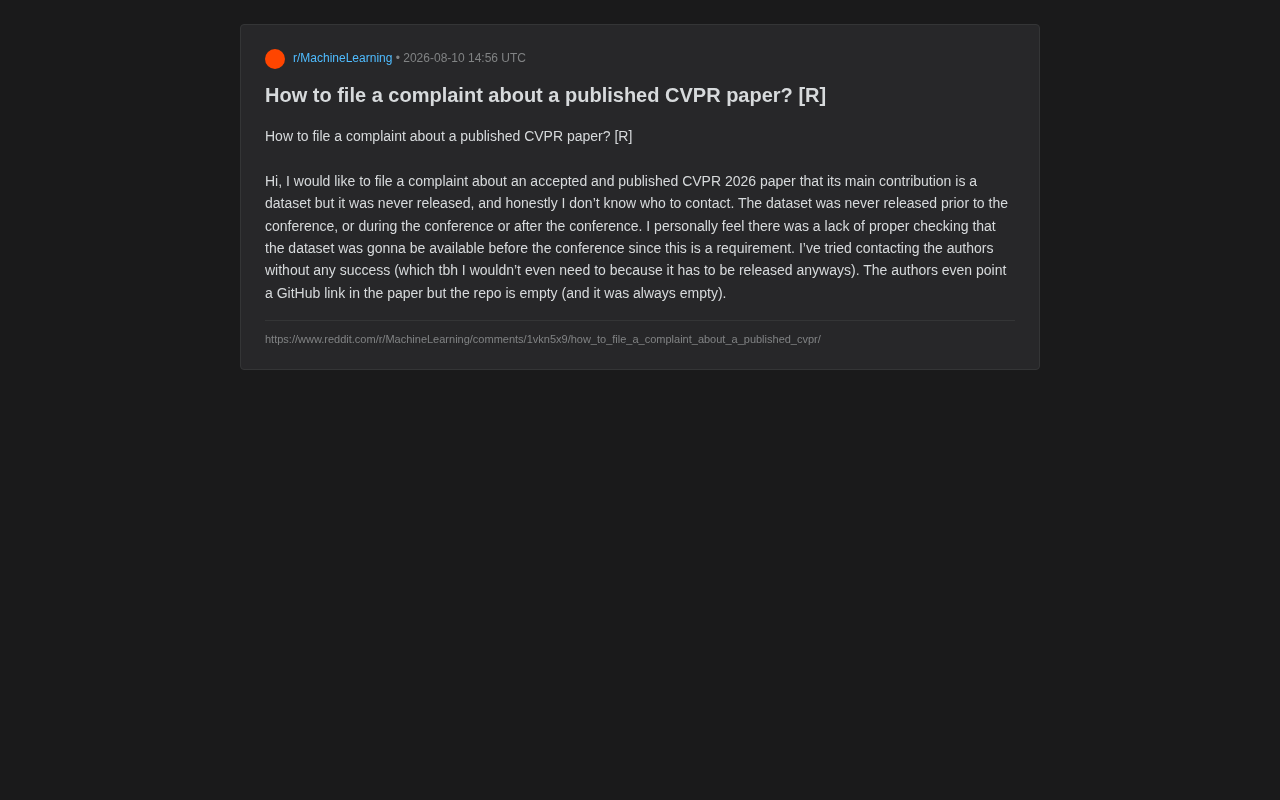
What made the situation even more frustrating was that their attempts to contact the paper's authors received no response whatsoever. In their own words: "Frankly, I shouldn't even need to contact them because the dataset was supposed to be released as per the rules."
Why Is Not Releasing the Dataset a Serious Problem?
On the surface, this might seem like a minor episode of a dataset being "slow to go live," but upon deeper analysis, it touches on an increasingly critical issue in the AI academic community—reproducibility and academic integrity.
The Reproducibility Crisis is not unique to AI; it was first widely discussed in psychology and biomedical sciences. A 2016 Nature survey revealed that over 70% of researchers had tried and failed to reproduce others' experiments. In machine learning and computer vision, this problem is exacerbated by the stochasticity of model training, hyperparameter sensitivity, and the demands of large-scale computational resources. NeurIPS introduced a Reproducibility Checklist in 2019, and conferences like CVPR followed suit, requiring authors to explicitly declare their plans for releasing code and data at submission time. However, these policies still have obvious gaps at the enforcement level.
The Special Nature of Dataset Papers
In computer vision, papers whose primary contribution is a dataset hold a special position. The value of such papers is almost entirely predicated on the dataset's accessibility. For a paper proposing a new algorithm, even if the code is not released, readers can at least attempt to reproduce it based on the method description. But for a paper whose core contribution is a dataset, if that dataset is not made public, the contribution is effectively zero.
In the history of computer vision, high-quality datasets have often played a more critical role than the algorithms themselves. The ImageNet dataset (released in 2009) catalyzed the deep learning revolution, the COCO dataset became the standard benchmark for object detection and image segmentation, and the KITTI dataset advanced autonomous driving perception technology. These datasets achieved such enormous impact precisely because they were fully released, enabling researchers worldwide to make fair comparisons and iterative improvements on a unified benchmark. An unreleased dataset, no matter how detailed the paper's description, cannot serve this catalytic function.
In other words, this paper occupied a valuable CVPR acceptance slot without providing any usable resources to the community. This is unfair to other excellent work that was rejected due to limited slots.
Are Top Conferences' Data Release Requirements Just Window Dressing?
Top-tier conferences including CVPR have been strengthening their requirements for code and data release in recent years. Many conferences require authors to fill out a "reproducibility checklist" at submission, declaring that their data and code will be made public. The researcher astutely identified the crux of the problem: "I think there is no proper verification before the conference that the dataset will actually be released."
This exposes a process loophole—during the review and acceptance stages, reviewers often make judgments based on authors' "promises" without any follow-up tracking mechanism to verify whether those promises are actually fulfilled. An empty GitHub link can be explained away during review as "code is being prepared, will be released upon acceptance," but once accepted with no oversight, the promise can be shelved indefinitely.
What Can You Do When a Paper's Dataset Isn't Released?
For the practical question raised by the original poster—"who should I complain to"—there are actually several viable channels in academia worth organizing and sharing.
Step 1: Contact the Conference Program Committee
CVPR is jointly organized by IEEE and CVF (Computer Vision Foundation). The most direct route is to contact the current edition's Program Chairs. This information is typically available on the conference website. Program Chairs have the authority to investigate papers that violate submission policies.
Step 2: Appeal to the Publisher's Academic Integrity Mechanisms
CVPR papers are ultimately indexed by IEEE. IEEE has dedicated Publication Ethics complaint channels that handle academic misconduct including inaccessible data and violations of public release commitments. Additionally, an increasing number of conferences are adopting third-party paper review platforms like PubPeer, which allow researchers to publicly question published papers.
PubPeer is an online academic paper review platform created in 2012 that allows any researcher to comment on and question published papers, either anonymously or under their real name. The platform has played an important role in exposing academic misconduct—several high-impact fraud cases (such as image manipulation and data fabrication) were initially discovered through community reports on PubPeer. Beyond PubPeer, OpenReview (the review platform used by many AI top conferences) also provides public discussion features for papers. These platforms represent a trend toward "decentralized academic oversight," compensating for the limitation of traditional peer review that only occurs before publication.
Step 3: Maintain a Complete Evidence Chain
Regardless of which channel you pursue, the key lies in evidence. The original poster's approach actually serves as a good reference—they documented the timeline showing the dataset was not released before, during, or after the conference, and preserved the state of the empty GitHub repository. These objective facts form a solid foundation for a complaint.
Deeper Anxieties in the AI Academic Community
This individual case resonated so widely because it touches on a collective anxiety shared by the entire AI research community.
In recent years, with the explosive growth in the number of AI papers, the review burden at top conferences has reached unprecedented levels. Under the "Publish or Perish" pressure of academic competition, some researchers may use a "promised" dataset to secure paper acceptance, while the actual motivation to release diminishes significantly—especially when the dataset involves privacy, copyright, or commercially sensitive information.
Publish or Perish is the classic expression describing career pressure in modern academia. Under this system, a researcher's promotion, grant applications, and academic reputation depend almost entirely on the number of publications and the prestige of the venues. This incentive structure leads to a series of distorted behaviors: salami slicing, overclaiming, and the false release promises discussed in this article. When merely "promising to release" a dataset is sufficient to help a paper pass review, while actually releasing it has no impact on the academic benefits already obtained, rational actors have an incentive not to release—especially when creating the dataset involves substantial manual annotation costs, has commercialization potential, or contains potentially controversial content.
This reminds us that academia may need to establish more rigid verification mechanisms: for example, requiring dataset papers to provide accessible hosting links (not empty repositories) before the camera-ready stage, or introducing post-publication audit systems that flag papers for retraction if public release commitments are not fulfilled.
Camera-ready is a critical milestone in the academic publishing process, referring to the finalization stage after a paper is officially accepted but before final submission to the publisher for printing or indexing. At this stage, authors must make final revisions based on reviewer feedback, confirm formatting compliance, and sign copyright agreements. For conferences that require code and data release, the camera-ready stage is theoretically the last checkpoint to verify whether authors have fulfilled their release commitments. If mandatory link validity checks were implemented at this stage—such as verifying that a GitHub repository contains substantive content or that a data hosting platform is accessible—it could effectively prevent empty-promise papers from entering the final publication pipeline.
Conclusion: Reproducibility Should Not Be Just a Checkbox
One paper, one empty repository, one round of unanswered emails—this seemingly minor incident is actually a test of the entire academic community's capacity for self-governance. Reproducibility should not be just a checkbox on a submission form; it should be the baseline of academic contribution.
For every researcher who encounters a similar situation, having the courage to speak up through proper channels is itself an important part of maintaining a healthy academic ecosystem. And for conference organizers, how to transform "release promises" from paper commitments into enforced reality will be a governance challenge they must confront head-on.
Related articles

Cursor AI Programming in Practice: Build a Student Management System from Scratch in 30 Minutes
A Bilibili creator demonstrates Cursor AI programming: generating a student management system in 30 minutes with natural language. Details on Agent mode, Claude selection, prompt techniques, and thresholds.

Top 20 AI Coding Tools Ranking: From Rock-Solid to Lackluster, a Scored Matrix
Bilibili creator releases top 20 AI coding tools ranking, tiered T0–T4 from rock-solid to lackluster, with Claude Code and Codex tied at T0. This article details the scoring dimensions (capability, reliability, robustness, durability, cost, domestic availability) and tool performances to help developers choose the right AI coding assistant.

Vibe Coding Systematic Tutorial: Master AI-Assisted Programming from Zero
A three-month Vibe Coding tutorial from a Bilibili creator covering Codex, ClaudeCode, and Cursor, from core logic to commercial project practice for beginners.