Cybersecurity ECI Explained: Why AI's Cyber Capabilities Are 8 Months Ahead of General Abilities

AI's cybersecurity capabilities may be advancing 8 months ahead of its general abilities, raising urgent defense concerns.
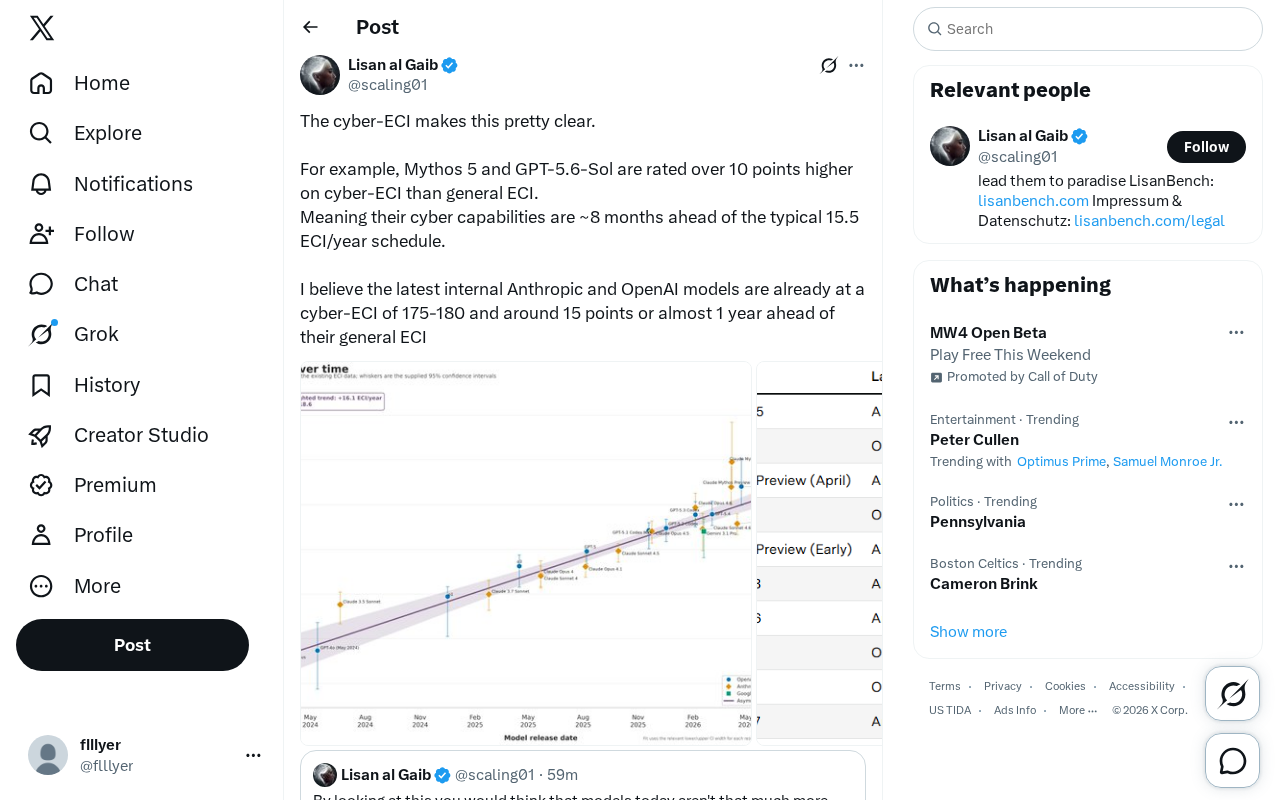
A new concept called cyber-ECI suggests AI's cybersecurity capabilities are systematically outpacing general abilities by approximately 8 months. Frontier labs' internal models may lead by nearly a full year. This gap, driven by code-related structural advantages in training, creates an information asymmetry where public risk assessments lag behind true capabilities, amplifying the existing offense-defense imbalance in cybersecurity.
When AI's Cyber Capabilities Outpace General Abilities
When assessing the pace of AI development, the industry typically uses a unified capability metric to measure a model's overall progress. However, an observation from Twitter is sparking discussion: AI's capabilities in the cybersecurity (cyber) domain appear to be advancing far faster than its general abilities.
According to this tweet's analysis, if we introduce a metric specifically measuring cyber capabilities — a "cyber-ECI" (Cybersecurity Effective Capability Index) — we find that certain frontier models score significantly higher on this dimension than on their general ECI ratings. This isn't a small gap — it's a structural lead that could carry profound security implications.
What Is ECI, and Why Do We Need a Cybersecurity Version?
ECI: A Temporal Yardstick for AI Progress
ECI (Effective Capability Index) is essentially a method that converts model capabilities into a "timeline of progress." Its design philosophy borrows from the economic concept of "purchasing power parity" — translating capability measurements across different dimensions onto a single time axis for comparison. This metric was originally proposed by the AI safety research community to address the problem of traditional benchmarks (such as MMLU, HumanEval, etc.) being siloed and difficult to compare across domains. Traditional benchmarks can only answer "how did the model score on a particular test," whereas ECI attempts to answer a more fundamental question: "What point in time does this model's capability correspond to?"
One key reference point: the typical pace of progress is roughly 15.5 ECI points per year. This rate is an empirical value derived from regression analysis of leading models' composite performance across multiple benchmarks over the past several years, reflecting the approximate rhythm of current AI capability growth. In other words, ECI isn't just an abstract score — it can be translated into intuitive language like "how many months ahead or behind."
This time-based framing is extremely useful. It allows us to answer a specific question: how far ahead of the industry average is a given model on a particular capability?
Why Cybersecurity Capabilities Need Separate Measurement
General ECI covers a model's composite performance across a broad range of tasks including reasoning, writing, coding, and multimodal understanding. But cybersecurity capabilities — including vulnerability discovery, code auditing, penetration testing strategies, and malicious code analysis — form a highly specialized and risk-sensitive subdomain.
Specifically, cybersecurity capability assessment typically spans multiple stages of the Kill Chain: reconnaissance-phase intelligence gathering and attack surface analysis, weaponization-phase exploit code writing, delivery-phase social engineering and phishing email generation, exploitation-phase actual vulnerability triggering, and installation and persistence-phase backdoor implantation. CTF (Capture The Flag) competitions are currently one of the primary methods for evaluating AI's cyber capabilities, with events like DARPA's AIxCC (AI Cyber Challenge) already systematically testing AI performance across these stages. Additionally, historical vulnerability reproduction from the CVE (Common Vulnerabilities and Exposures) database, real defect detection rates in code audits, and penetration testing success rates in simulated range environments are all measurement dimensions that cyber-ECI might incorporate.
The rationale for measuring this separately is compelling: progress in cyber capabilities directly impacts the offensive-defensive landscape. A model that performs unremarkably on general tasks but is exceptionally powerful at a particular stage of the cyber attack chain could have its potential danger masked by an overall score. The proposal of cyber-ECI therefore represents an important refinement in the granularity of AI safety assessment.
Key Data: Cyber Capabilities Lead by Approximately 8 Months
According to the analysis, some frontier models exhibit the following characteristics:
- These models have a cyber-ECI more than 10 points higher than their general ECI;
- Converting this using the pace of 15.5 points per year, this means their cyber capabilities are approximately 8 months ahead of the typical progression.
More aggressive estimates suggest that Anthropic and OpenAI's latest internal models may have already reached a cyber-ECI of 175 to 180, roughly 15 points higher than their general ECI — approaching a full year's lead.
Here it's important to understand the relationship between frontier labs' internal models and public models. Frontier labs like Anthropic, OpenAI, and Google DeepMind typically train and evaluate multiple model versions internally at the same time. Publicly released models usually undergo extensive safety alignment processing, including techniques like RLHF (Reinforcement Learning from Human Feedback) and Constitutional AI to restrict dangerous outputs. Internal models may be pre-alignment or mid-alignment versions that could be more powerful in raw capability, especially when safety researchers conducting Red Teaming deliberately assess a model's extreme capabilities under minimal safety constraints. Anthropic's Responsible Scaling Policy and OpenAI's Preparedness Framework both require internal assessment of dangerous capabilities before model release, which also means these labs understand the true capability boundaries of their own models far better than outside observers.
It should be emphasized that this portion is personal speculation ("I believe..."), not officially disclosed data. But even as a trend assessment, it points to a direction worth vigilance: the unreleased models in frontier labs' hands may have significantly stronger cyber capabilities than what the public can observe in released versions, and the lead may be widening.
The Tilting Scales of Offense and Defense: What This Means
The Capability Gap Between Internal and Public Models
If internal models' cyber capabilities are indeed nearly a year ahead of public versions, then outside assessments of AI cyber risk are likely lagging. Security policies, defensive measures, and regulatory frameworks are often designed based on "the models we can see," while the true capability frontier lies hidden inside laboratories. This information asymmetry is itself a risk.
Why Cyber Capabilities Are Advancing Faster
Cybersecurity tasks are, in a sense, highly correlated with programming ability, and code-related tasks happen to be one of the areas where current large models are improving the fastest. This correlation has deep roots: the essence of modern software vulnerabilities is flaws in code logic, and understanding vulnerabilities requires deep code comprehension. The pace of progress for current large models on code tasks is indeed significantly faster than in other domains — taking SWE-bench as an example, model success rates on real GitHub issue fixes soared from under 5% to over 50% within a single year.
This rapid progress stems from several structural advantages: code is a formal language with clear correctness criteria; platforms like GitHub provide billions of lines of high-quality training data; and code execution results can be automatically verified, enabling reinforcement learning and self-improvement. The same advantages apply to cybersecurity scenarios — exploits either succeed or fail, CTF challenges have definitive flags, and these serve as natural reward signals. The abundance of structured, verifiable training data (code repositories, vulnerability databases, CTF challenges, etc.) enables models to achieve super-linear improvement in this vertical direction. This may partially explain why cyber-ECI systematically outpaces general ECI.
The Urgency on the Defense Side
The cyber capability lead is a double-edged sword. The same capabilities can be used for offense (discovering and exploiting vulnerabilities) or defense (automated auditing, threat detection, remediation recommendations). The key question is whether defenders can deploy these capabilities into real systems at the same pace.
However, cybersecurity has long suffered from a structural asymmetry of "offense is easier than defense." Attackers only need to find one breach point to succeed, while defenders must protect every potential attack surface. This asymmetry may be further amplified in the AI-empowered era. Research reports from organizations such as the U.S. RAND Corporation and the UK's NCSC (National Cyber Security Centre) have already pointed out that AI could significantly lower the barrier to cyberattacks — advanced penetration techniques that once required years of experience could be "democratized" by models and made available to low-skill attackers. Meanwhile, defensive-side AI deployment faces greater friction: enterprises need to integrate AI tools into existing security operations systems, handle false positive issues, and meet compliance requirements — all constraints that attackers don't have to worry about.
If the proliferation of offensive capabilities outpaces the deployment speed of defensive capabilities, the overall security posture will deteriorate.
A Measured Perspective: Data Limitations and Analytical Boundaries
While this observation is thought-provoking, we should maintain a prudent outlook:
- Limited data sources: The specific scores and lead times, especially regarding internal models, are personal speculation and lack publicly verifiable evidence.
- Vague metric definitions: While cyber-ECI is an inspiring conceptual framework, its specific measurement methodology, problem composition, and scoring criteria would significantly affect conclusions.
- Questionable authenticity of example models: The model codenames mentioned may be hypothetical, used to illustrate trends rather than state facts.
Nonetheless, the core argument — AI's cybersecurity capabilities may be advancing faster than general capabilities, and frontier labs' internal capabilities may far exceed public awareness — is a signal that the entire industry should take seriously.
Conclusion: Building a More Perceptive AI Safety Assessment System
As AI capabilities increasingly diverge across domains, measuring "how powerful AI is" with a single metric is becoming increasingly insufficient. Domain-specific capability assessments like cyber-ECI represent a more mature approach: tracking progress separately across different high-risk dimensions, especially those with significant offensive-defensive implications.
The international community is currently accelerating the construction of AI safety assessment systems. The 2023 UK AI Safety Summit gave rise to the AI Safety Institute (AISI), and the U.S. established a corresponding body; the EU AI Act requires mandatory assessment of high-risk AI systems. However, these frameworks mostly focus on general capabilities and issues like bias and hallucinations, while specialized assessment of cybersecurity capabilities remains in its early stages. Organizations like METR (Model Evaluation and Threat Research) are developing specialized assessment protocols for dangerous capabilities, but there is inherent tension between test set coverage, update frequency, and confidentiality — overly public test sets get incorporated into training data and become ineffective, while overly secretive tests lack the credibility of peer review. Furthermore, capability assessment faces the fundamental issue of "capability ≠ intent": whether a model with superior cyberattack capabilities will actually be used for attacks depends on multiple factors including deployment methods, access controls, and social governance.
For security researchers, policymakers, and enterprises, the real challenge is not whether AI's cyber capabilities will lead — it's whether we can build assessment systems perceptive enough to detect that lead in time and prepare accordingly on the defense side. When a model's capability in a particular area "arrives a year early," the last thing we want is to be the last to know.
Related articles

Zhipu Open-Sources GLM-5.3-Flash 320B Model as Alibaba's Qwen4 Architecture Preview Launches Same Day
Zhipu open-sources GLM-5.3-Flash native multimodal model (320B total/18B active params) while Alibaba launches Qwen3.8-Flash-Next as Qwen4 architecture preview, both redefining LLM efficiency.
Instagram's New Rule: AI Accounts That Don't Disclose Their Identity Will Be Throttled
Instagram mandates AI identity disclosure — accounts that refuse will be throttled. Explore the enforcement challenges, detection limits, and industry impact.
Qwen 3.8 27B Hands-On Review: An Opus-Level Open-Source LLM You Can Run Locally
In-depth review of Alibaba's open-source Qwen 3.8 27B: a 27B-parameter multimodal model runnable on RTX 4090, approaching Claude Opus in coding and frontend tasks, fully open under Apache 2.0.