Daily GPU Rental Price Comparison: AWS, Azure, RunPod and Vast.ai

A project tracking daily GPU rental prices across AWS, Azure, RunPod, and Vast.ai debuts on Hacker News.
The article introduces a project showcased on Hacker News that updates GPU rental prices daily across AWS, Azure, RunPod, and Vast.ai, aiming to improve price transparency in the AI compute market. It notes that GPUs are the core resource for training and inference of large models, that rental prices directly affect the feasibility of AI projects, and that prices vary significantly across platforms and fluctuate frequently with supply and demand. The four platforms represent two supply models: AWS and Azure are comprehensive public clouds with complex pricing systems and enterprise-grade service premiums, while RunPod and Vast.ai focus on GPUs themselves, with prices closer to real-time market supply and demand. Daily comparison helps with budget planning, platform selection, and cost monitoring, but price alone is not enough for decision-making; total cost of ownership—including bandwidth, storage, availability, and compliance—must also be considered, along with non-equivalent GPU specifications. At present, the project has limited attention, and its data coverage and stability still need to be verified.
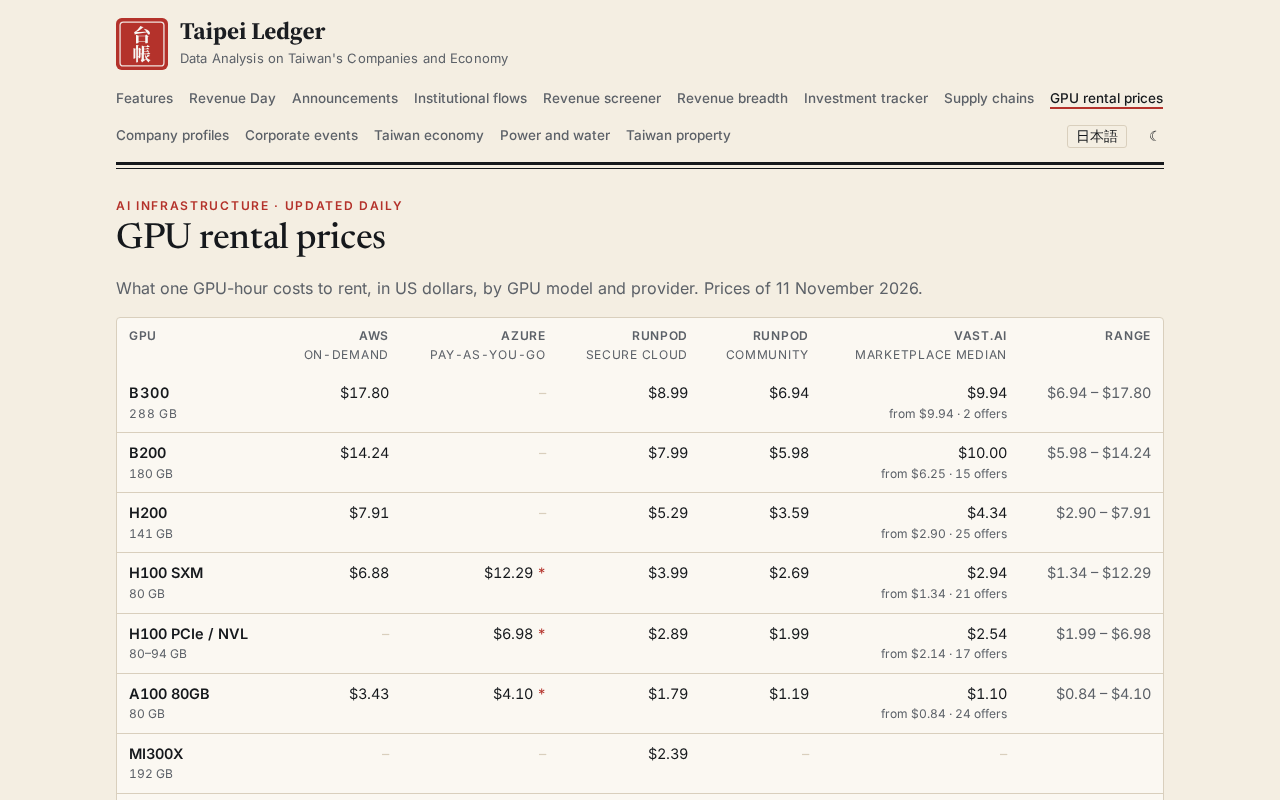
With AI compute demand continuing to rise, GPU rental prices have become a key variable for developers and enterprises when choosing a platform. Recently, a project called "Show HN: Daily GPU Rental Prices Across AWS, Azure, RunPod and Vast.ai" appeared on Hacker News, aiming to track GPU rental prices across major cloud providers and emerging compute platforms on a daily-updated, cross-platform basis.
Why GPU rental price tracking matters
GPUs are the core resource for training and inference of large models, and their rental cost directly affects the feasibility of AI projects. Public cloud giants AWS and Azure have long dominated the enterprise market, while RunPod and Vast.ai attract developers with more flexible pricing and a positioning geared toward AI workloads. Price differences across platforms can be very significant and fluctuate frequently with supply and demand, region, and instance type. A daily-updated price comparison tool can help teams make more timely trade-offs between budget and performance.
What the project does
According to the information shown on Hacker News, the project aggregates GPU rental prices from four platforms—AWS, Azure, RunPod, and Vast.ai—and updates them on a daily basis. This means users can observe how prices fluctuate over time, rather than just a snapshot at a single moment.
For teams that need to rent GPUs over the long term, this time-series perspective is especially valuable: it can reveal price swings caused by short-term promotions or inventory changes, and it can also provide a data foundation for cross-platform price comparison.
Differences in pricing logic across the four platforms
These four platforms represent two different models of compute supply. AWS and Azure are comprehensive public clouds, where GPU instances are usually bundled with storage, networking, and managed services; their pricing systems are complex and include on-demand, reserved, and spot models. RunPod and Vast.ai, by contrast, focus more on the GPU itself, offering more direct on-demand rental and community-based supply, with prices that tend to be closer to real-time market supply and demand.
Comparing the four in a single table every day is effectively comparing the gap between "enterprise-grade cloud service premiums" and "focused compute market prices." This kind of comparison is especially useful for startup teams and independent developers, since they are more price-sensitive and more likely to migrate between platforms.
On-demand, reserved, and spot instances are the three basic models of public cloud GPU pricing. On-Demand instances are billed by the second or hour, can be launched at any time, and are the most expensive; they suit short-term or unpredictable workloads. Reserved instances require a one- or three-year commitment in exchange for substantial discounts and suit long-term, stable training tasks. Spot instances use cloud providers' idle capacity and can cost as little as 10–20% of on-demand prices, but they may be reclaimed at any time, making them suitable for interruptible batch processing and fault-tolerant tasks. Understanding the differences among these three models is a prerequisite for reading AWS and Azure price tables—the same GPU can differ severalfold in price under different billing models, so cross-platform comparisons must first align billing bases; otherwise, it is easy to reach misleading conclusions.
Vast.ai's community-based supply model is fundamentally different from conventional cloud platforms. It is more like a peer-to-peer marketplace for GPU compute: individuals or small data centers list idle GPUs for rent, and Vast.ai handles matching and containerized scheduling. As a result, prices are formed through bidding by suppliers, fluctuate sharply, and depend heavily on geographic location and host quality. Under this model, the same GPU model may be quoted well below the market average, but reliability, network bandwidth, and host stability vary widely, so tenants need to screen hosts by reputation rating themselves. RunPod sits somewhere in between, with both a self-built data center Secure Cloud and a Community Cloud connected to third-party hosts; the former is more expensive but has a more stable SLA, while the latter is cheaper but carries risk. This layered structure is precisely why its pricing range is so wide.
Use cases and limitations
This kind of price tracking tool is suitable for budget planning, platform selection, and cost monitoring. However, making decisions based on price alone is not sufficient: factors such as network bandwidth, storage fees, availability, technical support, and compliance requirements also affect total cost of ownership. In addition, GPU models and configurations are not fully equivalent across platforms, so direct price comparisons need to account for specification differences.
At present, the project has not yet attracted much attention on Hacker News, and discussion is limited; its data coverage and update stability still need to be verified by more users. But the direction itself hits a real pain point in the AI infrastructure space—the transparency of compute prices.
Total cost of ownership (TCO) is a framework that is easily overlooked when evaluating GPU rental options. In addition to the hourly GPU price, TCO also includes additional storage fees (cloud disks and object storage are usually billed separately by GB/month), data ingress and egress bandwidth fees (cross-region or public internet traffic is often expensive), the cost of keeping resources attached while idle, and the hidden overhead of operations personnel and migration adaptation. Moreover, GPU models are not always equivalent across platforms—40GB versus 80GB versions of the A100, whether NVLink is available, the CPU-to-memory ratio, and local NVMe capacity can all significantly affect actual performance and the comparability of unit prices. Therefore, price tracking data is better used as a starting point for initial screening and trend observation; final selection still requires benchmarking and full-cost accounting based on the specific workload.
Conclusion
Daily tracking of GPU rental prices is a small step toward greater transparency in AI infrastructure, but it may have a real impact on developers' cost decisions. As the compute market continues to fragment, the value of such cross-platform price comparison tools is likely to become even more prominent.
One-line Summary
A project that tracks GPU rental prices daily across AWS, Azure, RunPod, and Vast.ai has appeared on Hacker News.
Paragraph Summary
The article introduces a project showcased on Hacker News that updates GPU rental prices daily across AWS, Azure, RunPod, and Vast.ai, aiming to improve price transparency in the AI compute market. It notes that GPUs are the core resource for training and inference of large models, that rental prices directly affect the feasibility of AI projects, and that prices vary significantly across platforms and fluctuate frequently with supply and demand. The four platforms represent two supply models: AWS and Azure are comprehensive public clouds with complex pricing systems that include enterprise-grade service premiums, while RunPod and Vast.ai focus on GPUs themselves, with prices closer to real-time market supply and demand. Daily comparison helps with budget planning, platform selection, and cost monitoring, but price alone is not enough for decision-making; total cost of ownership—including bandwidth, storage, availability, and compliance—must also be considered, along with the issue of non-equivalent GPU specifications. At present, the project has limited attention, and its data coverage and stability still need to be verified.
Related articles

Pure-Code Video Generation Tested: Which AI Model Actually Follows Instructions?
A Bilibili creator tested three AI models' pure-code video generation with unified prompts and three revisions each: Xiaonaomao has a high ceiling but lacks stability, GPT 6.2 Extra models well but only follows half the instructions, and OPAS 5.5 remains the benchmark.

GPT-6 Six-Tier Hands-On Test: Astra Ultra Dominates but Bills Double
GPT-6 six-tier test: Astra Ultra sweeps 3:0 in 3D tasks thanks to sub-agents and runs 14% faster, but hidden backend bills make its real cost 2.6x single-threaded.

GPT-6.2 Astra vs Fable 5.2: Huge Cost-Efficiency Gap Across 12 Real-World Tests
Bilibili creator tests GPT-6.2 Astra vs Fable 5.2 across 12 real tasks: Fable wins 7-5 but costs 7.2x more and takes nearly 5x longer. Token efficiency emerges as the key selection metric.