DailyHelm: The AI Assistant That Turns Analytics Data Into a Daily Revenue-Boosting Action List

DailyHelm turns overnight multi-source data analysis into a daily revenue-ranked action list for founders.
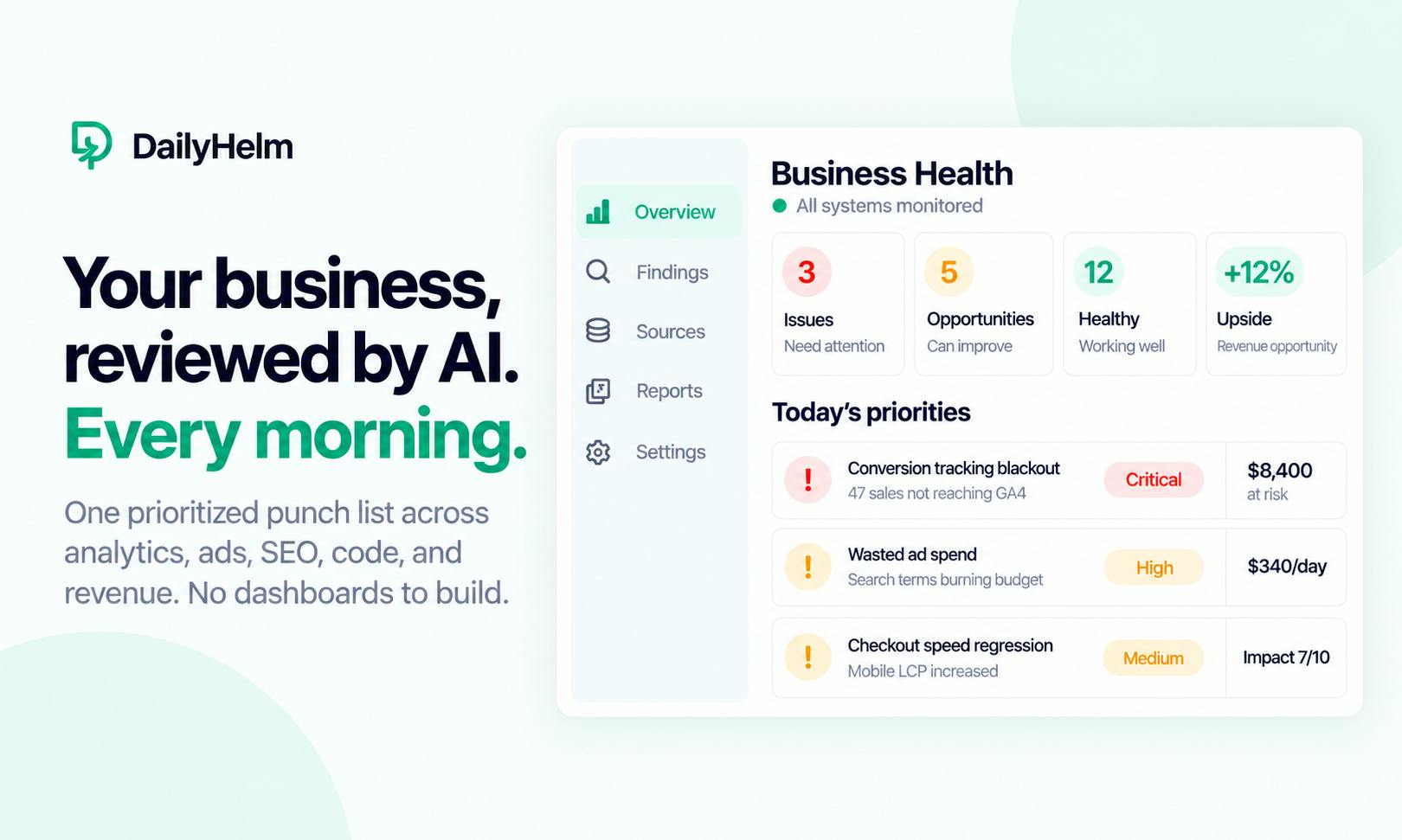
DailyHelm is an AI tool for founders and growth teams that hit #4 on Product Hunt on launch day. Its core logic fills the "last mile" gap traditional BI tools leave open: dashboards are great at showing data, but leave the exhausting work of interpretation and decision-making to users. DailyHelm monitors website analytics, ads, SEO, and e-commerce data overnight, proactively identifies issues, and outputs a prioritized fix list ranked by expected revenue impact — telling teams exactly what to tackle first. This shift from passive querying to active push is a defining pattern of the AI Agent era. The article also flags two core challenges: the reliability of revenue attribution estimates and whether recommendations are genuinely actionable beyond surface-level metric diagnostics.
From Understanding Charts to Knowing What to Do
Most founders have been there: you open Google Analytics, your ad dashboard, and your e-commerce data panel, stare at a wall of line graphs and conversion funnels, and still have no idea where to start. Traditional BI tools excel at displaying data — but they leave the most mentally exhausting part, the interpretation, entirely up to you.
DailyHelm, which launched on Product Hunt and climbed to #4 for the day, is built to close exactly that gap. It positions itself as an "AI business reviewer" for founders and growth teams, with a core value proposition that can be summed up in one line: turn analytics data into daily, actionable revenue-driving steps. It earned 144 upvotes and 27 comments after launch — a solid result in the crowded Analytics and Business Intelligence category, suggesting it's hitting a real nerve.
What It Actually Does
DailyHelm's workflow can be thought of as a "night shift." According to the product description, it continuously monitors multiple data sources overnight — including website analytics, paid ads, SEO performance, and e-commerce store data — then identifies actionable issues and opportunities buried within that data.
The key differentiator is what it outputs. A standard dashboard gives you charts, leaving you to judge which metrics look off, what those anomalies mean, and what to do about them. DailyHelm delivers a prioritized list of fixes ranked by likely revenue impact instead. In other words, it handles the reasoning step that most teams get stuck on — the leap from "data" to "decision."
For small teams without a dedicated data analyst, a product that says "here's what to fix first today" is far more compelling than yet another beautiful dashboard.
Why This Direction Is Worth Watching
Dashboard Fatigue Is a Real Problem
Over the past decade, data visualization tools dramatically lowered the barrier to accessing data — but created a side effect: more metrics, more noise. Founders now face dozens of KPIs every day, and the real challenge is prioritization — which fluctuations are signals, and which are just noise. DailyHelm filters by "revenue impact," which is fundamentally about helping users manage their attention. That's a pragmatic and grounded use case for AI in a business context.
From Passive Querying to Active Push
Traditional analytics tools are "pull" systems: you go look when you have a question. DailyHelm operates on a "push" model: it proactively surfaces issues and delivers them to you. This shift from reactive to proactive is the broader direction AI Agent products are moving — not just answering questions, but anticipating them and offering recommendations first.
What Is an AI Agent? AI Agent (intelligent agent) has become a buzzword in tech over the past couple of years. The key distinction from traditional AI assistants is autonomy: rather than waiting for user commands, an agent continuously monitors its environment, plans tasks independently, and takes action. In a business data context, this means the tool itself handles the complete chain of "detect problem → analyze cause → propose solution" — not just responding when you ask. DailyHelm's overnight monitoring and proactive push mechanism is a lightweight implementation of the agent paradigm: no user trigger required; the system regularly "patrols" your data and delivers its findings. The challenge with this model is controlling the false-positive rate — too many low-quality alerts create a "boy who cried wolf" effect, causing users to stop paying attention.
A Cross-Source, Integrated View
It's also worth noting that DailyHelm covers analytics, ads, SEO, and store data simultaneously. In practice, revenue problems rarely live in a single system — maybe ads are driving traffic but the landing page isn't converting, or an SEO ranking drop is quietly eating organic traffic. A single-source tool can't see the full picture. Cross-source diagnostics are precisely where this category of product has room to differentiate.
Where Healthy Skepticism Is Warranted
The product vision is clear, but there are a few critical questions that can't yet be answered from the outside.
First, the accuracy of attribution. "Ranked by revenue impact" sounds great, but revenue attribution is one of the hardest unsolved problems in the industry. How much incremental revenue a specific fix will actually generate involves complex causal reasoning — how reliable the AI's estimates turn out to be is something only real usage data can tell us.
Second, the actionability of recommendations. There's still a gap between "identifying a problem" and "knowing how to fix it." If the list only surfaces things like "this page has a high bounce rate" without a concrete remediation path, the value is diminished. The product promises users will "know what to fix and what to do next" — whether the actual experience lives up to that claim is the key question.
Third, the cost of building trust. For teams to hand off daily decisions to an AI, they need to see its recommendations validated repeatedly over time. Early false positives or low-quality suggestions can quickly erode user trust.
What Is Revenue Attribution? Revenue attribution is the process of crediting a specific revenue outcome to a particular cause or channel. This is a notoriously hard problem in digital marketing: a customer might first see a Facebook ad, then search on Google, then click an email link before finally making a purchase — and different attribution models (first-click, last-click, linear, data-driven, etc.) will assign very different credit to each touchpoint. When an AI claims a given fix "could drive X dollars in incremental revenue," the reliability of that estimate depends heavily on the underlying attribution model and data quality. For e-commerce and SaaS businesses with multi-channel acquisition and complex purchase paths, AI estimates should be treated as directional guidance rather than precise forecasts.
Takeaway
DailyHelm represents a broader shift happening in business intelligence tools: moving from "showing data" to "recommending action." For resource-constrained founding teams without dedicated analysts, a tool that automatically prioritizes your to-do list every morning and tells you "fix this first today" addresses a genuine pain point.
Whether it can deliver on that promise ultimately comes down to attribution accuracy and the real-world actionability of its recommendations — the same litmus test facing every "AI business advisor" product out there. But from a positioning standpoint, it's at least pointing in the right direction: in an era of data overload, the scarce resource was never data itself. It's always been the ability to turn data into action.
Related articles

Amphibious Transforming Drone: Beyond 100x Power Savings, What Are the Real Needs?
Is the amphibious transforming drone just a gimmick? Starting from the 100x power difference of the M4 Morphobot, explore real application scenarios and thesis topic ideas, analyzing boundary conditions where pure drones and pure ground robots both fail.

Warhound Raises $200 Million: Genetically Engineered "War Dogs" Paired with Anduril Gear
Warhound raises $200M, backed by Ben Lamm and Palmer Luckey, to genetically engineer dogs for military and law enforcement use and equip them with Anduril gear. This article analyzes its technology direction, funding logic, and ethical controversy.

Claude API Comes to Google Cloud: IAM Integration and SDK Access Guide
Anthropic hosts the full Claude API on Google Cloud with IAM-controlled permissions and unified billing. This guide covers the Vertex AI and Anthropic-hosted entry points, IAM role configuration, and SDK access.