Dam Removal Brings Fish Back to Rivers in the Northeastern United States
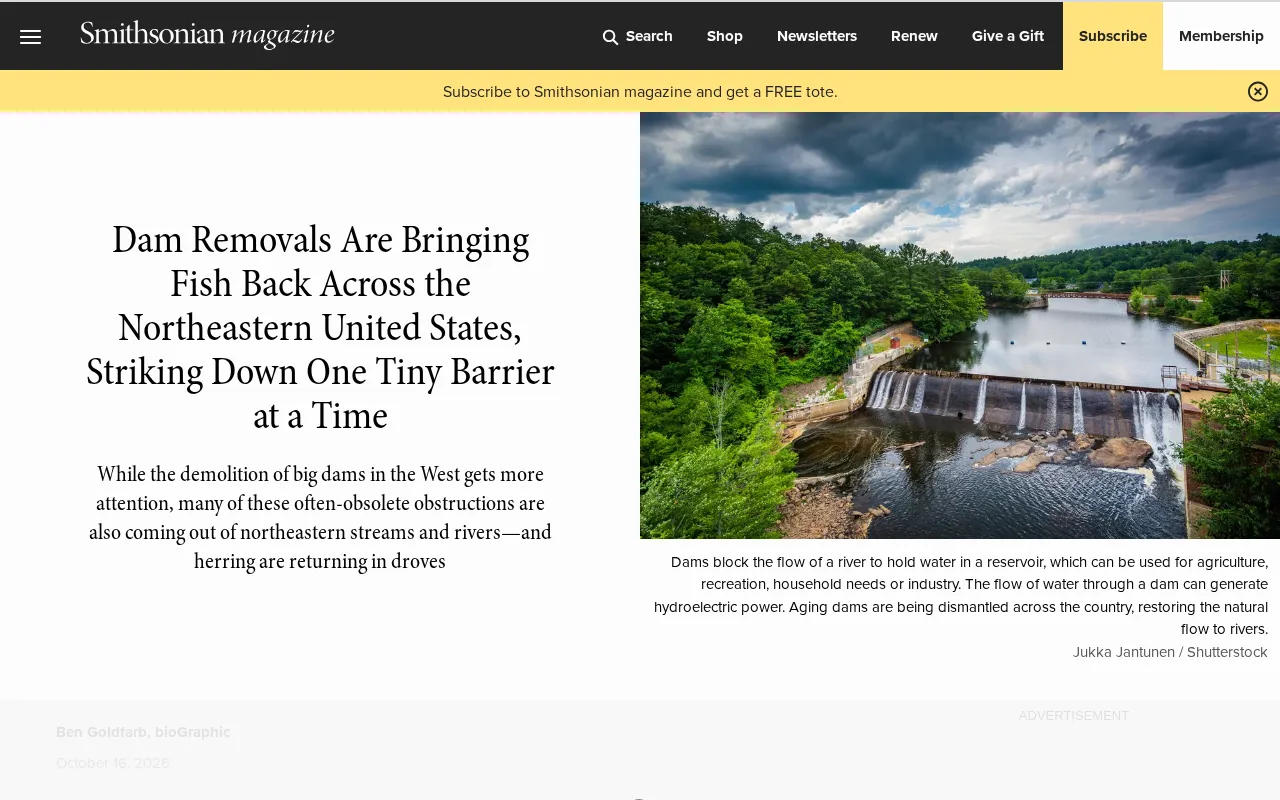
The Northeastern US removes obsolete dams to restore river connectivity and bring migratory fish such as herring and salmon back to upstream habitats.
Many small dams built during the Industrial Revolution in the Northeastern United States no longer serve power generation or water supply functions, yet they continue to block fish migration and carry high maintenance costs and failure risks, making removal an economically and ecologically rational choice. After removal, river connectivity is restored, water temperature, sediment transport, and riverbed structure return to natural conditions, and migratory fish such as herring and salmon reappear upstream; aquatic biodiversity in restored reaches is generally higher than in control reaches. However, dam removal also faces short-term risks such as community landscape concerns, effects on recreational fishing, and sediment release behind dams, which must be managed through staged removal, sediment assessment, and long-term monitoring. The Northeastern experience shows that dam removal is a cost-controllable and highly effective restoration tool, with the key being cross-sector coordination and balancing community interests.
The Northeastern United States is undergoing a quiet ecological restoration—removing aging dams. This trend not only restores rivers to their natural flow regimes but also brings migratory fish back to the habitats where they have reproduced for generations.
Why Dam Removal Has Become a Priority for Ecological Restoration
The Northeastern United States has a large number of small dams built during the Industrial Revolution. Many no longer serve power generation or water supply functions, yet they continue to block fish migration routes. According to observations in the field of ecological restoration, maintaining this aging infrastructure is costly and carries the risk of dam failure. Removing them is both an economically rational choice and an ecological necessity.
After dam removal, river connectivity is restored, and water temperature, sediment transport, and riverbed structure gradually return to natural conditions. This is crucial for fish that depend on rivers to complete their life cycles.
The dam legacy in the Northeastern United States is closely tied to the Industrial Revolution. In the 18th and 19th centuries, New England built a large number of low weirs along its dense network of rivers to power textile mills, sawmills, and gristmills. These dams were typically only a few meters high and stored limited water, making them classic "run-of-river" structures. As manufacturing moved elsewhere and power systems became centralized, a considerable portion of them have been abandoned for decades, with neither clear owners nor economic value. According to statistics from the U.S. Army Corps of Engineers, more than 90,000 dams are registered nationwide, and the actual number may be even higher, with many being small privately owned dams of this kind. Northeastern states are ahead in dam removal policy; Maine, Massachusetts, and others have established permitting and funding support mechanisms for dam removal, providing an institutional foundation for systematic removal of obsolete dams.
Evidence of Fish Population Recovery
Researchers and local residents have observed that after dam removal, migratory fish such as herring and salmon reappear in upstream waters. The return of these fish is no accident—they need continuous river corridors to complete spawning and feeding. Dam removal directly eliminates physical barriers, allowing fish to reach historical habitats.
Ecological monitoring data show that aquatic biodiversity in river reaches where dams have been removed is generally higher than in control reaches where dams remain. This finding provides strong scientific support for dam removal.
The herring and salmon mentioned in the article are typical anadromous fish, meaning they feed and mature in the ocean and migrate upstream into freshwater to spawn. Take river herring (including blueback herring and alewife) as an example: each spring they migrate from the Atlantic Ocean into freshwater rivers and need continuous, unobstructed passage to reach lakes or headwater spawning grounds. Even a low dam can block migration routes or force fish to congregate below the dam, increasing predation risk. Salmon have even higher passage requirements, and juveniles also need to swim downstream when migrating to sea. Therefore, the ecological effects of dam removal are usually assessed using core indicators such as "passage connectivity" and "accessible upstream spawning habitat area," which reflect restoration outcomes better than simple changes in population numbers.
The Complex Trade-offs Behind Dam Removal
Dam removal is not without controversy. Some communities worry that removing dams will change the local landscape or even affect existing recreational fishing structures. In addition, if sediment accumulated behind dams is not handled properly, it may cause short-term ecological impacts downstream.
Supporters of dam removal argue that long-term ecological benefits far outweigh short-term costs. They emphasize that ownership of many dams is no longer clear and no one is responsible for maintenance, making removal the most responsible course of action.
The engineering risk of greatest concern during dam removal is sediment behind the dam. During the operation of aging dams, flow velocity in upstream reaches decreases, and fine sediment and organic matter continuously settle in reservoir areas; some reservoirs may accumulate hundreds of thousands of cubic meters of sediment. If this sediment is released all at once when a dam is removed, it can raise the downstream riverbed, bury gravel spawning grounds, and consume dissolved oxygen in the water, causing short-term water quality deterioration. Common practice is "staged removal" or prior sediment dredging and stabilization, along with monitoring cross-sections downstream. Another often overlooked issue is the possible accumulation of heavy metals or historical industrial pollutants behind dams; sediment testing is required before removal. These engineering details determine whether dam removal is a matter of "just tearing it down" or "careful management," and they directly affect whether ecological benefits can be realized.
Implications for Ecological Restoration
The experience in the Northeastern United States shows that removing obsolete dams is a cost-controllable and highly effective means of ecological restoration. It does not require complex engineering interventions, yet it can restore natural river processes. For regions facing similar problems with aging dams, this practice offers a path worth learning from.
The key lies in establishing cross-sector coordination mechanisms, balancing ecological goals with community interests, and conducting proper pre-removal sediment assessment and post-removal long-term monitoring.
One-line Summary
Related articles

Pure-Code Video Generation Tested: Which AI Model Actually Follows Instructions?
A Bilibili creator tested three AI models' pure-code video generation with unified prompts and three revisions each: Xiaonaomao has a high ceiling but lacks stability, GPT 6.2 Extra models well but only follows half the instructions, and OPAS 5.5 remains the benchmark.

GPT-6 Six-Tier Hands-On Test: Astra Ultra Dominates but Bills Double
GPT-6 six-tier test: Astra Ultra sweeps 3:0 in 3D tasks thanks to sub-agents and runs 14% faster, but hidden backend bills make its real cost 2.6x single-threaded.

GPT-6.2 Astra vs Fable 5.2: Huge Cost-Efficiency Gap Across 12 Real-World Tests
Bilibili creator tests GPT-6.2 Astra vs Fable 5.2 across 12 real tasks: Fable wins 7-5 but costs 7.2x more and takes nearly 5x longer. Token efficiency emerges as the key selection metric.