Data Centers Spark Nationwide Backlash Across the U.S. — Is China Really Behind It?

U.S. data center backlash is real — but claims of Chinese manipulation lack evidence and oversimplify the issue.
As AI-driven data center construction booms across the U.S., communities are pushing back over energy consumption, water depletion, and noise pollution. A controversial claim on Reddit suggests China may be fueling this opposition to slow America's computing power buildout. While the geopolitical logic exists, the narrative lacks evidence and risks overshadowing legitimate community concerns. The real challenge lies in balancing AI infrastructure expansion with public interest.
Where Did America's "Data Center Rage" Come From?
As the AI wave surges forward, a massive data center construction boom is sweeping across the United States. Tech giants are aggressively acquiring land and building facilities nationwide to meet the enormous computational demands of AI training and inference. According to industry estimates, between 2024 and 2025, the combined annual capital expenditure of major U.S. tech companies on data centers has surpassed the $200 billion mark, with Microsoft, Google, Amazon, and Meta each planning expansions worth tens of billions of dollars. However, this building frenzy is triggering increasingly fierce public backlash — from Texas to Virginia, Arizona to Ohio, community residents, local governments, and environmental organizations are stepping up to resist these massive facilities.
This social sentiment, dubbed "Data Center Rage" by observers, is becoming a political and social variable that cannot be ignored in the expansion of AI infrastructure. Recently, a controversial claim has been circulating on social platforms like Reddit: behind this wave of opposition, there may be an information push from China.
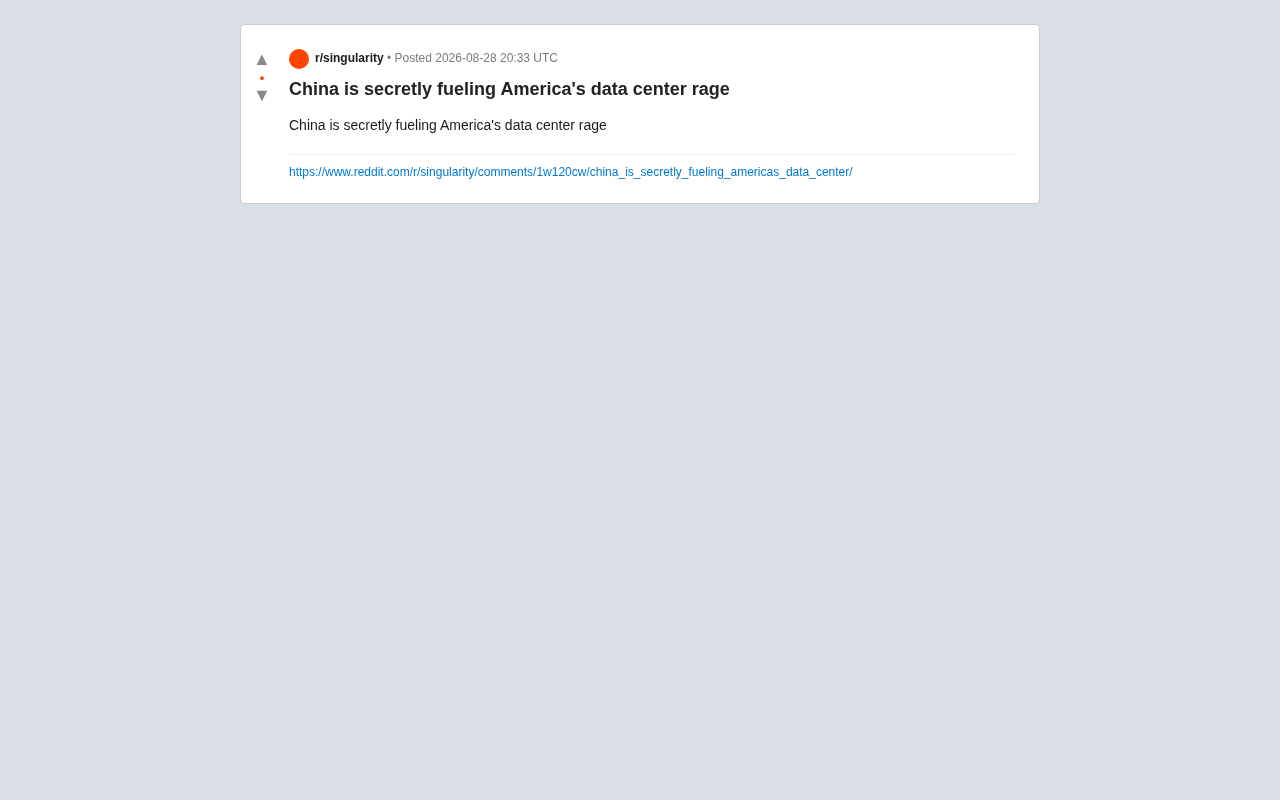
It's important to emphasize that this claim remains largely at the level of discussion and speculation, lacking definitive public evidence. But the deeper anxiety it reflects — the intertwining of the AI infrastructure race with geopolitical competition — is worth serious examination.
Why Do Data Centers Face Such Strong Community Opposition in the U.S.?
To understand this controversy, we first need to grasp why data centers provoke such intense public resistance. This isn't baseless — it's grounded in very real concerns.
Enormous Energy and Water Consumption
Modern AI data centers are genuine "energy black holes." A single large-scale AI data center can consume as much electricity as a mid-sized city. In concrete terms, traditional data centers typically operate at power levels of tens of megawatts, but next-generation AI training clusters are pushing toward 500 megawatts or even gigawatt-scale capacities per facility — equivalent to the entire output of a mid-sized coal-fired power plant. The core metric for data center energy efficiency is PUE (Power Usage Effectiveness), the ratio of total facility energy consumption to actual IT equipment energy consumption. The ideal value is 1.0, meaning all electricity goes to computing, but in practice, cooling, power distribution, and other auxiliary systems typically push PUE to between 1.2 and 1.6. Even as the industry continuously optimizes, the high-density cooling demands of AI workloads continue to drive up overall energy consumption. According to projections from the U.S. Energy Information Administration (EIA), by 2030, data centers could consume roughly 12% of total U.S. electricity generation, up from approximately 4% in 2023.
In regions where power supply is already strained, the arrival of data centers directly pushes up local residents' electricity bills and adds pressure to the grid. The U.S. power grid faces a structural dilemma: most transmission infrastructure was built in the mid-20th century, and the pace of upgrades and modernization lags far behind the growth of new demand. Building new high-voltage transmission lines from planning to commissioning typically takes over 10 years, while data centers can be constructed in just 18 to 24 months. This time gap is creating severe local supply-demand imbalances.
Beyond electricity, the water resources required for cooling systems are equally staggering. Evaporative cooling technology commonly used in data centers works by atomizing and evaporating water to dissipate heat — it's highly efficient and cost-effective, but the trade-off is massive water consumption. A typical large data center may consume 3 to 5 million gallons (roughly 11,000 to 19,000 cubic meters) of water per day, equivalent to the daily water usage of a town of about 50,000 people. In drought-stricken regions like the American Southwest, where Colorado River water levels continue to drop and multiple states are locked in increasingly bitter disputes over water allocation, the conflict between data centers and agricultural and residential water use is particularly acute. Local residents naturally question: why should scarce public resources be sacrificed for a tech company's computational expansion?
Noise Pollution, Land Use, and Declining Quality of Life
Data center operations generate continuous low-frequency noise, with cooling equipment and backup generators being the primary sources of disturbance. Large tracts of land are rezoned for industrial use, fundamentally altering the character of communities. For many residents who chose suburban life seeking peace and quiet, a massive facility operating 24/7 is an unwelcome intruder. What frustrates community residents even more is that despite their enormous footprint, data centers create remarkably few direct jobs — a facility costing billions of dollars and spanning hundreds of thousands of square feet may require only 50 to 100 people for daily operations and maintenance, a stark contrast to the employment generated by traditional factories or commercial development.
These very real pain points form the solid foundation of "Data Center Rage." In other words, even without any external forces at play, this opposition movement is entirely self-generating and legitimate.
The Logic and Doubts Behind the "China Is Secretly Pushing This" Narrative
So why has the claim of "China secretly fueling this" emerged? The underlying chain of logic goes roughly as follows.
The U.S.-China Computing Power Race Through a Geopolitical Lens
The competition between the U.S. and China in AI has escalated to the level of national strategy, with computing power viewed as the core resource in the AI race. Data centers are the physical vessels of that computing power. Since 2022, the U.S. government has implemented a series of export control measures restricting the sale of advanced AI chips and semiconductor manufacturing equipment to China, including NVIDIA's high-end GPUs and advanced lithography technology. These controls aim to curb China's access to the top-tier computing chips needed to train large-scale AI models. The supply chain for the core hardware of global AI computing — high-performance GPUs — is highly concentrated, with NVIDIA alone commanding over 80% of the AI training chip market, making chip supply itself a critical lever in geopolitical competition.
Meanwhile, China is actively advancing its own computing infrastructure. The "East Data, West Computing" project, officially launched in 2022, is China's national-level computing power strategy, designed to channel data processing demand from the eastern coastal regions to resource-rich western regions, optimizing energy efficiency while balancing regional development. This initiative involves the construction of eight national computing hubs and ten major data center clusters, at a scale comparable to U.S. data center expansion plans.
Following the logic of the "China is behind this" narrative, if the pace of U.S. data center construction could be slowed, it would effectively mean "hitting the brakes" on an opponent in the computing arms race. Some therefore speculate that amplifying community opposition in the U.S. could serve certain geopolitical interests.
Lack of Evidence and the Complexity of Information Dissemination
However, this narrative has notable weaknesses. First, as discussed above, public opposition has ample domestic causes — attributing it simply to external manipulation lacks evidence and risks deflecting attention from the real issues. Second, labeling legitimate community advocacy as the work of "foreign forces" could suppress reasonable public discourse and may even be weaponized as a rhetorical tool to push through controversial projects.
It's worth noting that Foreign Influence Operations in the U.S. do have well-documented precedents. U.S. intelligence agencies and cybersecurity researchers have recorded coordinated information operations targeting American public opinion from multiple countries — including Russia and Iran. The most prominent example was the Russian "Internet Research Agency" (IRA) using social media to create and amplify divisive social issues during the 2016 U.S. presidential election. However, "precedent exists" is not the same as "it's actually happening in this case." While social media platforms like Meta and X (formerly Twitter) have established detection mechanisms for "Coordinated Inauthentic Behavior" (CIB), these systems have limitations in the face of increasingly sophisticated tactics, and no platform has published any investigative findings related to the data center opposition movement.
In today's highly networked information environment, any social issue can be exploited and amplified by various actors — this is simply the norm in the social media era. Algorithmic recommendation systems naturally tend to amplify emotional and divisive content, meaning that even without any organized external intervention, a real social conflict can be rapidly intensified in online spaces. But "who is amplifying" and "whether there is organized manipulation" are two entirely different questions, requiring rigorous investigation and evidence — not simple conjecture.
The Deeper Power Struggle Behind AI Infrastructure Expansion
Regardless of whether the "China is behind this" claim holds water, this discussion reveals a larger reality: AI infrastructure expansion is evolving from a purely commercial and technical matter into a complex issue intertwining energy, environment, community interests, and geopolitics.
Speed of Infrastructure Deployment as a Strategic Competitive Advantage
In the AI era, whoever can build sufficient computing infrastructure faster may gain the upper hand in the race. This makes the "deployment speed" of data centers a strategic resource in itself. Any factor that delays construction — whether environmental reviews, community resistance, or grid bottlenecks — may be assigned strategic significance beyond its inherent scope.
Take Northern Virginia, the world's largest data center cluster, as an example. The region hosts roughly one-third of the world's known data center capacity. The "Data Center Alley" stretching from Loudoun County to Prince William County traces its origins to the geographic advantage of internet backbone network convergence in the early 2000s. Yet even in this most data center-friendly region, community opposition is rapidly intensifying — Prince William County temporarily suspended approvals for new data center projects in 2023 in response to resident protests over noise, traffic, and power load.
The approval process for U.S. data center projects involves multiple levels: federal environmental impact assessments (NEPA), state-level power interconnection approvals, county-level land use changes and building permits, and potentially water usage rights approvals. The entire process can take several years. By comparison, in some Middle Eastern and Southeast Asian countries, the cycle from project initiation to operation can be compressed to 12 to 18 months. This gap in approval efficiency is reshaping the global computing power landscape. Tech companies are adopting various strategies to accelerate the process, including acquiring existing industrial land to bypass land use change procedures and signing tax incentive agreements with local governments in exchange for regulatory fast-tracking.
Balancing Public Interest with Industrial Expansion
For the United States, striking a balance between meeting AI computing demand and protecting community interests is a real-world challenge. Simply suppressing opposition may escalate social tensions; but allowing resistance to spread unchecked could undermine the country's position in the AI race. This requires more transparent communication, fairer compensation mechanisms, and more sustainable energy planning.
Internationally, there are noteworthy approaches to handling conflicts between large infrastructure projects and community interests. For example, the Community Benefits Agreement (CBA) mechanism requires developers to sign legally binding agreements with community representatives before project launch, committing to specific returns for local residents in areas such as employment opportunities, infrastructure improvements, and environmental compensation. Some U.S. local governments have begun requiring data center developers to sign similar agreements, but in practice, compensation standards vary widely and lack unified industry norms.
On the energy supply side, the industry is exploring multiple innovative solutions. Small Modular Reactors (SMRs) are seen as a potential game-changer for data center energy supply — these reactors typically range from 50 to 300 megawatts, have a small footprint, and can be deployed near data center campuses to provide stable, carbon-free baseload power. Microsoft has already signed power purchase agreements with nuclear energy startups, and Google is actively pursuing SMR-related partnerships. Additionally, liquid cooling technology (immersing servers directly in non-conductive coolant) is gradually replacing traditional evaporative cooling, promising to dramatically reduce data center water consumption. If these technological breakthroughs can be deployed at scale, they would fundamentally ease the core tensions between data centers and communities over energy and water resources.
Conclusion: Beware of Simplistic Explanations — Return to Facts and Rational Discussion
"China is secretly fueling America's Data Center Rage" — this sensational claim reflects less a confirmed fact than a collective anxiety born of the white-hot AI race.
For readers following the tech industry, what deserves greater vigilance is the tendency toward simplistic, label-driven attribution. The public backlash against data centers is rooted in real pain points — energy consumption, water resource competition, and declining community quality of life. Dismissing it all as "foreign manipulation" neither helps solve the problems nor addresses the self-reflection that the industry's own expansion demands.
In an era of breakneck AI infrastructure buildout, what we need most is fact-based, rational discussion — one that acknowledges the strategic urgency of the computing power race while respecting the legitimate concerns of ordinary community residents. Only then can we find a sustainable balance between technological progress and social well-being.
Related articles

Bilibili's Hit Dify Tutorial: A Practical Guide to Building 20+ AI Apps from Scratch
A distilled guide to Bilibili's top-rated Dify tutorial: Windows + Docker deployment, MySQL connection, five app types, model integration strategy, and publishing.

Agent Skills Beginner's Guide: From Concepts to Multi-Agent Collaboration in Practice
A comprehensive guide to Agent Skills: core concepts, components, the importance of Description, standardization, beginner learning paths, and multi-agent collaboration.

One Neuron Detects Both Cats and Cars? We Reproduced It and Found a New Explanation
The cat-car neuron reinterpreted: researcher Cammarata argues it distinguishes pointy from round, not cats from cars. We reproduced the experiment and found the new explanation holds on most inputs—but cars are the exception. The interpretability debate continues on language models.