Data Centers Suffer Midterm Election Setback, AI Infrastructure Expansion Hits Roadblocks

After the midterm elections, voters support restricting data center expansion, and AI computing growth faces political headwinds.
U.S. midterm election results show voters in many places backed candidates favoring data center moratoriums or referendums, creating political resistance to expansion. An NBC News poll found about 76% of voters favor restrictions, reflecting concerns over energy, water, land, and community impact. Data centers are core AI infrastructure, and blocked expansion could raise costs and slow computing scale-up. The industry is advised to adjust strategies accordingly.
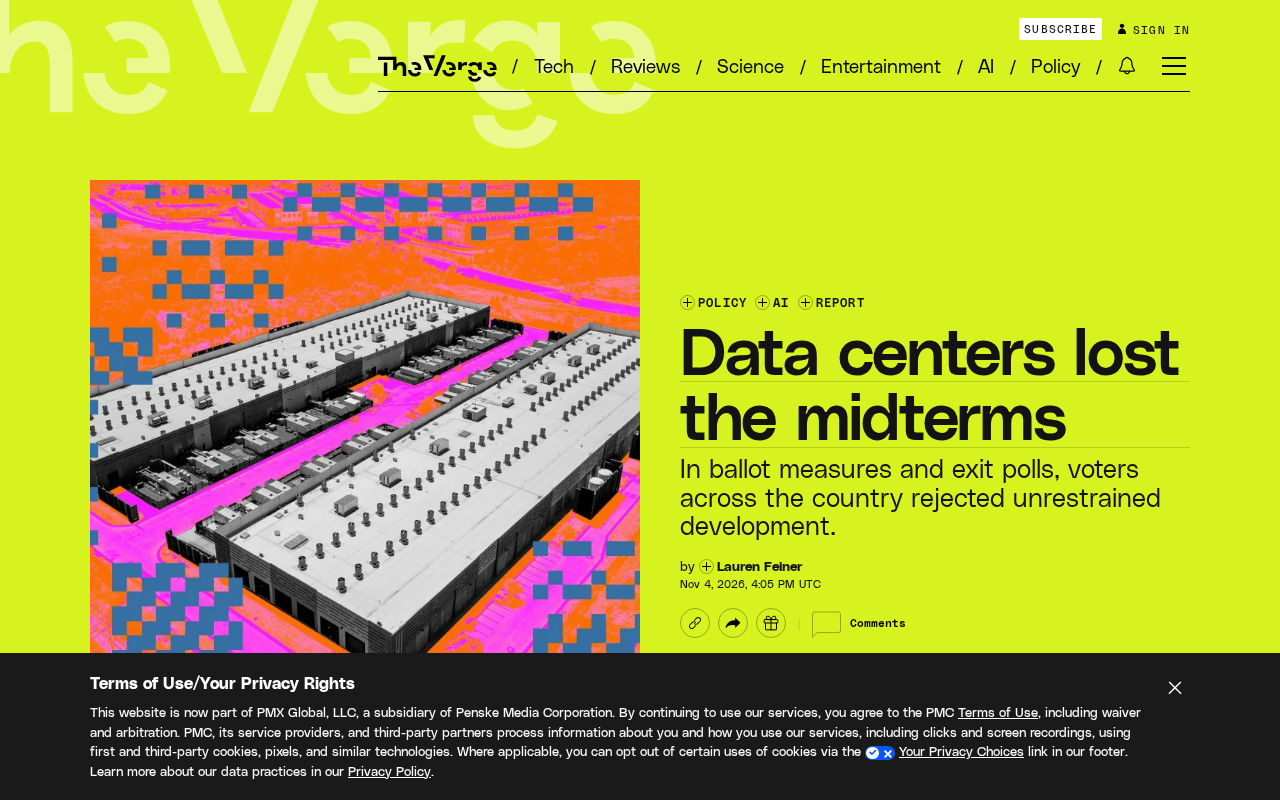
Election Results Deal a Blow to Data Center Expansion
According to RSS sources, data center developers are facing a stricter construction environment following the midterm elections. Voters across the country cast ballots for candidates favoring moratoriums and referendum measures that set up more obstacles to data center expansion, dealing a heavy blow to a core pillar of the AI industry. This shift marks a major political setback for the data center sector.
Voter Sentiment: Majority Support Restrictions
According to an NBC News poll conducted on Election Day, 76% of surveyed voters (the original data is truncated, but clearly an overwhelming majority) favor restricting data center expansion. This high percentage indicates growing public concern over the environmental, energy, and land impacts of data centers, with voters eager to express their stance through the ballot box.
While data centers are regarded as the cornerstone of the digital economy, the impact of their physical facilities on local communities is increasingly controversial. A typical large data center requires tens to hundreds of megawatts of power supply, its cooling systems consume large amounts of water, and diesel backup generators bring air pollution and noise issues. In addition, the land occupied by data centers often competes with agricultural or residential use, driving up local land prices. Together, these factors form the physical basis for voter concerns and explain why motions to restrict expansion can win bipartisan support in regions with different political leanings.
Notably, in the U.S. midterm elections, multiple states and counties saw a trend toward devolving data center land-use approval authority to local referendums. This means that even if state-level policy is friendly, specific projects may still be stalled by community opposition, increasing project uncertainty.
Potential Impact on the AI Industry
Data centers are the infrastructure for AI training and inference, and obstacles to their expansion will directly affect AI companies' ability to scale computing capacity. Stricter construction restrictions may raise data center construction costs and lengthen project timelines, in turn driving up the overall cost of AI services. In the long run, this could slow the pace of AI technology deployment across industries.
"Computing scale" is a key metric for measuring an AI company's ability to train and deploy models, typically measured by the floating-point operations (FLOPS) of GPU clusters or the total power of the cluster. Current large-model training often requires thousands to tens of thousands of GPUs running continuously for weeks, demanding extremely high power density and cooling capacity from data centers. Once new data center construction is blocked, AI companies may be forced to increase rack power density within existing facilities or turn to renting existing capacity from third-party cloud providers—but both paths drive up unit computing costs.
The more far-reaching impact is that the AI race is largely a race of computing expansion speed. If the trend of doubling training cluster size every few months slows due to infrastructure bottlenecks, it will directly slow the R&D pace of next-generation models and may change the bargaining dynamics between leading AI companies and cloud providers.
Industry Response and Future Outlook
Facing political resistance, data center developers may need to adjust their strategies—for example, increasing investment in regions that are already supportive, exploring more energy-efficient technology solutions, or seeking community support through public relations campaigns. However, the election results have made it clear that the data center industry needs to address public concerns more actively, or its expansion plans will face even more challenges.
One-line Summary
After the midterm elections, voters support restricting data center expansion, and AI computing growth faces political headwinds.
Paragraph Summary
U.S. midterm election results show that voters in many places cast ballots for candidates favoring moratoriums on data center construction or requiring referendums, creating political resistance to data center expansion. An NBC News exit poll shows that about 76% of surveyed voters favor restricting data center expansion, reflecting public concerns over energy consumption, water use, land use, and community impact. Data centers are core infrastructure for AI training and inference, and obstacles to their expansion could raise construction costs and lengthen project timelines, in turn affecting AI companies' ability to scale computing capacity. The article suggests the industry adjust its strategies, including shifting to policy-friendly regions, advancing energy-efficient technologies, and strengthening community communication, to cope with an increasingly tough political and public opinion environment.
Related articles

9 AI Subscription Plans Compared: The Real Cost Per 100M Tokens Revealed
Bilibili creator tests 9 AI subscription plans from Volcano, Alibaba, Tencent, Baidu, Zhipu, Xiaomi, MiniMax and more, converting them all to real cost per 100M tokens, breaking down fixed-quota vs. three-tier coefficient billing and how caching, time-of-day discounts, and window limits affect actual quota.

Vibe Coding for Beginners: Expressing Intent Instead of Handwriting Code
What is Vibe Coding? A 137-episode Bilibili course defines it: the core is expressing intent, not writing code. This article analyzes Vibe Coding's productivity logic, target audience, and entry expectations to help beginners decide if it's worth learning.

LangChain Beginner's Guide: An Agent Development Roadmap from LangGraph to Deep Agents
Clarify the encapsulation relationship among LangChain, LangGraph, and Deep Agents, and master the learning path and selection logic for agent development frameworks—suitable for beginners in large model development.