Database Schema Drift: Root Causes and Strategies for Silent SQL Tool Failures
Schema drift causes silent SQL tool failures in AI Agents—here's how to detect and prevent them.
When upstream databases change structure, AI Agent SQL tools can silently return incorrect results. This article examines why runtime introspection, controlled views, assertions, and unit tests fall short, and proposes schema version awareness, automated diff monitoring, and data distribution tracking as practical solutions.
What is Schema Drift? Why Does It Cause Silent SQL Tool Failures
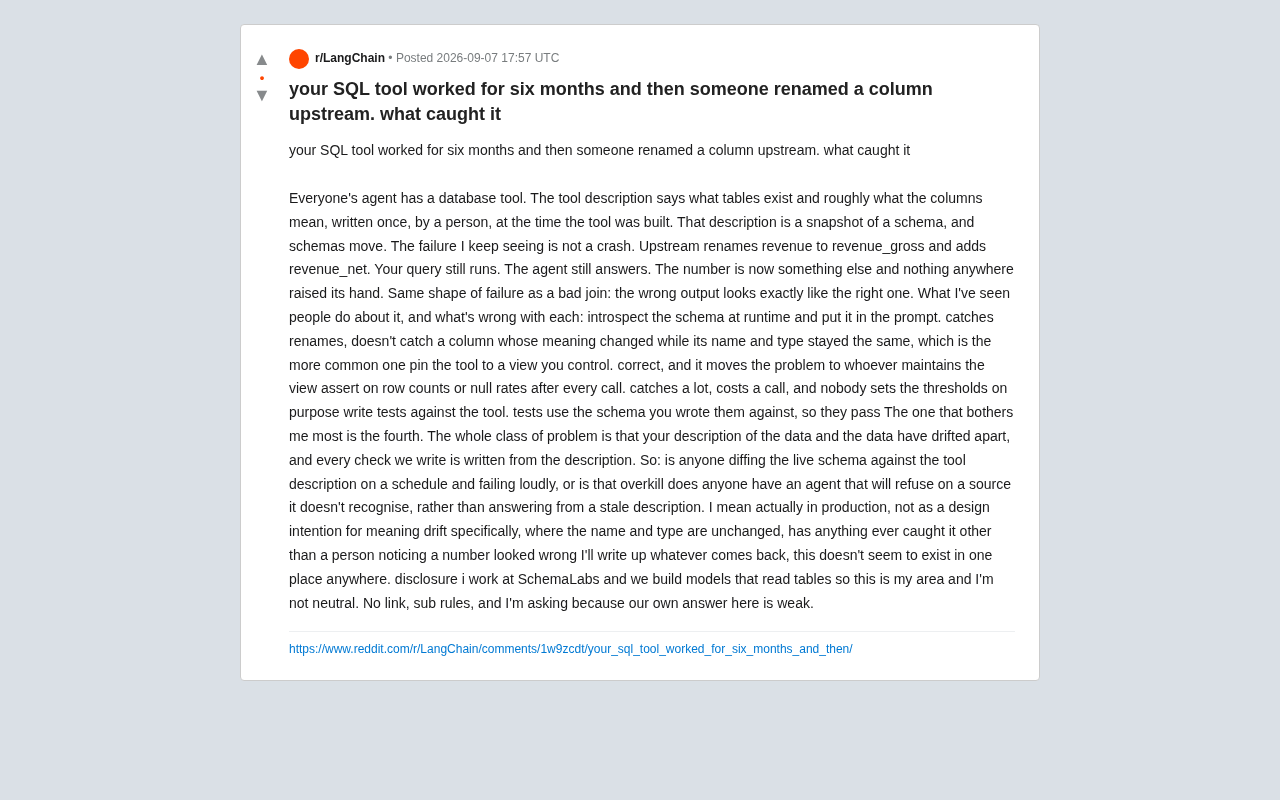
In scenarios where AI Agents interact with databases, there's a severely underestimated risk: upstream database schema changes can cause SQL tools to return incorrect results without any warning. This isn't a code crash—it's the more dangerous "silent failure" where queries execute normally, agents respond normally, but the meaning of the data has completely changed.
Schema Drift Background
Schema Drift is a common phenomenon in database evolution, referring to unexpected changes in database structure over time. In traditional software development, schema changes are typically managed through version control and migration scripts. However, in microservice architectures and multi-team collaboration environments, changes to upstream databases are often difficult to sync promptly to downstream consumers. This problem is particularly severe in AI Agent scenarios because agents typically generate SQL queries based on static schema descriptions and cannot perceive real-time changes to underlying data structures. Schema drift includes not only explicit structural changes (such as field renaming or type modifications) but also more subtle semantic drift—where field definitions remain unchanged but business meanings have shifted.
The Danger of Silent Failures
Silent failure is one of the most dangerous failure modes in software systems because it doesn't trigger any error handling mechanisms yet produces incorrect output. In data analysis and decision support systems, the consequences of silent failures can be catastrophic: business decisions based on wrong data, incorrect reports sent to customers, or automated operations that shouldn't have been triggered. Unlike crashes or exceptions, detecting silent failures requires semantic-level validation of output results, which is extremely challenging in AI Agent scenarios. This failure mode is especially common in database queries because SQL's flexibility allows many incorrect queries to still "successfully" execute and return seemingly reasonable results.
Here's a typical schema drift scenario: the upstream team renames the revenue column to revenue_gross and adds a new revenue_net column. Your query still runs, but the "revenue" it returns might now be gross revenue instead of net revenue, and no part of the system will raise an alarm. This failure mode is identical to incorrect JOINs—incorrect output is formally indistinguishable from correct output, making it difficult to detect.
Four Common Solutions and Their Limitations
Runtime Schema Introspection
Schema Introspection Mechanism
Schema introspection is the metadata query capability provided by database systems, allowing programs to dynamically obtain database structure information at runtime. Mainstream databases provide standard interfaces, such as the INFORMATION_SCHEMA views in SQL standards, PostgreSQL's pg_catalog system tables, and MySQL's SHOW commands. In AI Agent scenarios, typical runtime schema introspection implementations query target table column information, data types, constraints, etc. before generating SQL, and inject this information into prompts to help large language models generate more accurate SQL statements. However, this approach has two fundamental limitations: it increases query latency and database load, and it can only obtain structural information without understanding the business semantics of fields.
Dynamically fetching schema information and placing it in prompts before each query is the most intuitive approach. It can catch field renaming issues but cannot handle more subtle cases: field names and types remain unchanged, but semantics have changed. For example, a status field changes from representing "order status" to "payment status"—the type is still a string, but the meaning is completely different.
Locking Down Controlled Database Views
Database View Isolation
A database view is a virtual table defined based on query results from one or more base tables. In data governance practices, views are commonly used as an abstraction layer for data access, isolating downstream consumers from upstream schema changes. For example, when upstream table column names change, view definitions can be modified to maintain downstream query compatibility. This pattern is very common in enterprise data warehouses, known as the separation of "logical data models" from "physical data models." However, the view solution also introduces new complexity: views themselves require version management and testing, too many view layers can affect query performance, and view maintainers still need to respond promptly to upstream changes—the responsibility is simply transferred from tool developers to data engineering teams.
Binding SQL tools to database views you control is technically the correct isolation method, but essentially just transfers the problem to view maintainers—someone still needs to keep views in sync with upstream data, and the risk of schema drift hasn't disappeared.
Post-Query Assertion Checks
Assertion-based Validation
Assertion-based validation is a core concept in software testing, referring to detecting deviations in actual system behavior by declaring expected behavior. In database query scenarios, assertions can be set for statistical characteristics of results, such as row count ranges, null value ratios, numerical distributions, and primary key uniqueness. This is similar to data profiling techniques in data quality monitoring, detecting anomalies by continuously tracking data characteristics. However, implementing assertion validation in AI Agent scenarios faces several challenges: first, reasonable assertion rules need to be defined for each query, which is an engineering burden in itself; second, assertion checks require additional database queries, which can become performance bottlenecks in high-frequency scenarios; most importantly, many schema drifts don't cause significant changes in statistical characteristics.
Checking metrics like row counts and null rates after each SQL call can catch some anomalies, but there are several practical obstacles: additional database calls introduce performance overhead, setting reasonable thresholds lacks justification, and more critically, it cannot detect situations where "data ranges change but statistical characteristics are similar."
Writing Unit Tests for Tools
This is the solution most likely to create a false sense of security. Tests are written based on the schema description you had when writing the tool, so of course the tests will pass—but that's exactly the problem. The core contradiction of schema drift is the divergence between "tool description" and "actual data," and all checks written based on descriptions cannot discover this divergence.
Three Key Questions in Schema Drift Detection
Is Automated Schema Diff Monitoring Feasible
Contract Testing Philosophy
Contract Testing is a testing pattern in microservice architectures, promoted by Martin Fowler and others. Its core idea is that service providers and consumers define interface specifications through explicit "contracts," with both parties independently verifying contract compliance. In API scenarios, this typically manifests as automated validation of OpenAPI specifications. Applying this philosophy to database schema management means upstream databases should publish formal schema contracts, downstream consumers develop tools based on contracts, and continuously validate contract validity through automated testing. When upstream schemas change, contract tests immediately fail, thereby preventing incompatible changes from entering production environments. However, in reality, most databases lack such contract mechanisms, and schema changes are often implicit and unidirectional.
Are teams regularly comparing production schemas with tool descriptions and proactively alerting when differences are found? From an engineering practice perspective, this is similar to contract testing in API version management, but it doesn't seem to be a standard practice in the database tooling field yet. Implementation costs are not high, but most teams may consider this over-engineering.
Can Agents Proactively Refuse Unknown Data Sources
Ideally, AI Agents should proactively refuse to answer when encountering unknown data sources, rather than giving seemingly reasonable answers based on outdated descriptions. The key here is "whether this is actually implemented in production"—many systems consider this in design, but often lack strict validation mechanisms in actual operation.
Can Semantic Drift Be Automatically Captured
Data Drift Detection
Data drift detection was originally a concept from the machine learning field, referring to monitoring changes in model input data distribution over time. When training data distribution diverges from production data distribution, model performance degrades—this is called data drift. Detection methods include statistical tests (such as Kolmogorov-Smirnov test, chi-square test) and distribution distance measures (such as KL divergence, Wasserstein distance). Borrowing this approach, baseline distributions can be established for database query results, with continuous monitoring of actual distribution deviations. For example, monitoring value ranges, frequency distributions, and correlation characteristics of certain fields. This method has some detection capability for semantic drift because changes in business meaning often accompany changes in data distribution. But the implementation challenge lies in establishing monitoring baselines for each key field and defining reasonable alert thresholds.
For the most difficult semantic drift—where field names and types haven't changed but meanings have—there are currently almost no mature automated detection methods beyond manual discovery of numerical anomalies. This may be the biggest blind spot in schema governance.
Practical Directions for Building Schema Version Awareness Mechanisms
This problem has cautionary implications for all database-related AI tools. When we build agents, we often assume tool descriptions are static and accurate. But in real environments, data infrastructure is alive—tables get refactored, columns get renamed, business logic continuously evolves.
A pragmatic improvement direction is to establish schema version awareness mechanisms:
- Versioned tool descriptions: Add timestamps and version numbers to each SQL tool's schema description, clearly marking the table structure version it depends on
- Regular schema comparison: Use automated scripts to regularly compare production schemas with tool descriptions, generating change reports
- Change-triggered reviews: When schema inconsistencies are detected, automatically trigger manual review processes, blocking agent autonomous queries
- Data distribution monitoring: For semantic drift, introduce data distribution monitoring mechanisms, similar to data drift detection methods in ML models
From Passive Discovery to Active Defense
Database Migration Tools
Database migration tools like Flyway, Liquibase, and Alembic are standardized tools for managing schema changes. Their core mechanism is to express schema changes as versioned migration scripts, executing these scripts in sequence to evolve databases from one version to the next. Each migration script is traceable, with the system maintaining a version history table recording executed migrations. This pattern is very effective in monolithic applications because application code and database schemas are managed in the same codebase. But in AI Agent scenarios, tools often consume multiple upstream databases not under their control, and the assumptions of traditional migration tools (single codebase, unified deployment) no longer hold—new cross-system schema synchronization mechanisms are needed.
Silent failures caused by schema drift aren't a problem with standard answers, but a real challenge being experienced in the AI-database interaction field. Currently, most teams rely on "post-incident discovery" mode—users report numerical anomalies, then manually trace root causes. But as AI Agent autonomy increases, the risks of this passive mode will continue to amplify.
Database schema governance has mature practices in traditional software engineering (such as migration tools like Flyway and Liquibase), but adapting them to the AI Agent context requires new toolchains and methodologies. This intersection deserves more attention and investment from engineering teams.
Key Takeaways
Related articles
OpenAI's Staggering $38.5 Billion Loss: The Financial Truth and Capital Game Before Its IPO
OpenAI faces a reported $38.5B loss before its IPO. This deep dive analyzes compute costs, strategic logic, IPO timing, and what it means for the generative AI industry.
Gemini 3.7 Flash In-Depth Review: Speed, Quality, and Multi-Model Collaboration
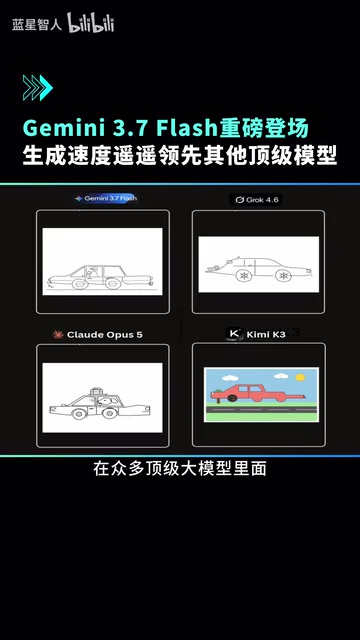
In-depth analysis of Google Gemini 3.7 Flash model's core advantages: extreme generation speed, high-quality code and game generation, multi-model collaboration mechanisms, and multimodal understanding potential, with real-world test cases.
PyTorch and Hugging Face Bangalore Tech Summit: In-Depth Recap
Bangalore PyTorch and Hugging Face tech summit recap: 170+ developers explore large-scale inference optimization, reinforcement learning practices, and open-source community building, analyzing India's AI ecosystem trends and technical innovation.