Databricks Doubles Down on AI Products, Opens New San Francisco Headquarters

Databricks opens a new San Francisco HQ and doubles down on AI products, drawing attention with its counter-cyclical expansion.
Databricks officially opened its new 235,000-square-foot headquarters at One Sansome Street in San Francisco, expanding as tech companies broadly shrink office space. The new HQ serves to attract San Francisco AI talent, stay close to the enterprise customer ecosystem, and provide physical capacity for AI product team growth. In parallel, its Lakehouse + AI strategy connects data governance, model training, and business deployment on one platform, meeting enterprise demand to no longer separate data and AI development. The move will intensify enterprise AI platform competition; customers gain a more complete roadmap but must watch vendor lock-in and fixed-cost risks. Success ultimately depends on real-world results.
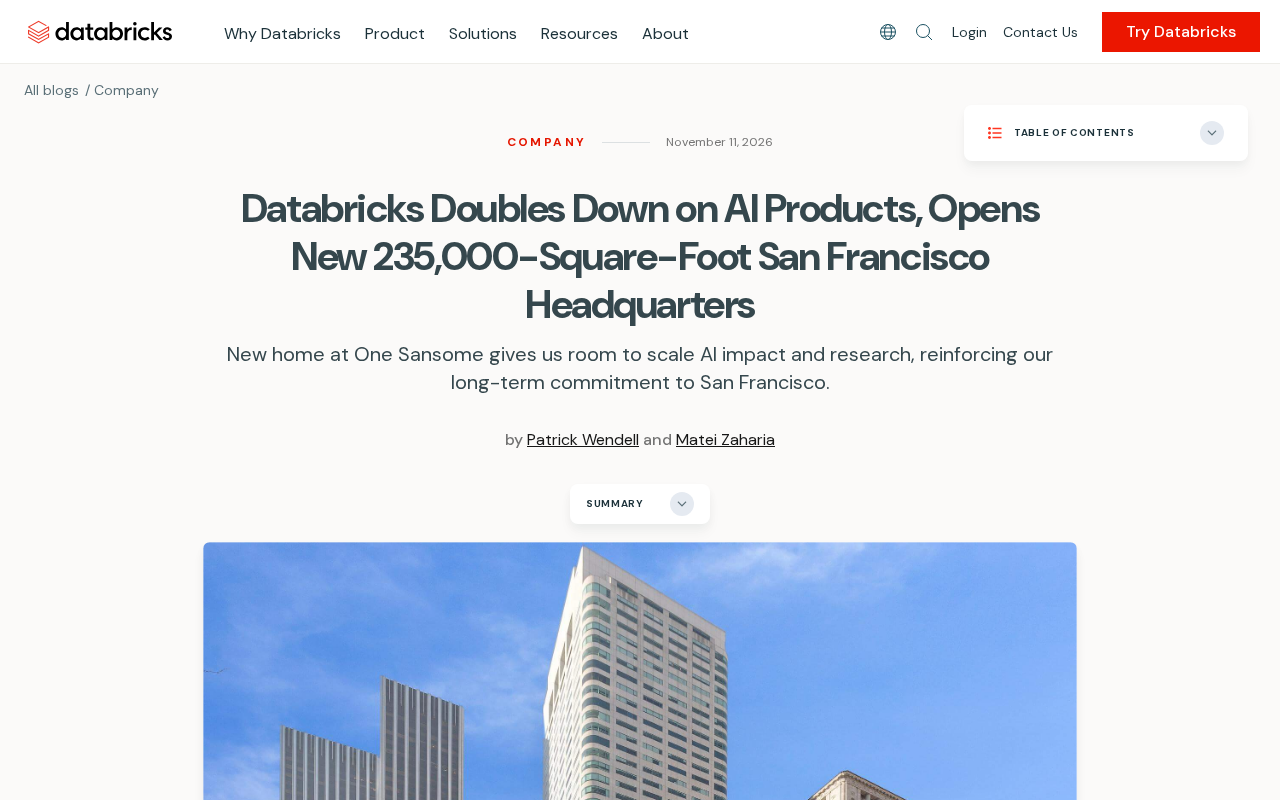
New Headquarters: More Than Just Office Space
Last week, data and AI company Databricks officially opened its new headquarters at One Sansome Street in San Francisco, spanning 235,000 square feet. The move stands out at a time when remote work is prevalent and tech companies are increasingly shrinking their office footprints.
The opening of the new headquarters is not just a physical expansion but also a signal to the outside world: as the AI race enters a white-hot phase, Databricks is choosing to double down rather than pull back. As a global hub for AI talent and startups, San Francisco offers Databricks a large headquarters that helps it attract local talent, stay close to its customer ecosystem, and strengthen its brand presence in the AI space.
In terms of location, One Sansome Street sits in the heart of San Francisco's financial district, surrounded by a large number of enterprise customers and partners. For a company whose core business is an enterprise-grade data and AI platform, this locational advantage translates into more efficient customer communication and business development.
AI Product Line Accelerates Across the Board
In tandem with the headquarters expansion, Databricks has made clear it will further increase its investment in AI products. As the pioneer of the Lakehouse architecture, Databricks has in recent years continued to embed AI capabilities into its data platform—from model training and deployment to inference—seeking to connect data engineering with AI applications.
This strategic direction aligns closely with industry trends. Enterprise customers are increasingly unwilling to keep data storage and AI development split across two separate systems; instead, they want to complete data governance, model development, and business deployment on a single platform. Databricks' dual bet—data platform plus AI products—is a direct response to this demand.
Notably, Databricks' investment in AI is not an isolated effort. From acquiring AI-related startups to launching product capabilities for large models, the pace of its product line expansion has clearly accelerated over the past two years. The opening of the new headquarters is, in a sense, providing physical capacity for the expansion of these product teams.
The Lakehouse architecture is a data platform paradigm proposed by Databricks. Its core idea is to layer data warehouse transaction management, schema constraints, and query performance on top of the low-cost, open storage of a data lake, so that the same data can both support BI reporting and be used directly for machine learning and AI training. In traditional architectures, data lakes and data warehouses are often independent, requiring enterprises to repeatedly move and synchronize data, which brings redundancy, latency, and inconsistent definitions. Lakehouse unifies metadata and ACID transactions through open table formats (such as Delta Lake), allowing data engineering, analytics, and AI development to share the same trusted data. For Databricks, this architecture is the foundation for embedding AI capabilities into its data platform and a key differentiator from pure model service providers.
The Industry Logic Behind the Office Expansion
Against the backdrop of the tech industry's overall cautious cost control, Databricks' counter-cyclical expansion is worth pondering. On one hand, the strong momentum of the AI sector has brought the company ample business growth and capital support; on the other hand, a large headquarters is itself a talent-competition tool—in the battle for AI talent, office experience and corporate culture are becoming differentiating factors.
Such expansion also carries risks. There is tension between long-term commitments to commercial real estate and the rapid changes in the AI industry; if business growth falls short of expectations, fixed costs will become a burden. However, judging from Databricks' current business momentum, the company clearly believes the growth potential of AI products is sufficient to support this investment.
Potential Impact on the Industry Landscape
Databricks' increased bet will further intensify competition in the enterprise AI platform market. In overlapping areas such as data lakehouses, AI development tools, and model services, major vendors are all vying for enterprise customers' AI budgets. The confidence conveyed by Databricks through its headquarters expansion and product investment may prompt competitors to reassess their own pace of resource allocation.
For enterprise customers, greater vendor investment usually means a more complete product roadmap and longer-term service commitments. But they also need to be wary of vendor lock-in risk—when data, models, and workflows are deeply tied to a single platform, migration costs rise significantly.
Whether this expansion can translate into a substantive improvement in product competitiveness ultimately depends on how well its AI products perform in real enterprise scenarios. The square footage of a headquarters can be measured, but the value of AI products can only be decided by customers voting with their feet.
Vendor lock-in refers to the technical, time, and compliance costs an enterprise must bear to migrate to another system after deeply binding its data, models, and workflows to a single platform. In the AI platform context, lock-in risk mainly comes from the coupling of proprietary data formats, model training pipelines, and permission governance systems; migration involves not only moving data but also rebuilding feature engineering, evaluation, and monitoring processes. For customers, ways to reduce risk include prioritizing open table formats and standard interfaces, retaining data export and portability clauses, and avoiding single-vendor dependence in critical paths. Although greater vendor investment brings more complete product commitments, bargaining power and exit costs also change accordingly, and enterprises need to weigh long-term service guarantees against architectural autonomy.
One-line Summary
Databricks opens a new San Francisco headquarters and doubles down on AI products, drawing industry attention with its counter-cyclical expansion.
Paragraph Summary
Databricks has officially opened its new 235,000-square-foot headquarters at One Sansome Street in San Francisco, expanding against the backdrop of widespread office downsizing among tech companies. The article notes that the new headquarters both helps attract San Francisco AI talent and stay close to the enterprise customer ecosystem, while also providing physical capacity for the expansion of AI product teams. In parallel, it is advancing its Lakehouse + AI strategy: connecting data governance, model training, and business deployment on a single platform, responding to enterprise customers' desire to no longer separate data and AI development. This increased bet will intensify competition in the enterprise AI platform market; for customers it means a more complete product roadmap, but they should also be wary of vendor lock-in and long-term fixed-cost risks. The ultimate outcome depends on how well the AI products perform in real enterprise scenarios.
Related articles

Complete Grok Bot Refund Guide: Cursor, X, and App Store Rules Explained
Grok Bot has no standalone subscription—refunds depend on your payment channel. Learn Cursor's 14-day window, X's prorated refunds, App Store/Google Play processes, and SuperGrok's xAI form.

Cursor Renamed to GrokBuild? Anonymous Leak and Official Information Fully Analyzed
An anonymous account claims Cursor may be renamed GrokBuild and that GrokBuild CLI 2.0 is in alpha. This article reviews the rumor details, confirmed acquisition and plan integration facts, and notes that no official renaming has been announced, urging caution with unverified news.

When Insect Portraits Turn Out Surprisingly Cute: A Playful Look at Macro Imagery
Starting from a low-traction Hacker News post, this analysis explores why insect macro portraits feel surprisingly cute: anthropomorphic perspective, contrast, spread mechanisms, and the blurred boundary between real photography and AI-generated imagery.