db-branch: Second-Level Database Branching with ZFS for AI Agents and CI

db-branch uses ZFS snapshots to achieve second-level database branching for AI agent and CI isolation scenarios.
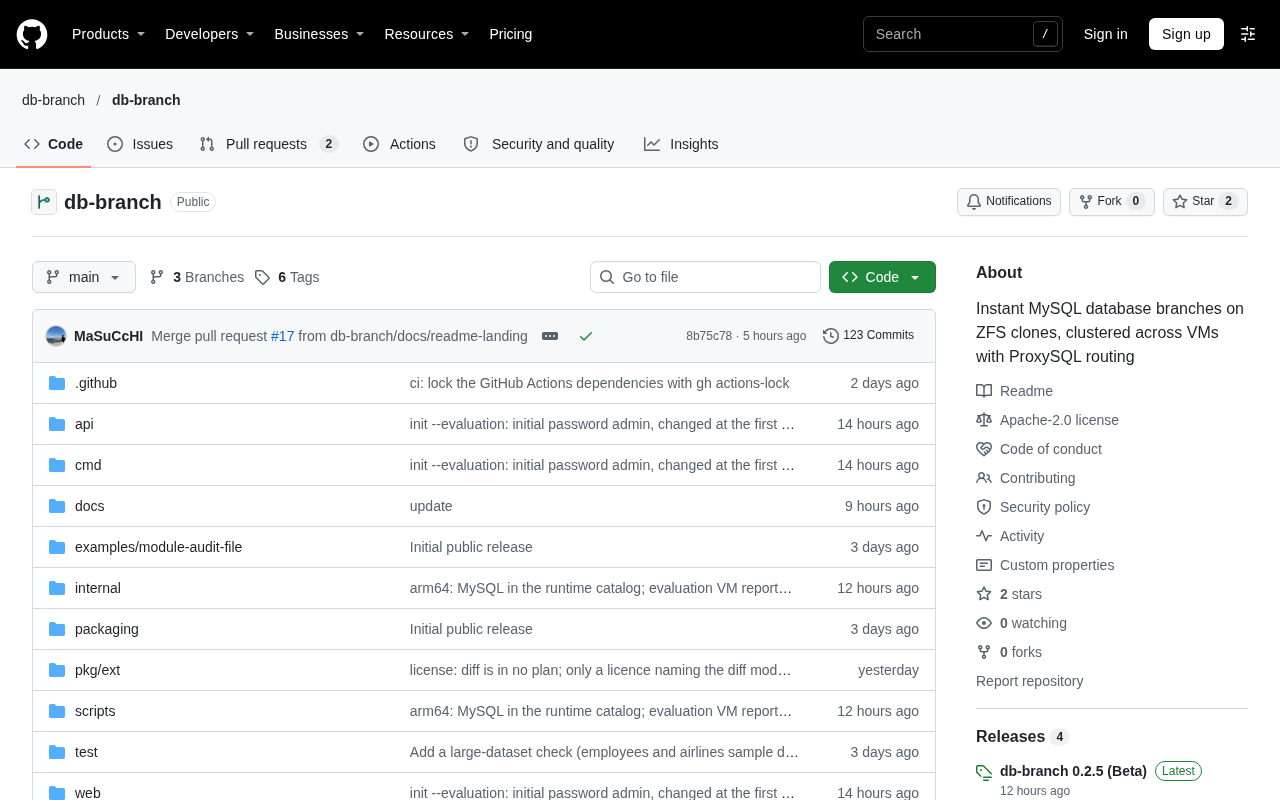
db-branch is a new project featured on Hacker News' Show HN section. Its core idea is to leverage ZFS's copy-on-write and snapshot capabilities to rapidly generate independently writable branch copies of databases, compressing the linear time cost of traditional export/import or physical copying to seconds with minimal initial extra storage overhead. The project explicitly targets two scenarios: AI agents—assigning each agent an independent database to support trial-and-error and rollback—and CI—spinning up a clean branch database on each pipeline run to avoid test contamination. However, the project has limited discussion on Hacker News, and the original information only includes a title and brief description, without disclosing supported database types, performance data, deployment methods, or license agreements, so its actual usability still awaits external validation.
Database branching is becoming increasingly important in AI agent and continuous integration (CI) scenarios, but traditional approaches are often slow and cumbersome. A new project called db-branch has appeared on Hacker News' Show HN section, claiming to create database branches in seconds using the ZFS filesystem.
Core Mechanism: ZFS Snapshot-Driven Second-Level Branching
According to the project's introduction on Hacker News, db-branch's core idea is to leverage ZFS's copy-on-write and snapshot capabilities to rapidly generate independently writable branch copies of database instances. Traditionally, copying a database often requires export/import or physical copying, with time growing linearly with data volume; branches based on ZFS snapshots can be created almost instantaneously, with minimal initial extra storage overhead.
The key value of this mechanism is environment isolation: each AI agent or CI pipeline can obtain an independent database copy, free from interference, and destroy it when done.
ZFS copy-on-write is a data management mechanism: when a data block needs to be modified, the filesystem does not overwrite the old block in place, but instead writes the new data to a new block and updates the pointer to point to the new block, leaving the old block unchanged. This brings two direct effects: first, snapshots only need to record the pointer state at a given moment, making creation nearly constant time; second, multiple snapshots share unmodified data blocks, so additional storage overhead only occurs after data is actually modified. This is precisely why ZFS snapshot-based database branches do not need to copy the entire dataset at creation time—new space is only gradually consumed after writes occur on the branch, which is the fundamental reason it can achieve "second-level creation with near-zero initial cost."
Database branching borrows the idea from Git branching: deriving an independently readable/writable new version from a database state, where modifications on the branch do not affect the parent database, and subsequent changes to the parent can optionally be merged or discarded. Its difference from "copying a database" is that branches typically share underlying data blocks, recording incremental changes separately after snapshot creation. This pattern is particularly suited for scenarios requiring one-time, short-lived isolated environments, such as parallel testing or agent trial-and-error. It should be noted that whether a branch can be independently writable depends on how the database engine and filesystem work together—not all databases can transparently run on top of ZFS snapshots.
Typical Scenarios for AI Agents and CI
The project title explicitly targets two types of users: AI agents and CI.
In CI scenarios, tests often require a clean database state. With db-branch, pipelines can quickly spin up a branch database on each run and discard it after testing, avoiding cross-test contamination.
In AI agent scenarios, agents may need to read and write to the database while performing tasks, or even conduct risky trial-and-error operations. Assigning an independent branch to each agent ensures operational safety and facilitates post-hoc rollback or auditing.
Test isolation in CI refers to each pipeline or test case running on an independent data state, preventing data written by one test from affecting another test's assertion results. Traditional approaches include cleaning tables, rebuilding schemas, or using transaction rollback before each test—the former is slow and error-prone, while the latter is unsuitable for cross-connection and cross-process scenarios. Snapshot-based branching provides "whole-database-level" isolation: once a branch is created, it is a freely readable/writable, disposable copy, naturally preventing contamination between tests and making it easy to preserve the scene for troubleshooting on failure.
Community Feedback and Information Limitations
It should be noted that this entry has received limited attention and discussion on Hacker News. The original material only includes the project title and a brief description, without disclosing details such as supported database types, specific performance data, deployment methods, or license agreements. Therefore, there is currently insufficient external validation regarding its actual usability and maturity.
For interested technical teams, it is recommended to consult the project repository and documentation directly, and to verify in a non-production environment first.
Summary
db-branch proposes a technically clear path: using filesystem-level snapshots to reduce the cost of database branching. If this approach is validated across more databases, it has the potential to become practical infrastructure in AI agent and CI workflows. However, based on currently available public information, it remains an early-stage project worth watching but still awaiting validation.
Related articles

Claude Solves Two Major Black Hole Physics Problems, Ushering in a New Era of AI Research Collaboration
Anthropic's Claude solved two open problems in black hole physics: a 2003 unfinished phase transition calculation and a black hole mass bound since 2009. AI as a research collaborator, using holographic duality and the modular bootstrap, with results awaiting peer review.

Claude Solves Two Major Black Hole Theory Problems: A New Milestone in AI Scientific Research
Anthropic announced Claude solved two open black hole theory problems: the weak-coupling sign of the Hawking-Page transition and the exact limit of modular bootstrap. This article details the background, Claude's solutions, verification controversies, and limitations, exploring AI's breakthrough and boundaries in theoretical physics.
Claude Solves Two Open Problems in Black Hole Physics: A New Sample of AI-Assisted Research
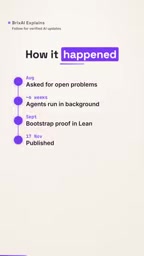
Anthropic's research paper documents Claude solving two open black hole problems: whether hot gas transitions to black holes abruptly, and the lightest black hole mass limit. The model produced 22 candidates in hours, with the agent running in the background for about six weeks; results were reviewed by physicists, though Anthropic says they don't directly apply to our universe.