Debunking the Token Compression Myth: Does RTK Actually Save Money? A $1,500 Real-World Test Reveals the Truth

A $1,500 test proves RTK token compression tools don't save money — DeepSeek costs rose 17% instead.
A rigorous A/B test burning over $1,500 across 1,744 task attempts has thoroughly debunked the popular narrative that "compressing tokens saves money." RTK, the token compression tool with 79K GitHub stars, claims to cut tool output by 90% and reduce costs by 60% — but real-world data shows DeepSeek per-task costs rose 17%, while Claude savings of ~5% were almost entirely attributable to a single statistical outlier. The root cause: AI Agent costs are dominated by context caching (94–98% of total tokens) and extra conversation rounds triggered by information loss — both beyond the reach of any compression plugin. The right path to cost reduction is optimizing cache hit rates and prompt quality, measured by cost per passing task rather than raw token counts.
Token Compression = Cost Savings? This Logic Is Getting Exposed
As usage-based billing and subscription models become the dominant pricing approach for AI coding tools, token consumption has become a pain point every developer cares about. A wave of projects and plugins claiming to "compress tokens and save money" has flooded the market, with the hottest being RTK (Rust Token Killer), alongside similar tools like Qman and Headroom. Their marketing pitch is remarkably consistent: slash token usage by half on Claude Code and save 50% on your bills.
The narrative sounds airtight — fewer tool outputs equals fewer tokens equals lower costs. RTK has already racked up 79K stars on GitHub, sitting firmly at the top of AI coding cost-reduction projects, and tweets claiming "60% cost reduction" have racked up 313,000 views on Twitter. But one real-world test — burning over $1,500 and running more than 1,700 tasks — has completely dismantled this logic.
Rigorous Testing: An A/B Comparison Across 174 Tasks and 1,744 Attempts
The rigor of this test is worth noting. The tester used Terminal Bench 2.1 as the terminal interaction task suite and ran two model pipelines: one using Claude Code with top-tier models, and another using DeepSeekAd via OpenRouter through Open Code (currently one of the most cost-effective models available).
Each task was run five times under both conditions — with and without RTK — using the same routing, platform, and time window to minimize confounding variables. After removing tasks that failed due to external factors, the final sample comprised 174 tasks and 1,744 attempts.
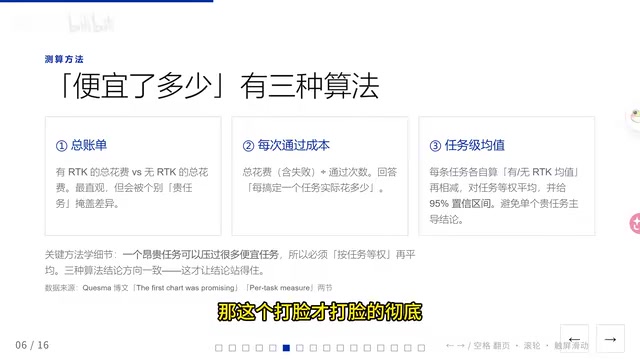
The test also employed three cost calculation methods: total bill, cost per passing attempt, and task-level cost — each with 95% confidence intervals. The reason for cross-validating with three methods was to make the debunking airtight: only when all three approaches point to "no savings" does the conclusion hold water.
The Numbers Don't Lie: Bills That Went Up, Not Down
The results were pretty ugly. Starting with total bills: on the Claude pipeline, the no-RTK run cost $731 versus $698 with RTK — a roughly 5% drop that's essentially negligible. On the DeepSeek pipeline, the no-RTK cost was $51, but with RTK it actually climbed to $54 — a 5% increase.
For cost per passing attempt, Claude came in 3% cheaper, while DeepSeek came in 7% more expensive. The harshest data point showed up in task-level cost accounting: Claude's cost increased by 1% (statistically insignificant), while DeepSeek's per-task cost surged by 17%. Even looking at only the 36 fully-passing tasks, costs still rose 18%.
Quality metrics told the same story. After installing RTK, Claude's task pass rate dropped by 1 percentage point and DeepSeek's fell by 2%. In other words, RTK neither saved money nor improved quality — using it was the same as not using it, or arguably worse.
RTK Gain: A Carefully Packaged Vanity Metric
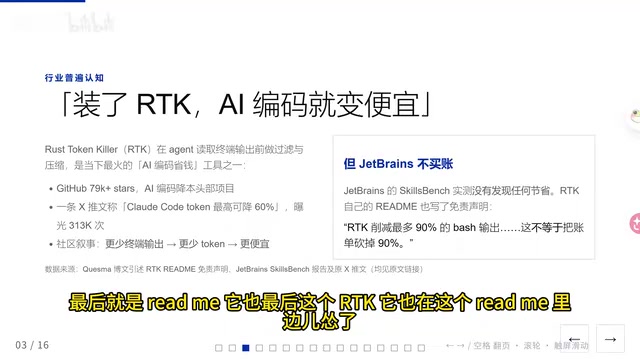
RTK's core selling point has always been "RTK gain" — across 445 DeepSeek attempts, it self-reported savings of 349.2M tokens, claiming an ~89% reduction. The numbers look alarming, but the math hides a trick.
The gain calculation works like this: take the original output, subtract the filtered output, divide by 4 — and count only the deleted tokens that were never billed in the first place, ignoring downstream round costs. Here's a concrete example: if you hand the model a massive TXT file, RTK counts the entire document's token volume as "saved," even though the model might have only read the filename or the first few lines. That's where the wordplay comes from.
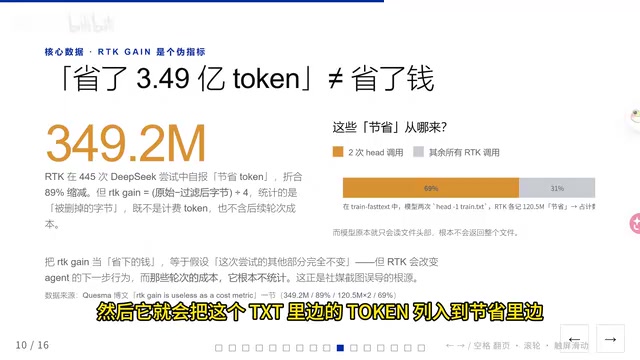
More critically, RTK's own Readme includes a disclaimer: it can reduce tool output by up to 90%, but that does not mean your bill drops by 90%. In other words, the official documentation already acknowledges that "reading less output" and "spending less money" are two entirely different things.
Understanding this requires distinguishing between different token types in an AI Agent workflow. Input tokens are everything sent to the model each turn — system prompts, conversation history, and tool return values. Output tokens are the model's generated responses. Tool output tokens specifically refer to content returned to the model from tool calls like file reads and command executions — and that's exactly what RTK compresses. In most API pricing structures (such as Anthropic's Claude API), cached input tokens cost only 1/10th to 1/30th the price of standard input tokens, and once the context is cached, the majority of each subsequent conversation turn goes through the cache channel. Tool output tokens — the ones RTK targets — represent a tiny fraction of the overall cost structure, so even zeroing them out has minimal impact on the bill. This pricing mechanism is the root cause of the massive gap between "token count reduction" and "bill reduction."
Why Token Compression Doesn't Save Money: Three Uncomfortable Truths
First, tool output tokens are a tiny slice of the pie to begin with. Without RTK, tool outputs account for only about 7% of non-model output tokens, with other components making up roughly 11%. The real cost driver is caching — context gets cached every turn, and cache reads account for 94% to 98% of total token volume. Cache tokens cost one-tenth to one-thirtieth as much as regular input or output tokens, so high cache hit rates dramatically lower bills. The problem: you can't compress cache tokens. The tool output RTK shaves down is barely a drop in the bucket.
Second, compressing single rounds increases total rounds. RTK reduced tool characters by 9%, but prompt tokens increased by 9%. Average per-turn input dropped 7%, yet total conversation turns jumped 18%. Those extra agent rounds cost far more than the compression ever saved.
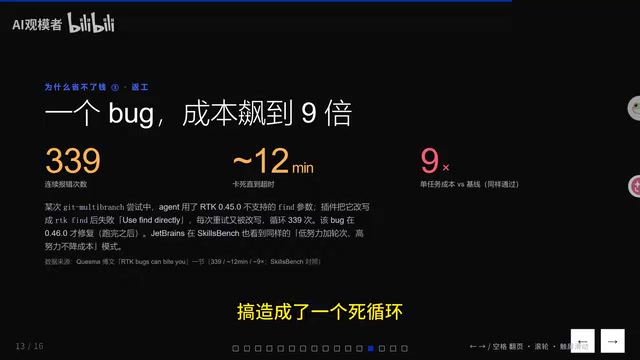
Third, there's a blowback cost. During testing, RTK triggered a bug during compression that caused an infinite loop — 339 consecutive errors, stuck for 12 minutes before timing out, with the single-task cost shooting to 9x the baseline. The task eventually passed, but at an absurd price.
There's also a counterintuitive detail: the modest 1–3% "savings" on the Claude pipeline were almost entirely driven by a single task (Core Wars). Strip that out, and the savings across all other tasks amount to less than 1% — pure statistical noise.
The multi-turn nature of AI Agent workflows means that gains from "single-turn token compression" get wiped out by increased round counts. In an agent workflow, every tool call, code execution, or file read generates a new context append, and the total task cost is the sum of all turns — not a snapshot of any single round. When RTK compresses tool return content, the model may lack sufficient information and need to ask follow-up questions or re-invoke tools — this "information compensation behavior" directly increases total turn count. More importantly, each additional conversation turn causes the entire current context to be billed again as input tokens (even cache hits incur cache read fees). Therefore, evaluating any optimization technique in an agent context requires measuring from task start to task completion across the full pipeline — not just looking at single-turn token reductions.
Four Practical Recommendations for Engineering Teams
If you genuinely want to cut costs, instead of chasing compression plugins, focus on the following:
- Track cost per passing task, not token counts. Metrics like RTK gain — which count deleted tokens — have no meaningful relationship to your actual bill.
- Prioritize cache optimization and prompt quality. Improving cache hit rates and trimming your prompts will outperform any compression plugin.
- Run your own tests on your own workloads. The benefits are highly task-dependent — RTK helps on some tasks and hurts on others.
- Treat RTK as a marginal optimization at best, not a cost-saving miracle. For the vast majority of users, these plugins simply don't apply.
What's really being debunked today isn't just the RTK plugin itself — it's the concept substitution that's been quietly happening: reading less output ≠ spending less money. Token compression reduces the characters that get read, but the real costs in AI Agent workflows are buried in context caching, extra conversation turns, and task quality degradation causing expensive retries — none of which any compression tool can touch.
So stop fantasizing that installing a plugin will cut your costs by 90%. Don't fall for it.
Related articles

Cursor AI Programming in Practice: Build a Student Management System from Scratch in 30 Minutes
A Bilibili creator demonstrates Cursor AI programming: generating a student management system in 30 minutes with natural language. Details on Agent mode, Claude selection, prompt techniques, and thresholds.

Top 20 AI Coding Tools Ranking: From Rock-Solid to Lackluster, a Scored Matrix
Bilibili creator releases top 20 AI coding tools ranking, tiered T0–T4 from rock-solid to lackluster, with Claude Code and Codex tied at T0. This article details the scoring dimensions (capability, reliability, robustness, durability, cost, domestic availability) and tool performances to help developers choose the right AI coding assistant.

Vibe Coding Systematic Tutorial: Master AI-Assisted Programming from Zero
A three-month Vibe Coding tutorial from a Bilibili creator covering Codex, ClaudeCode, and Cursor, from core logic to commercial project practice for beginners.