Decision Models vs LLMs vs Encoders: Who Wins at Multilingual Sentiment Classification
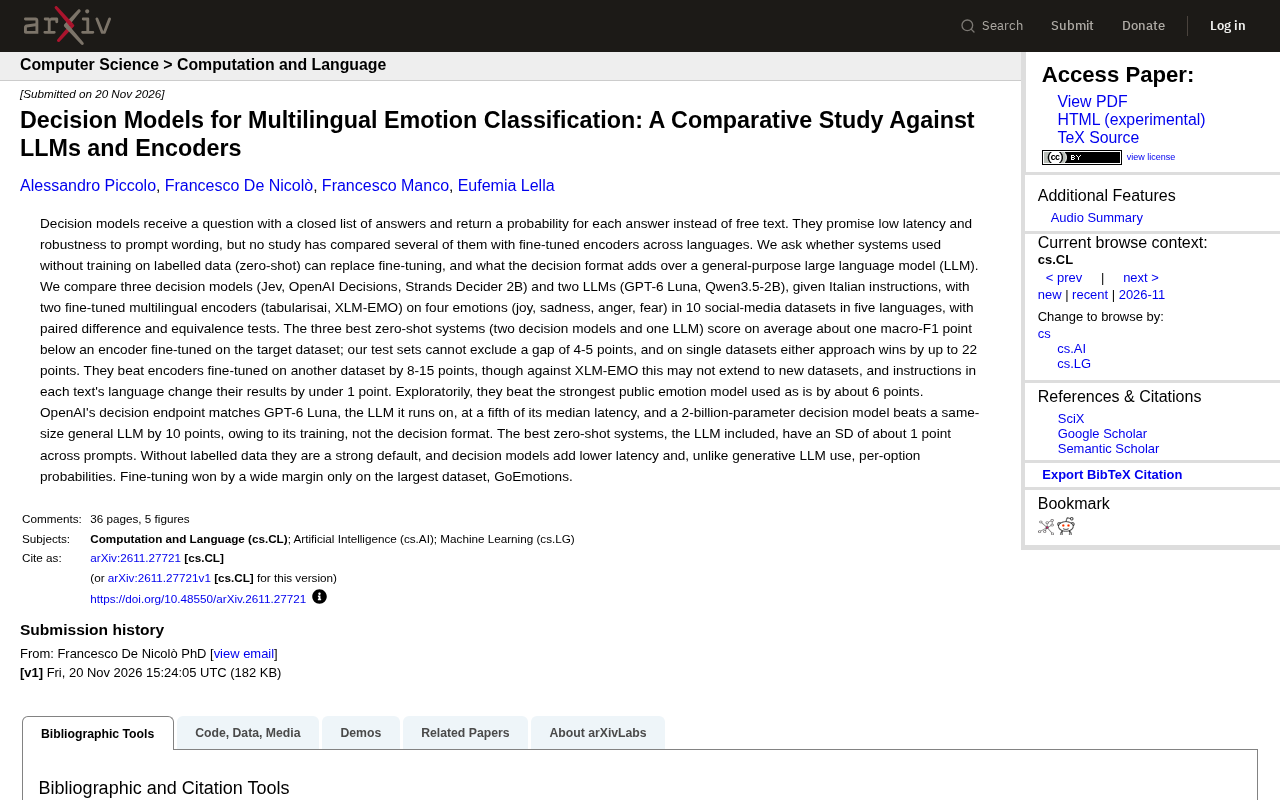
Multilingual sentiment comparison: zero-shot decision models trail fine-tuned encoders by ~1 macro-F1 point, winning on latency and probability output.
A systematic multilingual sentiment classification study compares three decision models, two LLMs, and two fine-tuned encoders across five languages, ten social media datasets, and four emotions. Best zero-shot systems average only ~1 macro-F1 point below target-domain fine-tuned encoders, though a 4-5 point gap can't be ruled out and per-dataset leads reach 22 points; cross-dataset zero-shot gains 8-15 points. Decision format value lies in latency—OpenAI's endpoint matches GPT-6 Luna at one-fifth median latency—and per-option probabilities, not accuracy. Fine-tuning wins clearly only on GoEmotions.
When Sentiment Classification Stops Generating Text: Where Decision Models Fit
Sentiment classification is undergoing a subtle paradigm split. The traditional approach is to fine-tune an encoder model, or to have a large language model generate a sentiment label directly; Decision Models take a third path—they receive a closed list of candidate answers and output a probability for each option, rather than freely generating text.
A systematic comparative study on multilingual sentiment classification puts all three approaches on the same test bench for the first time: three decision models (Jev, OpenAI Decisions, Strands Decider 2B), two large language models (GPT-6 Luna, Qwen3.5-2B), and two fine-tuned multilingual encoders (tabularisai, XLM-EMO). The task covers four emotions—joy, sadness, anger, and fear—with data from ten social media datasets in five languages, and the evaluation uses paired difference tests and equivalence tests.
The study's core questions are twofold: can zero-shot systems that rely on no labeled data replace fine-tuning? And what does the decision output format add beyond a general-purpose LLM?
The True Level of Zero-Shot Systems: About 1 Macro-F1 Point Behind
The most direct conclusion: the three best-performing zero-shot systems (two decision models plus one LLM) average only about 1 macro-F1 point below encoders fine-tuned on the target dataset.
But this "nearly tied" result needs careful interpretation. The study explicitly notes that, limited by the test sets, a gap of 4 to 5 points cannot be ruled out; and on individual datasets, each approach's lead can reach as much as 22 points. In other words, the near-equal average masks dramatic dataset-level variation—in some scenarios zero-shot systems have a clear advantage, while in others fine-tuned encoders lead by a wide margin.
The real gap emerges in cross-dataset generalization. Zero-shot systems outperform encoders fine-tuned on a different dataset by 8 to 15 points. However, the study also cautions that for XLM-EMO this advantage may not extend to new datasets, so it should not be treated as a universal rule.
One finding with direct practical significance: instruction language has little effect. Switching instructions to the language of each text changes results by less than 1 point—meaning deployment does not require separate instruction templates for each language.
Macro-F1 is a commonly used aggregate metric in classification tasks: first compute F1 (the harmonic mean of precision and recall) for each class separately, then take the arithmetic mean across classes. Unlike micro-averaging or accuracy, macro-F1 treats every class equally, so the performance of minority classes carries the same weight in the total score. In tasks like sentiment classification where class distributions may be imbalanced, macro-F1 reflects degradation on weaker classes more sensitively. The "about 1 macro-F1 point lower" mentioned in the article refers to 1 percentage point on a 100-point scale, but since macro-F1 variance is heavily influenced by the number of classes and small-sample classes, a single-point difference may not be statistically significant—which also explains why the study uses paired difference tests and equivalence tests, and emphasizes that test-set limitations may mask a true gap of 4 to 5 points.
The Value of the Decision Format: Latency and Probability, Not Accuracy
Decision models are often expected to deliver accuracy gains, but the data give a more nuanced answer.
OpenAI's decision endpoint scores comparably to the GPT-6 Luna running underneath it, while its median latency is only one-fifth of the latter's. This shows that the main benefit of the decision format is on the efficiency side: the same judgment quality, with faster responses.
Another comparison is even more telling: a 2-billion-parameter decision model scores 10 points higher than a general-purpose LLM of the same size. The researchers attribute this gap to how that model was trained, not to the decision format itself. In other words, the small model's performance comes from training; the format is merely the carrier.
What makes the decision format truly irreplaceable is its output shape: unlike generative LLMs, it directly provides a probability for each option. For scenarios that need confidence scores, downstream threshold judgments, or risk grading, this structured output eliminates the hassle of parsing and calibrating free text.
In terms of stability, the best-performing zero-shot systems (including the LLMs) have a standard deviation of about 1 point across different prompts, keeping sensitivity to wording within a controllable range—largely consistent with the decision models' claim of being "robust to prompt wording."
Decision Models have an interface fundamentally different from traditional generative calls: the caller provides a closed set of candidate labels in the request, and the model produces no free text but instead returns a normalized probability or score for each candidate. This "restricted classification head"-style output brings two engineering benefits. First, parsing cost drops to zero—when a generative model returns text like "I think this text expresses joy," the downstream still needs string matching, error correction, and confidence calibration; decision output is directly a numeric value usable as a threshold. Second, decoding cost is reduced—no autoregressive token-by-token generation is needed; a single forward pass yields the distribution over all options, so median latency drops significantly. Note that probability calibratability still depends on the model's training objective; high confidence does not equal high accuracy, and downstream risk grading should first check the calibration curve on a validation set.
When Fine-Tuning Is Still Necessary
The study does not sentence fine-tuning to death, but it delineates its zone of advantage: only on the largest dataset, GoEmotions, does fine-tuning win by a clear margin.
This points to a pragmatic deployment logic. In scenarios lacking labeled data, zero-shot systems are a strong default choice—their average gap to target-domain fine-tuned encoders is only about 1 point, yet they completely skip data labeling and training costs. When task data is large enough and domain features are concentrated enough, fine-tuned encoders can still establish a clear advantage.
As an exploratory comparison, the study also finds that these zero-shot systems score about 6 points higher than the strongest publicly available sentiment models used directly, further supporting their competitiveness as out-of-the-box solutions.
GoEmotions is a multi-label emotion dataset released by Google in 2020, derived from Reddit comments. The original annotations contain 27 fine-grained emotions plus a neutral class, and after merging and simplification it is often used as a single-label or grouped emotion classification benchmark. Its characteristics are large scale, concentrated domain (English social media colloquial text), and relatively controllable annotation noise. For fine-tuned encoders, this "sufficient data volume, concentrated distribution" condition is precisely their zone of advantage: encoders can fully adjust decision boundaries on the target distribution, while zero-shot systems can only rely on general semantics learned during pretraining. This also explains why the study observes a clear fine-tuning win only on GoEmotions—when other datasets are smaller or more domain-diverse, the overfitting risk and labeling cost of fine-tuning offset its potential gains.
Selection Recommendations
Compressing the above findings into actionable judgments:
- No labeled data, need fast deployment: prioritize zero-shot decision models or LLMs; average performance is about 1 point behind fine-tuned encoders, with no training required.
- Latency-sensitive: a decision endpoint can compress median latency to one-fifth that of an LLM on the same base, suitable for high-concurrency sentiment discrimination services.
- Need per-class probabilities: the decision model's per-option probability output is naturally suited to confidence thresholds and risk grading, saving the parsing step.
- Sufficient data and concentrated task: on large-scale datasets, fine-tuned encoders still win by a clear margin.
- Cross-dataset transfer: zero-shot systems are 8 to 15 points higher than cross-dataset fine-tuned encoders, but this needs verification for specific encoders and should not be generalized.
The most memorable point from this study may be: the accuracy difference between decision models and LLMs often comes from the base model's training rather than the output format; what the decision format reliably delivers is latency and probability structure.
One-line Summary
A multilingual sentiment classification comparison shows zero-shot decision models average only about 1 macro-F1 point behind fine-tuned encoders, with their real advantage in latency and probability output.
Paragraph Summary
A systematic comparison of multilingual sentiment classification puts three approaches on the same test bench: three decision models, two LLMs, and two fine-tuned multilingual encoders, covering ten social media datasets in five languages and four emotions. The key finding: the best zero-shot systems average only about 1 macro-F1 point below target-domain fine-tuned encoders, but the test sets cannot rule out a 4-5 point gap, and on individual datasets the lead can reach 22 points; in cross-dataset scenarios zero-shot systems are instead 8-15 points higher. The value of the decision format is not accuracy—OpenAI's decision endpoint scores comparably to an LLM on the same base while its median latency is only one-fifth; a 2-billion-parameter decision model leads a same-size general model by 10 points, a gap stemming from training method rather than the format itself. Fine-tuning wins clearly only on the largest dataset, GoEmotions.
Related articles

Figma Workplace Scandal: Employee Sues CEO for Forcing Confrontation with Harasser
Figma and its CEO are sued by a current employee alleging sexual harassment and discrimination, and forcing the victim to confront her harasser. This article outlines the background, potential impact, and industry reflection.

Jensen Huang and Nvidia: Elite Privilege Behind the Revolving Door of Business and Politics
An opinion piece uses Jensen Huang's reappointment as Nvidia CEO to examine business-government ties and elite impunity, questioning free-market ideals and AI industry governance.
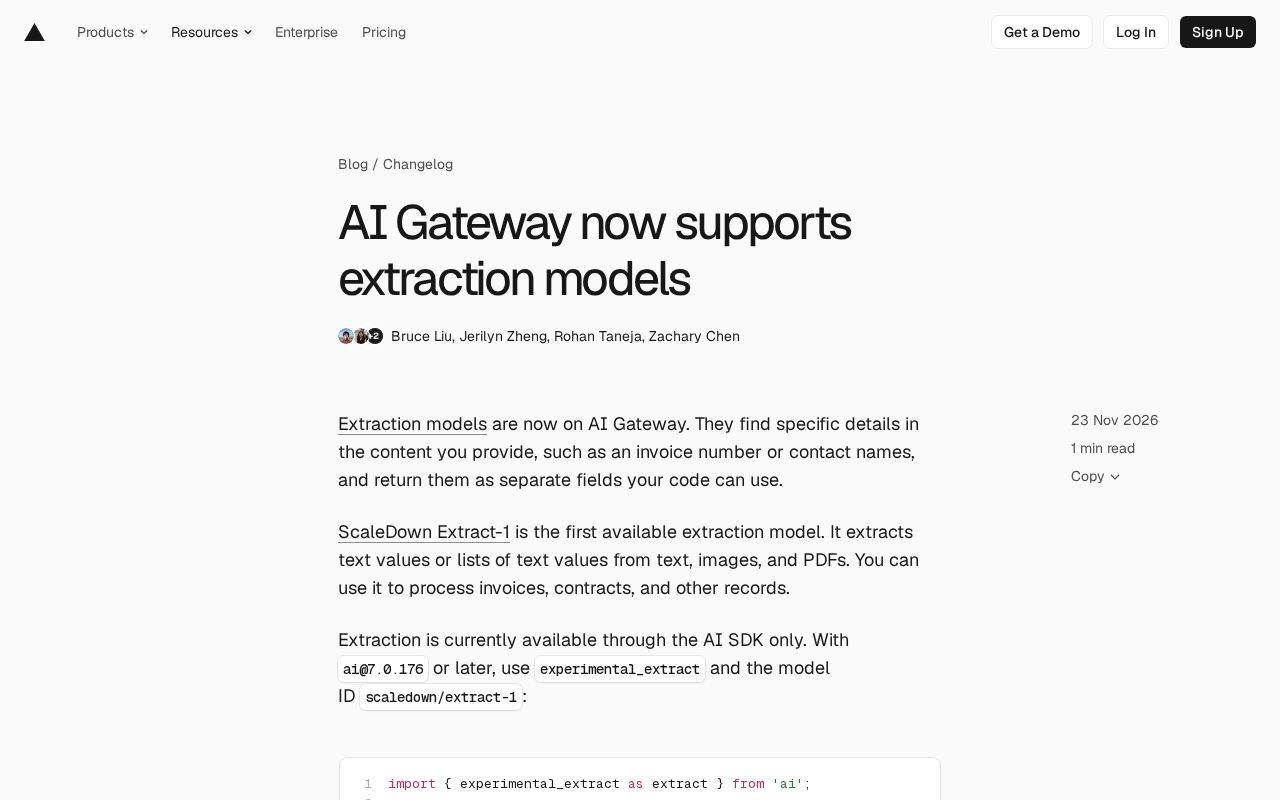
AI Gateway Launches Extraction Models: Precisely Pull Structured Fields from Invoices and Contracts
AI Gateway adds extraction models, debuting with ScaleDown Extract-1, which pulls fields like invoice numbers and contacts from text, images, and PDFs, returning confidence scores and character offsets via AI SDK's experimental_extract.