Decoding Agent Harness: AI Agent Architecture Through the Lens of the Claude Code Source Leak

The Claude Code source leak reveals Agent Harness architecture, offering a rare industrial-grade reference for building AI agents.
Agent Harness is an engineering architecture built around LLMs that combines scheduling, tool invocation, context management, and execution control — transforming models from isolated chat interfaces into reliable systems for complex tasks. In March 2024, an Anthropic engineer accidentally published source maps alongside the Claude Code NPM package, briefly exposing roughly 1,902 unobfuscated TypeScript source files (~500K lines). The article recommends using community-curated GitHub analysis repos to extract architectural insights top-down, rather than reading raw source code directly.
What Is Agent Harness (Harness Engineering)
Agent Harness is becoming one of the most frequently discussed architectural concepts in the LLM application space. Some believe this agent software architecture will gradually become the mainstream choice for enterprise AI applications — it no longer treats the large model as an isolated conversational interface, but instead builds an entire engineering system around the model for scheduling, tool invocation, context management, and execution control.
The word "harness" itself paints a vivid picture of its role: strapping a powerful but untamed large model into a controllable set of reins, allowing it to reliably complete complex, multi-step tasks with tool use and rollback capability. This is precisely the core challenge of agent engineering today.
The Claude Code Source Code Leak: A Recap
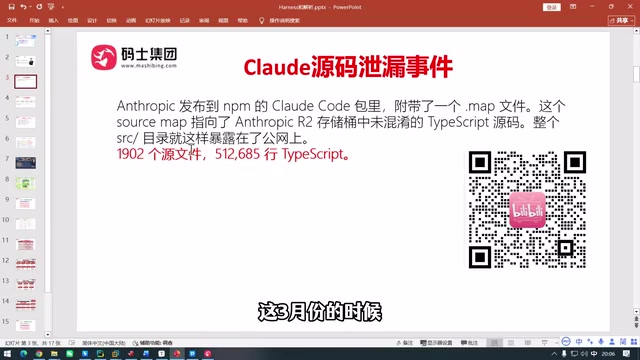
Any discussion of Agent Harness inevitably leads back to the Claude Code source code leak. According to a breakdown by a Bilibili content creator, the incident occurred in March: an Anthropic engineer published the Claude Code package to NPM along with a source map file. That mapping file pointed to unobfuscated TypeScript source code stored in an Anthropic R2 storage bucket.
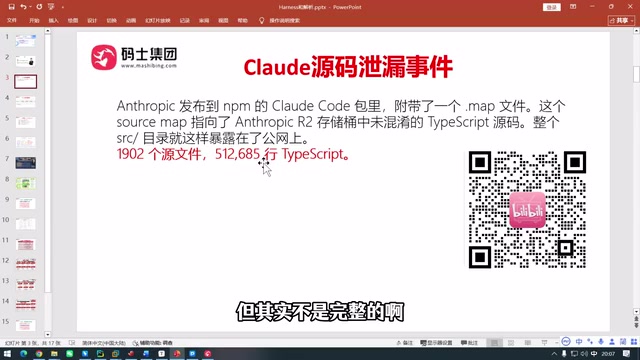
As a result, this source code was briefly exposed on the public internet. The leak reportedly involved approximately 1,902 source files totaling around 500,000 lines of code (the original phrasing cited "510,000 lines"). It's worth emphasizing that this was not Claude Code's complete codebase — only a core portion of it. The incident itself is old news, but it gave the outside world a rare opportunity to glimpse how a top-tier AI company actually implements agent engineering in practice.
Why This Leak Matters
For most developers, reading hundreds of thousands of lines of unorganized source code isn't practical. What's truly valuable is the architectural patterns that can be distilled from it: the core mechanisms, the engineering highlights, and how these design choices serve a reliable coding agent. This is precisely what Harness Engineering aims to document and preserve.
The Technical Mechanics Behind Source Maps and Source Code Exposure
A source map is a debugging artifact from frontend engineering (typically with a .map extension) that records the mapping between compiled or minified code and the original source. Under normal circumstances, JavaScript packages published to NPM are bundled and compressed, making the logic unreadable to outsiders. But if a source map is published alongside the package and contains URLs pointing to the original source, anyone can follow those links to find the unobfuscated source files. The key in this incident: Anthropic's engineer failed to strip the source map before publishing, and the mapped paths pointed to a publicly accessible Cloudflare R2 object storage bucket — leaving the original TypeScript source briefly visible before it was discovered and downloaded. This type of mistake is not uncommon in frontend engineering; the root cause is typically the absence of a review step for sensitive build artifacts in the release pipeline.
How to Efficiently Read Through This Source Code
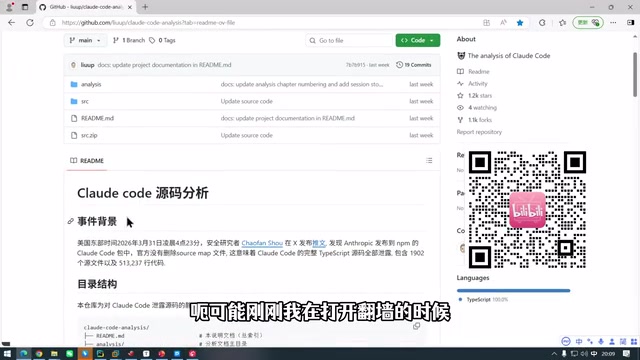
Rather than grinding through the source code line by line, a more practical approach is to leverage community-curated analysis resources. The original author recommends a GitHub project that has gone through nearly the entirety of the leaked Claude Code source and produced a systematic summary.
This repository is said to be organized by directory, focusing on two major areas: the agent's core mechanisms and its software architecture highlights. For anyone looking to understand the underlying principles of Agent Harness, these secondary resources are far more accessible than the raw source — and make design intent much clearer.
Reading Recommendations
Start from the curated table of contents. Read the core mechanisms section first — understand how the agent manages context, orchestrates tool calls, and controls execution flow. Then move to the architectural highlights to understand how these mechanisms are organized into a cohesive system at the engineering level. This top-down approach is far more efficient than diving headfirst into 500,000 lines of code.
The Engineering Value of Agent Harness
The significance of Agent Harness lies in transforming "how to make LLMs do reliable work" from tribal knowledge into a reusable engineering paradigm. The scheduling layer, tool layer, context management layer, and execution control layer — built around the model — together form a complete agent runtime. Claude Code, as a mature coding agent product, provides an industrial-grade reference implementation of this paradigm through its leaked source.
For enterprises and developers, the value of understanding this architecture is clear: when building your own AI applications in the future, you can draw on the layered design of mature products rather than figuring everything out from scratch. This is also why Harness Engineering is regarded as one of the more cutting-edge technical directions in LLM application development today.
Each of the four layers in Agent Harness has a clear responsibility: the scheduling layer decides when to invoke which tool or sub-agent, typically corresponding to a Planner or Orchestrator role; the tool layer encapsulates external capabilities (such as code execution, file I/O, search, and API calls) and exposes them to the model through a unified interface; the context management layer handles information compression, history pruning, and memory retrieval for long-running tasks to avoid exceeding the model's context window; and the execution control layer handles error catching, retry strategies, interrupt recovery, and security sandboxing for reliability. Together, these four layers solve a fundamental problem: how to turn a language model that generates content in a single pass into a reliable workflow engine capable of continuously executing multi-step tasks and self-correcting when errors occur. Claude Code, as a coding agent, offers a rare industrial-grade reference for how these four layers are concretely implemented — and that's precisely what makes the source leak so noteworthy.
Conclusion
Agent Harness represents the evolution of LLM applications from "calling an API" to "engineering a real agent." The Claude Code source code leak, however accidental, provided a first-hand sample of this direction that the community can actually study. For readers who want to go deeper, start with the community-curated source analysis repository, focus on the core mechanisms and software architecture, and extract engineering lessons that can be transferred to your own work.
Related articles

Free Unlimited Claude Code Solution: Agnes AI + CC Switch Setup Guide
No paid subscription needed — pair the free AI platform Agnes AI with the open-source tool CC Switch to provide a backend for Claude Code, enabling unlimited free calls to text, image, and video models. This guide covers the full setup, test results, and usage boundaries.

A Complete Zero-Cost Guide to Getting Started with Claude Code for Beginners in China
A beginner's guide to Claude Code for users in China: two installation methods (command line and IDE plugin), full configuration steps for replacing the official API with the free domestic LongCat model, and a hands-on demo of building a small tool with natural language, plus tips.

When the NSA Gets Involved: The AI Supply Chain Crisis Behind Open-Source CVEs and API Key Hijacking
Multiple open-source projects disclosed severe CVEs in one day, PHP flaws alarmed the FBI, and Railway and OpenCode were breached with API keys stolen. This article breaks down the vulnerability window, AI-accelerated exploitation, and the AI supply chain crisis behind the API key black market, with a developer defense checklist.