Decoding the H-1B Visa Executive Order: What It Means for Tech Industry Talent Policy

A new H-1B visa executive order has sparked debate in the tech community, highlighting the high stakes of talent policy in the AI era.
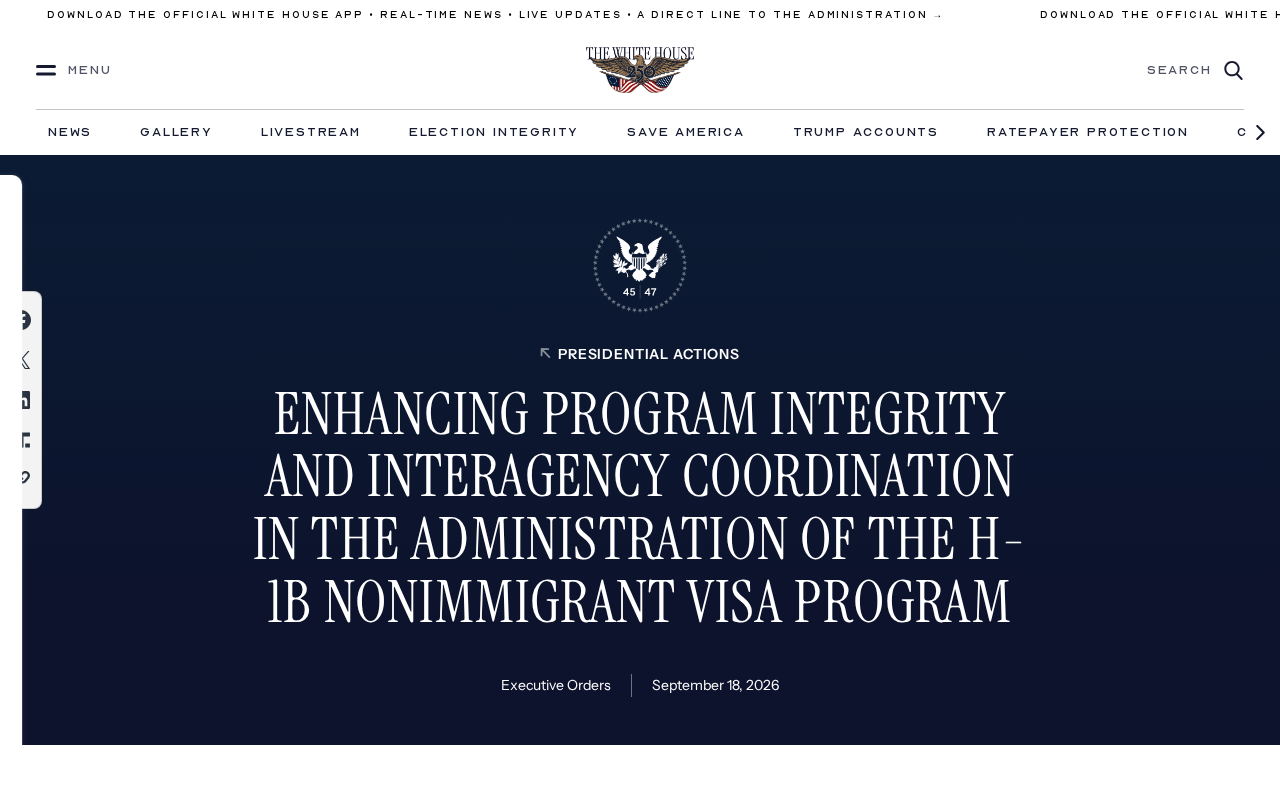
A recent executive order on H-1B nonimmigrant visa administration sparked discussion on Hacker News. As the primary channel for U.S. tech companies to hire top global talent, the H-1B system's strict annual caps and lottery process make any policy shift highly consequential for visa holders and employers alike. The article examines why the tech community is paying close attention: many engineers' careers and legal status depend directly on this visa, while policy uncertainty drives up hiring costs and complicates personal career planning. Against a backdrop of intensifying global AI talent competition, how the H-1B is managed has become a key indicator of U.S. tech policy direction. As the specific provisions of the order were not disclosed in the source material, readers are advised to consult official government publications and qualified legal counsel.
An Executive Order That Has the Tech Industry on Edge
A recent post on Hacker News about an executive order concerning H-1B nonimmigrant visa administration has drawn attention from the technical community. While the original post was modest in engagement (15 upvotes, 16 comments), H-1B visa policy has long been a highly sensitive issue for tech workers, startups, and major technology companies alike.
The H-1B visa is a temporary work visa category the U.S. offers to foreign workers with specialized skills. It has historically served as the primary pipeline through which Silicon Valley and tech companies across the country recruit overseas engineers, data scientists, and researchers. Any administrative change to how this visa is managed can set off a chain reaction affecting the talent landscape and hiring strategies across the tech industry.
Why the Tech Community Cares So Much
For a community like Hacker News — dominated by engineers and founders — H-1B isn't an abstract policy debate. It's deeply personal. A large number of technical professionals working in the U.S. depend on this visa to maintain legal status, while companies rely on it to fill skill gaps that domestic talent pipelines struggle to meet.
Direct Impact on Talent Supply
Tech companies — particularly in fields like AI, cloud computing, and semiconductors where demand for top-tier talent is intense — frequently face a domestic supply shortage. The application threshold, approval speed, and annual cap for H-1B visas directly determine whether these companies can successfully hire the specialists they need. Any tightening or loosening at the executive level immediately shows up in hiring timelines and labor costs.
The annual statutory cap for H-1B visas is 65,000 slots, with an additional 20,000 reserved for applicants who hold a master's degree or higher from a U.S. institution. Because applications have chronically exceeded the cap, U.S. Citizenship and Immigration Services (USCIS) has used a computerized random lottery system since 2005 to determine eligibility, with acceptance rates sometimes falling below 30%. This means that even fully qualified applicants and their employers may be shut out simply due to lottery results. H-1B holders can typically work in the U.S. for up to six years (an initial three-year period, renewable once). Those seeking permanent residency (a green card) must go through a separate immigration process, which can involve decades-long backlogs — especially for applicants from India and China.
The Anxiety of Policy Uncertainty
Frequent shifts in visa policy are themselves a form of cost. For visa holders, uncertainty means risk to their immigration status and career plans. For employers, it means difficulty making long-term workforce plans. This is precisely why even a brief mention of an executive order can spark discussion across the tech community.
What the Executive Order Might Address
Executive orders targeting H-1B visa administration typically operate across several dimensions: adjustments to the approval process, changes to priority evaluation criteria, stronger compliance requirements for employers, and tightened scrutiny of wage thresholds or the legitimacy of job roles.
Such administrative measures are often framed around goals like "strengthening oversight," "preventing abuse," or "protecting domestic jobs" — but their real-world effects vary widely depending on the specific provisions. Some changes may improve approval transparency and efficiency, while others may raise the bar for applications, extend processing times, and ultimately increase costs for both employers and applicants.
It's worth noting that because the original source did not include the specific text of the executive order, the analysis above is grounded in the general policy framework around H-1B visas. The actual impact should be assessed based on the complete official text once available.
An executive order is a legally binding directive issued by the U.S. President directly to federal agencies, bypassing the congressional legislative process. In the immigration space, administrations across party lines have invoked executive authority to adjust visa policy: the Obama administration used executive action to expand work authorization for certain applicant categories, while the Trump administration during its first term used executive orders and memoranda to significantly tighten H-1B approval standards, raise wage thresholds, and suspend certain visa categories. Because executive orders typically don't require congressional approval, they can take effect quickly — but can be just as quickly reversed by a new administration or halted by courts citing violations of the Administrative Procedure Act. This policy pendulum effect is a structural root cause of the ongoing uncertainty felt by businesses and workers alike.
The Deeper Stakes for AI and the Tech Industry
In an era of intensifying AI competition, talent is a decisive resource. The world's top machine learning researchers and algorithm engineers are highly concentrated, and a country's ability to attract and retain these individuals directly shapes the competitiveness of its tech sector.
As the primary institutional mechanism through which the U.S. absorbs global technical talent, how the H-1B visa is managed has become something of a policy bellwether for America's broader approach to technology. Tightening could push companies to relocate certain R&D roles offshore or lean more heavily on remote work arrangements; loosening would help the U.S. maintain its edge in the global talent competition.
For startups, the stakes are especially high. Compared to resource-rich tech giants, early-stage companies are at a disadvantage when navigating increasingly complex visa processes. Policy uncertainty can indirectly dampen the vitality of the innovation ecosystem.
Global AI talent is currently in extremely short supply, with demand from industry far outpacing the available pool of top machine learning researchers. Research from McKinsey, Stanford HAI, and other institutions shows that foreign-born or immigrant researchers make up an extraordinarily high share of the workforce at leading U.S. AI labs and tech companies — exceeding 50% in some fields. Meanwhile, countries including Canada, the United Kingdom, and Germany have rolled out "fast-track" immigration pathways specifically targeting high-skilled tech talent, actively positioning themselves to absorb professionals unsettled by U.S. visa policy. This makes the loosening or tightening of H-1B policy more than a domestic labor market question — it's directly embedded in the global AI competition. Restricting entry pathways, in a very real sense, risks ceding talent to competitors.
A Measured Approach to Policy Changes
When news like this surfaces, tech workers and companies alike are best served by staying grounded. The actual impact of an executive order requires a holistic reading of the full text, subsequent implementation rules, and potential legal challenges. Historically, many visa-related executive actions have undergone revisions, litigation, and even temporary injunctions before taking full effect.
For individuals, staying informed through official channels and consulting a qualified immigration attorney is the most prudent response to policy shifts. For companies, building a diversified talent acquisition strategy and reducing dependence on any single visa pathway is the key to long-term resilience.
Given the limited information available in the original source material, readers are strongly encouraged to consult the official text of the executive order as published by the U.S. government, along with authoritative legal analysis. This article is intended to provide only a background analytical framework.
Related articles

Free Unlimited Claude Code Solution: Agnes AI + CC Switch Setup Guide
No paid subscription needed — pair the free AI platform Agnes AI with the open-source tool CC Switch to provide a backend for Claude Code, enabling unlimited free calls to text, image, and video models. This guide covers the full setup, test results, and usage boundaries.

A Complete Zero-Cost Guide to Getting Started with Claude Code for Beginners in China
A beginner's guide to Claude Code for users in China: two installation methods (command line and IDE plugin), full configuration steps for replacing the official API with the free domestic LongCat model, and a hands-on demo of building a small tool with natural language, plus tips.

When the NSA Gets Involved: The AI Supply Chain Crisis Behind Open-Source CVEs and API Key Hijacking
Multiple open-source projects disclosed severe CVEs in one day, PHP flaws alarmed the FBI, and Railway and OpenCode were breached with API keys stolen. This article breaks down the vulnerability window, AI-accelerated exploitation, and the AI supply chain crisis behind the API key black market, with a developer defense checklist.