Deconstructing a Scalable AI Agent Automation System Architecture
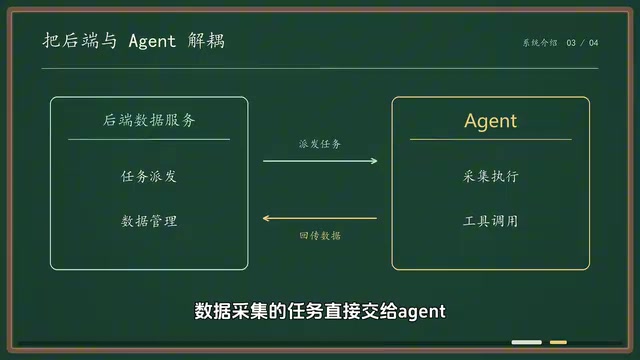
Delegate collection to the Agent, keep the backend focused on dispatch and data—this open-source system demonstrates a decoupled Agent automation architecture.
The article introduces an open-source AI learning system by a Bilibili creator. The core idea is to separate the Agent from the backend data service: the backend only handles task dispatch and data management, while volatile logic like data collection is executed by the Agent, achieving greater scalability. The demo flow: connect an Agent and configure the DeepSeek model, dispatch a Bilibili video collection task via template, the Agent loads download Skills and calls APIs to complete collection, and data is stored for the learning system to read and digest. The author emphasizes collection is for personal learning only, and notes that the "backend dispatch + Agent execution + data return" skeleton can be reused in workflow automation and other scenarios. The project is open source and suitable as an entry-level reference for Agent application development.
Why Separate the Agent from the Backend?
When many developers build automation systems, their first instinct is to cram collection, processing, and display all into one big program. A Bilibili creator took this route initially when sharing his AI learning system, but quickly found that "implementing everything inside the system lacks scalability." So he made a key decision: separate the Agent from the backend data service.
The results after separation were so good that he himself remarked, "It's really so convenient." The backend is responsible for just two things—dispatching tasks and managing data; the dirty work of data collection is handed directly to the Agent. The direct benefit of this separation of responsibilities: when you want to add features to the Agent, you can extend it at any time without touching a single line of backend code.
The architectural approach worth borrowing here is that it separates "what changes" from "what doesn't." Data management and task scheduling are relatively stable parts, while collection logic and external API integration are high-frequency change areas. Delegating the latter to a pluggable execution unit like the Agent extends the system's overall lifecycle significantly.
How the System Runs: From Connecting an Agent to Dispatching Tasks
The entire workflow starts with connecting an Agent. The creator demonstrated using the server's built-in Agent: after deploying the program, select the working path and Agent program directory, then configure the AI model. He used a model provided by OpenDesign (DeepSeekAd); after configuration, he tested the connection—status showed normal, and real-time running logs were visible below.
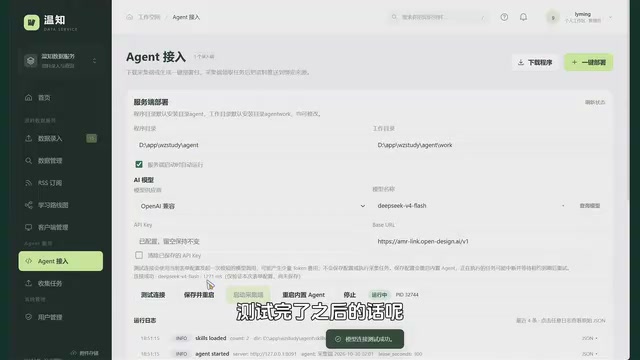
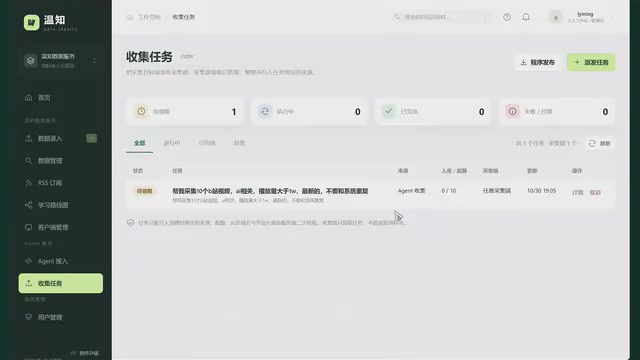
Once the Agent is connected, the server defines a data format and task dispatching can begin. The demo scenario was collecting the latest Bilibili videos related to AI with over 10,000 views; the system has ready-made templates for one-click dispatch. The creator specifically mentioned that the collection uses an open-source framework, "which is more legit," but still advised against casual scraping—it's for learning demonstration purposes only.
After tasks are dispatched, the Agent loads video-download-related skills, calls the appropriate APIs to query data, then performs downloads. During this process, the Agent's built-in functions, MCP, Skill, and other capabilities can be extended in a targeted way based on task type—this is exactly the flexibility that decoupling enables.
MCP (Model Context Protocol) is an open protocol that establishes standardized connections between AI models and external tools and data sources. Proposed by Anthropic in late 2024, its core idea is to abstract "what the model can call" into a unified Server interface; the model side simply sends requests according to the protocol to access resources like file systems, databases, and third-party APIs. For Agent systems, MCP's value lies in decoupling: when adding a new external capability, you only need to deploy the corresponding MCP Server, and the Agent side can discover and call it without code changes—highly consistent with the article's architecture of "backend dispatches tasks, Agent extends flexibly."
Skill in the Agent context usually refers to a reusable capability unit that encapsulates a specific domain's operational workflow, sitting between "a single tool function" and "a complete sub-Agent." A Skill often includes several API calls, parameter validation, and result processing logic. The Agent dynamically loads the corresponding Skill based on task type, avoiding stuffing all capabilities into the system prompt. The article's mention of "loading video-download-related skills" is exactly this mechanism: when a collection task needs download capability, the download Skill is mounted; after the task ends, it can be unmounted—saving context and enabling on-demand extension.
After Data Lands: Collection Is Just a Means, Learning Is the Goal
After the Agent finishes collecting, data enters the system's data management module. In the demo, the creator opens task details to see which skills the task loaded and which APIs it called; the final video data appears in the list.
He emphasized a usage boundary: the purpose of collecting this data "is for learning, not for doing other things"—just to see the latest video content that matches his taste, then read and digest it directly through the learning system. This positioning is quite clear-headed—automated collection can easily slide into gray areas, and clarifying the purpose keeps the tool within reasonable bounds.
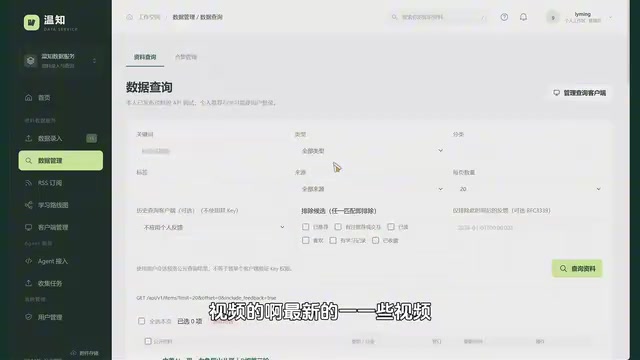
From a product experience perspective, this system strings "collection—management—learning" into a closed loop. Users don't need to jump between multiple tools; the Agent runs tasks in the background and results appear directly in the learning interface. This integrated experience can't be pieced together from small scripts.
Bilibili video data collection typically follows two technical paths: one is calling Bilibili's open platform or third-party wrapped open-source APIs to query video metadata (title, view count, publish time, etc.); the other is obtaining playback URLs through video parsing interfaces and downloading media files. The "open-source framework" mentioned in the article mostly refers to the latter—collection libraries that encapsulate request signing, pagination, and deduplication logic. Note that Bilibili's user agreement has explicit restrictions on automated scraping; view counts, comments, and other data are platform assets, and high-frequency requests can trigger risk controls or even legal risks. Therefore, the original article emphasizes "for learning demonstration only"; in practice, control request frequency, respect the robots protocol, and limit data usage to personal learning.
The Reusability of This Pattern: Beyond Data Collection
After practicing, the creator made a noteworthy discovery: this Agent integration pattern "isn't just for data collection." He plans to build an electronic workflow (workflow) in the system and have the Agent automate its execution—that's the next direction.
In other words, the skeleton of "backend dispatches tasks + Agent executes + data flows back" can be reused in any scenario requiring "automated execution + result management." Data collection is just the first use case; workflow automation is the second. For developers looking to get started with Agent application development, this path of "get one pipeline working first, then replicate horizontally" is far more pragmatic than designing a grand, all-encompassing framework from the start.
The project itself is open source; the creator provided the source code link at the end of the video and welcomes downloads. If you're looking for an entry-level reference for an Agent automation system, this deconstruction approach and runnable code are a better starting point than purely theoretical articles.
A Few Practical Suggestions
Based on the demonstration of this system, several points worth noting for implementation can be distilled. For model integration, leave room for testing and logging—the creator made connection status and running logs visible during the demo, which greatly lowers troubleshooting costs when issues arise. Task templates can significantly lower the barrier to use; turn common collection needs into templates so users can dispatch with one click. Plan the extensibility of Skills and MCP in advance; don't wait until requirements arrive to refactor. Set clear purposes and boundaries for collection behavior to prevent tool misuse.
The barrier to Agent application development is dropping rapidly, but what truly sets people apart is the judgment of system boundaries—what to delegate to the Agent and what to keep in the backend. This system provides a clear answer.
Related articles

AI Comic Drama with WorkBuddy from Scratch: A Step-by-Step Skill Pack Installation Guide
Learn how to create AI comic dramas with WorkBuddy from scratch. This guide covers installation, Skill pack import and invocation, plus a script generation demo with manual revision tips to get you through the first step from script to storyboard.

WorkBuddy Agent Runs the Entire GEO Database Mining Pipeline with a Single Prompt
WorkBuddy agent automates GEO database mining: from data search and curation to batch correction, differential analysis, co-expression networks, feature gene screening, and immune infiltration—a single prompt generates a complete bioinformatics report, greatly lowering the barrier to bioinformatics analysis.

PC Memory Wasted? Hacker News Debates Centralized Data Centers
Hacker News users argue that personal computer memory is wasted and should be centralized in data centers, sparking debate on centralized vs. distributed computing resource allocation. This article analyzes the logic behind the claim, the costs of centralization, and new tensions in memory resource allocation in the AI era.