Deconstructing Claude Code's Architecture: An Advanced AI Agent Development Guide for Frontend Engineers
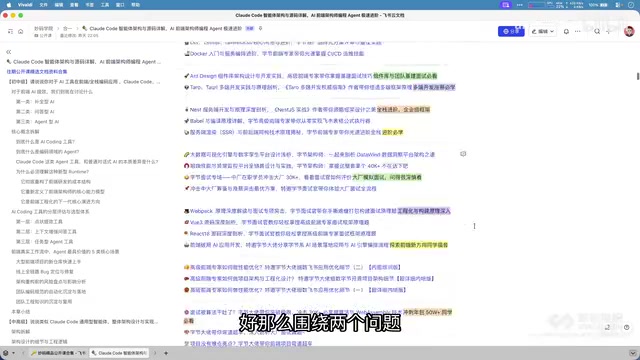
Deconstruct Claude Code's four core modules and build a minimal coding agent with TypeScript.
This article breaks down a general-purpose coding agent's four core modules — Agent Loop, Tool system, Skills parser, and Memory — based on a public lecture analyzing Claude Code's architecture. Structured as a three-stage interview framework (awareness → architecture → build from scratch), it walks through a TypeScript minimal Claude Code demo and argues that "AI productivity + AI Agent development" are the two most valuable learning tracks for frontend and full-stack engineers today.
For frontend and full-stack engineers, understanding the internal mechanics of a general-purpose Coding Agent is shifting from a "nice-to-have" to a "must-have." This article is based on a public lecture on Bilibili that breaks down the Claude Code agent architecture and source code, outlining the four core modules of a coding agent and the complete implementation pipeline for a minimal Claude Code you can build from scratch.
Why Frontend Engineers Need to Master Coding Agents
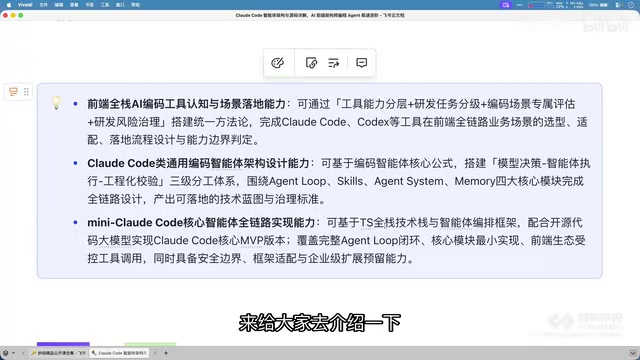
The course opens with a candid observation: when asked about AI in a frontend interview, most people are completely lost. The instructor's direction is clear — over the next two years, there are only two learning priorities: AI-powered productivity and AI Agent development.
AI-powered productivity means getting fluent with tools like Codex and Claude Code — using them so effectively they can "work for you around the clock." AI Agent development is the more advanced skill, covering workflow-based agents, general-purpose agents, and domain-specific agents built for vertical industries. As for the flood of buzzwords online — prompt engineering, Context Engineering, Vibe Coding, Spec Coding — the course advises setting them aside for now and staying focused on these two core tracks instead of getting distracted by concept anxiety.
The course also offers a sobering industry observation: the window for pure frontend roles is narrowing. Either frontend engineers leverage Node.js / TypeScript to pivot toward full-stack and AI, or backend engineers use AI Coding to fill the frontend gap. The instructor's view: frontend engineers transitioning to full-stack lack server-side architecture experience, while backend engineers tackling complex UI interactions tend to struggle — "what you get out of these tools ultimately depends on who's using them."
Three-Stage Interview Framework: From Awareness to Implementation
The course is structured around three progressively harder interview questions — a useful framework for self-assessment.
Junior to Mid-Level: Tool Awareness
At this level, interviewers ask: "What's your take on AI tools for frontend/full-stack development?" This tests your understanding of tools like Codex and Claude Code in real-world scenarios — it's a conceptual check.
Mid to Senior Level: Architecture and Implementation
One level up, the question becomes: "Walk me through the overall design and implementation of a general-purpose agent like Claude Code" — specifically, how the Agent Loop, Skills, and multi-agent collaboration work. Some interviewers reframe this as: "Have you ever designed Skills or MCP for your team to improve productivity?"
Expert Level: Build One from Scratch
The hardest tier: "If you were tasked with building a general-purpose agent like Claude Code, where would you start?" At this stage, it's not about knowing Claude Code's source code — it's whether you have hands-on experience building general-purpose agents in real-world projects, whether you can articulate an implementation approach, and whether you can ship a core functional version.
The Four Core Modules of a Coding Agent
The course identifies four key modules that make up a general-purpose coding agent, all implementable in TypeScript:
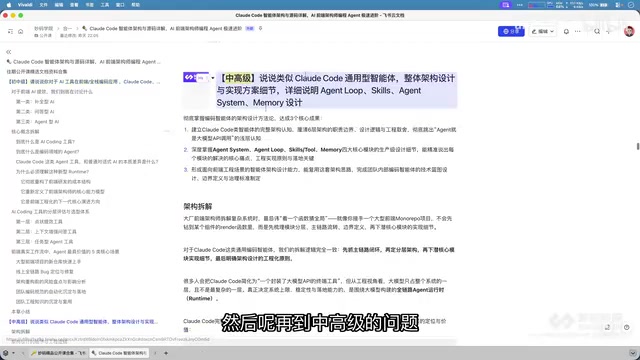
- Agent Loop: The central nervous system of the agent. After receiving a user prompt, the model decides which tools to call, executes them, feeds the results back into the model, and repeats — until the task is complete.
- Tool System: The model can't directly interact with the file system. Every read, write, and directory listing must go through Tool Calls. This is the heart of any minimal tool system.
- Skills Parser: Handles parsing and managing the agent's available skills, enabling modular capability expansion.
- Memory Module: A file-based memory system broken into multiple tiers — session memory (short-term), project-level memory, team and user memory, and system memory.
The model provider layer is pluggable. The demo uses a locally deployed Qwen3 small model (~9B parameters) served via Ollama. For enterprise development, the instructor recommends larger models like Qwen3-Plus, GLM, or MiniMax to ensure stable tool calling and JSON parsing.
The Agent Loop maps academically to the ReAct (Reasoning + Acting) framework: each round, the model first reasons (Thought), then decides on an action (Action), receives the observation returned by the tool (Observation), and enters the next reasoning round — until the model determines the task is complete and outputs a final answer. This "Think → Act → Observe → Think again" loop is the shared skeleton of all major Coding Agents — Devin, Cursor Agent, and Claude Code included. Understanding this explains why a seemingly simple instruction can trigger a dozen tool calls: the model needs multiple feedback rounds to progressively close the information gap, rather than acquiring all context at once.
MCP (Model Context Protocol) is an open protocol introduced by Anthropic to standardize the interface between models and external tools/data sources. The Skills parser is closely tied to MCP: an MCP Server can wrap capabilities like the file system, databases, and browsers into standard interfaces, which the agent dynamically discovers and registers via an MCP Client — no hardcoding required for each tool's invocation method. This is the engineering foundation for "modular capability expansion."
The Minimal Implementation Pipeline
The course demonstrates a minimal Claude Code project written from scratch, implementing only the core essentials. After launching with npm run dev, it enters an interactive chat session.
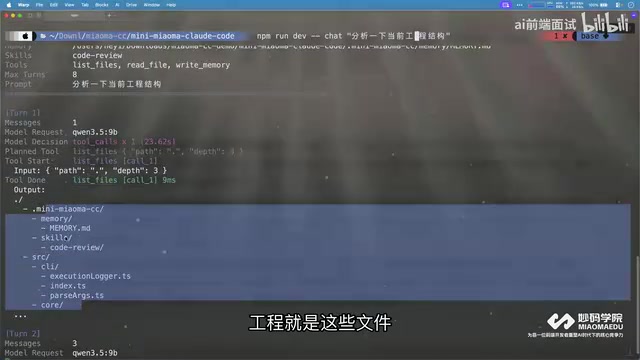
Using "analyze the current project structure" as the example prompt, here's how the full pipeline runs:
- Receive the prompt: The agent receives the "analyze current project" request.
- Enter the Agent Loop: The model determines which tools are needed. In the first round, it triggers
list filesto enumerate all files in the current directory. - Read file contents: The model continues calling tools to read basic information from each file.
- Summarize and output: A summary is generated. If the instruction includes "record the findings," the agent also attempts to write the output to a document.
The demo also exposes the limitations of small models — the 9B model occasionally fails to parse parameters, returns unstable data, or throws errors when writing to documents. The instructor acknowledges this is expected behavior; switching the prompt or using a larger model resolves it. This neatly illustrates the tool system's dependency on model capability: the robustness of the Agent Loop depends heavily on whether the underlying model can reliably output structured tool calls.
Function Calling (Tool Call) is the key mechanism that allows large language models to drive external operations. When the model returns not plain text, but a structured JSON payload containing a function name and parameters, the host program (the Agent Loop) parses that JSON and executes the corresponding function locally — such as reading or writing a file — then appends the result as a new message to the conversation context and passes it back to the model. This is why JSON parsing stability directly determines agent robustness: smaller models (like 9B) are more prone to truncated output or missing fields, causing tool calls to fail. For enterprise use cases, it's recommended to use models specifically alignment-trained for Function Calling, or to add retry logic and format validation at the Agent Loop layer.
Practical Advice for Frontend Engineers
Boiled down to one sentence: first get fluent with the tools, then understand the architecture, then build a minimal version yourself. The four modules — Agent Loop, Tool, Skills, Memory — are a universal map for understanding any coding agent, and TypeScript is entirely capable of carrying this implementation, making it especially accessible for frontend and full-stack developers.
Faced with the daily flood of AI information, the antidote to anxiety is steady progress along two tracks: AI-powered productivity and AI Agent development. Once you understand the internal mechanics of tools like Claude Code, you'll have far more confidence — whether in interviews or real-world project delivery.
Related articles

LynnReal-Omni: 32B Unified Video Diffusion Model Goes Open Source with Multi-Task Coverage in Four Steps
LynnReal-Omni is a 32B unified video diffusion model on MiniMax H3, covering text-to-video, pose guidance, style transfer, restoration in 4 steps. Flash version generates 540p video in 377ms on one H100.

Anthropic Co-Founder: AI 'Kill Switch' May Need to Be Mandatory by Law
Anthropic's co-founder tells the BBC that AI 'kill switches' may need to be legally mandated. We analyze the industry logic, technical challenges, and the tension between regulation and innovation.

The AI Data Center Boom Is Colliding With Cities Scarred by Heavy Industry
The AI data center boom is clashing with post-industrial communities. Philadelphia's case reveals structural conflicts between AI growth, energy use, water, and environmental justice.