Deconstructing Core Java Interview Skills: Teaching AI to Work and Catching AI's Mistakes
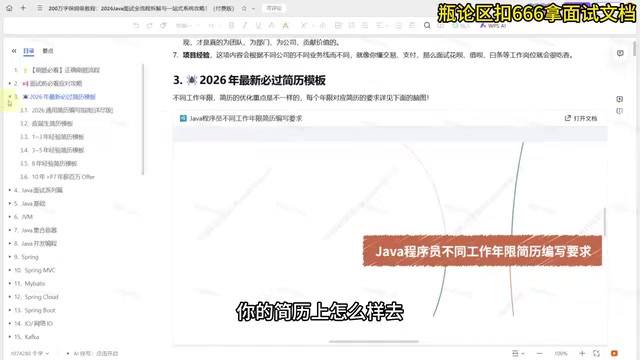
AI-era Java interviews demand two skills: teaching AI to work and catching its mistakes.
This article analyzes how Java interviews have evolved in the AI era around two core capabilities: driving LLMs to complete development tasks and leveraging deep Java fundamentals to validate AI outputs. It covers resume optimization with LLM experience, source-code-level Java mastery, RAG and prompt engineering knowledge, project highlight extraction, and building technical breadth and depth for top-tier company interviews.
What Has Actually Changed in Java Interviews After AI Went Mainstream
As AI technology fully permeates the development landscape, many Java programmers feel lost when job hunting. In the past, memorizing standard interview questions and doing some basic resume polishing was enough to land interviews—but that playbook clearly no longer works. Today, Java (including AI-oriented) positions evaluate candidates along two core capability dimensions.
The first is the ability to "teach AI to work"—meaning whether you can proficiently drive large language models to complete development tasks. The second is the ability to "catch AI's mistakes"—the Java ecosystem expertise and project delivery skills that have always been emphasized. While these two points may seem simple, they precisely capture what enterprises truly need from developers today: AI can boost efficiency, but ultimately, humans are still responsible for code quality and system stability.
In other words, AI hasn't replaced Java engineers—it has raised the bar. You need to know how to use AI AND be able to catch the errors AI makes.
Resume Optimization: The First Hurdle to Landing Interviews
Regardless of how technology evolves, your resume remains the critical key to securing interview opportunities. With large language models being so hot right now, how to appropriately incorporate LLM-related content into your resume has become an important differentiator.
The key here isn't simply piling on vague descriptions like "familiar with ChatGPT" or "understand large models." Instead, you need to demonstrate how you've applied AI capabilities in real business scenarios through your actual projects. For example:
- Have you used RAG to optimize retrieval scenarios?
- Have you integrated LLMs for intelligent customer service or content generation?
- Have you worked with prompt engineering and conversation memory management?
For different job directions, you should prepare different resume templates with different emphases. A compelling resume essentially condenses and presents your "two core capabilities" to the interviewer in advance.
Java Ecosystem Skills: The Absolute Foundation of Interviews
If AI capability is a bonus, then solid Java ecosystem skills remain the unshakeable foundation—the confidence behind "catching AI's mistakes."
High-quality interview preparation doesn't simply provide answers when covering the Java ecosystem; instead, it combines source code analysis, diagrams, and real-world scenario questions for deep understanding. Take Redis as an example: you might present a practical case of Pipeline batch processing and compare its performance against non-pipeline approaches. Redis Pipeline is a client-side optimization mechanism for batch command sending—in normal mode, the client must wait for the server's response after each command before sending the next one, requiring N network round-trips (RTTs) for N commands. Pipeline allows the client to batch-send multiple commands at once, reducing N RTTs to 1, achieving performance improvements of several times or even tens of times in high-concurrency scenarios. Going deeper into Redis source code written in C, you can explain how eviction strategies like LFU (Least Frequently Used) and LRU (Least Recently Used) solve real-world problems. Notably, Redis's LRU implementation isn't the textbook strict linked-list approach but uses an approximate LRU algorithm (random sampling + eviction pool), achieving an engineering balance between performance and accuracy.
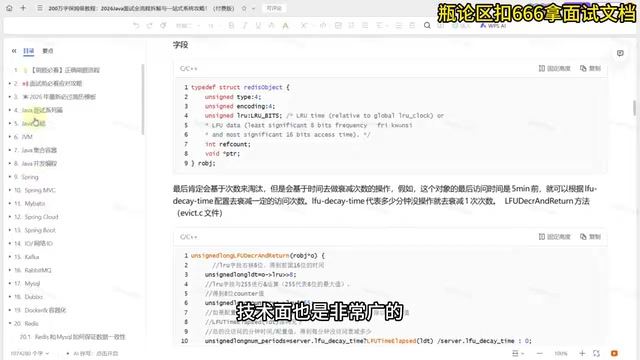
This three-part learning approach of "case study + source code + comparison" is exactly the depth required in today's Java interviews. Interviewers are no longer satisfied with candidates who can merely recite concepts—they want to see whether you truly understand the underlying principles and can make correct trade-offs in practice. This directly corresponds to the judgment needed to catch AI's mistakes—when AI-generated code has hidden issues, only engineers with deep foundational knowledge can identify and fix them.
LLM Deep Dive: From RAG to Prompt Engineering
For in-depth AI position evaluations, simply "knowing how to call an API" is far from sufficient. LLM interview assessments cover the complete knowledge chain from underlying algorithms to the application layer.
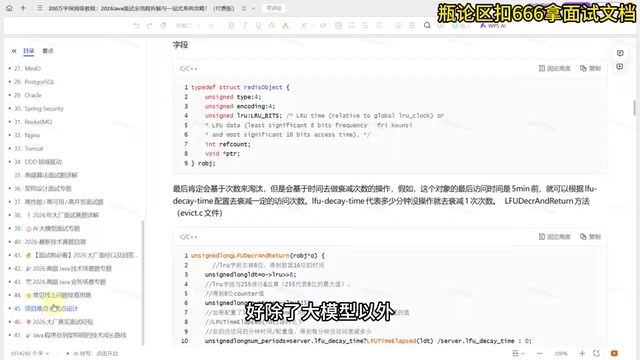
This includes both deeper content (such as algorithm principles) and practical directions that engineers encounter more frequently:
-
RAG (Retrieval-Augmented Generation): How to build knowledge bases and optimize retrieval precision. The core idea of RAG is to retrieve relevant document fragments from external knowledge bases (such as vector databases like Milvus or Pinecone) before the model generates an answer, then inject these fragments as context into the Prompt to guide the model to generate answers based on real data. This approach effectively mitigates the LLM "hallucination" problem (where models fabricate non-existent information) while enabling models to access the latest data beyond their training cutoff date. In Java engineering practice, RAG typically involves document chunking strategy design, embedding vectorization (using OpenAI Embedding or open-source models like BGE), vector similarity retrieval, and Prompt context assembly—placing high demands on engineers' system design capabilities.
-
Conversation Memory Management: How to maintain context consistency across multi-turn conversations. Large language models are inherently stateless—each request is independent, and the model doesn't automatically "remember" previous conversation content. Therefore, engineers need to implement context management mechanisms at the application layer, passing historical conversation records as part of the Prompt to the model. However, due to model token limits (such as GPT-4's 128K context window), when conversation turns become too numerous, strategies like sliding windows, summary compression, and key information extraction must be employed to manage context length. In Java backend implementations, this typically involves session state storage (Redis/database), conversation history trimming algorithms, and long-term memory retrieval combined with vector databases.
-
Prompt Engineering: How to design efficient, stable Prompts that improve model output quality. Prompt engineering isn't simply about "writing a paragraph for AI to understand"—it involves role definition (System Prompt), task decomposition, output format constraints (such as requiring JSON output), few-shot example provision, Chain-of-Thought guidance, and many other strategies. In enterprise applications, excellent Prompt design can significantly reduce output uncertainty and minimize post-processing costs. For Java engineers, prompt engineering often needs to be deeply integrated with code logic—for example, dynamically assembling Prompt templates, injecting variables based on business context, and designing Prompt version management and A/B testing mechanisms.
These topics collectively form the deep knowledge reserves Java engineers need for AI positions. The market's demand for Java+AI hybrid talent essentially hopes that developers can both use Java's engineering capabilities to truly deliver AI applications and understand LLM operating mechanisms to make reasonable architectural decisions.
Project Challenges and Highlights: A Must-Ask in Every Interview
Project experience is the part of Java interviews that will inevitably be probed. Interviewers will almost certainly ask: "What were the challenges and highlights of your project? How did you solve them?"
For this high-frequency question, you need to extract challenges and highlights tailored to different project types. Whether it's banking credit systems, MES manufacturing execution systems, OA office systems, insurance, or e-commerce projects, each has its own typical technical challenges and optimization opportunities. Taking MES as an example, MES (Manufacturing Execution System) is middleware connecting the enterprise's upper-layer ERP planning system with lower-layer industrial equipment control systems, managing the entire process from production order release to product completion. Typical challenges MES projects present to Java engineers include: industrial protocol integration (such as OPC UA), real-time data collection and high-throughput processing, flexible configuration engine design for complex process routes, and fault-tolerant system architecture under high-reliability requirements. Only by mastering extraction methods can you know how to optimize your project descriptions and present ordinary CRUD work with technical substance.
The core of extracting project highlights is upgrading "what I did" to "what difficult problems I solved and what value I delivered."
Technical Breadth and Depth: The Key to Breaking Into Top Companies
Resume, ecosystem skills, and LLM capabilities—these three are sufficient for most interviews. But if you want to further target top-tier companies and achieve salary growth through job changes, technical breadth and depth must be elevated simultaneously.
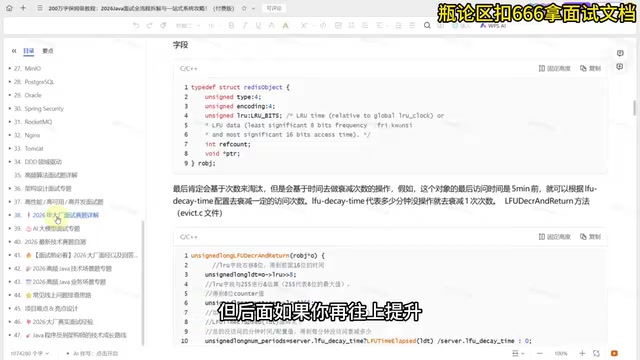
A practical approach is to create knowledge mind maps for each technology stack. For example, for message middleware like Kafka or microservice architectures, draw out a complete knowledge map, then check which areas are weak and which content hasn't been mastered, enabling targeted improvement. Taking Kafka as an example, its knowledge graph should cover: producer partition strategies and message acknowledgment mechanisms (acks configuration), Broker replica synchronization mechanisms (ISR) and log storage structure (Segment), consumer Rebalance strategies and Offset management, and how to guarantee Exactly-Once Semantics in actual business scenarios. This structured review approach is far more efficient than blindly grinding through practice problems.
Finally, validate your level with real interview questions from top companies. These questions, drawn from real interview experiences and current evaluation trends at major companies, help job seekers objectively assess whether they meet market requirements.
Final Thoughts
Today's Java interviews are essentially a comprehensive contest around two core capabilities: "teaching AI to work" and "catching AI's mistakes." AI hasn't made Java engineers obsolete—it has redefined what makes an excellent engineer: you need both the sensitivity to embrace new technology and the judgment that comes from solid foundational knowledge.
For developers currently preparing to switch jobs or job hunting, rather than feeling anxious, it's better to systematically fill in these four puzzle pieces:
- Resume Optimization: Highlight AI practical experience and core Java capabilities
- Java Ecosystem Skills: Source-code-level understanding with the judgment to catch AI's mistakes
- LLM Capabilities: Master core skills like RAG and prompt engineering
- Project Experience: Extract challenges and highlights to demonstrate problem-solving depth
With technical breadth and depth as your advancement ladder, you'll be able to stand out in the AI-era job market.
Related articles

Uber Deploys ChatGPT Work Company-Wide: AI in the Workplace Enters the Scaled Implementation Phase
Uber deploys ChatGPT Work to 30,000+ employees, extending it from engineering to all roles. We analyze its expert-engineer pairing, end-to-end automation, and questions of AI control and power concentration—insights for scaling AI in the workplace.

Shift at Midnight Hands-On: When "ID Verification" Becomes Alien Hunting
Shift at Midnight blends ID verification with horror survival in a four-player co-op game. We break down its inspection mechanics and chaotic humor.

Zelensky Recounts the Outbreak of War: I Need Ammunition, Not a Ride
Zelensky recalls the first day of war in a YouTube interview: farewell to family, rejecting Biden's evacuation offer with "I need ammunition, not a ride," and how Bucha shaped his stance on compromise and peace talks.