Deep Analysis of Cursor Pay-Per-Use Plugins: The Truth and Risks Behind a 75%-Off "Legit" Solution

Analyzing Cursor pay-per-use plugins: how account pool arbitrage works and the compliance, security, and financial risks involved.
This article provides an in-depth analysis of a Cursor "refill" plugin claiming 75% off official Pro accounts via pay-per-use billing. It examines the product's core features — permanent balances, full model access, and transparent billing — then reveals the underlying account pool rotation mechanism. The analysis identifies three critical risks: ToS violations risking account bans, unverifiable data security claims, and prepaid balance loss if the service shuts down.
Introduction: Yet Another Cursor "Refill" Scheme
As Cursor becomes the AI programming tool of choice for an increasing number of developers, third-party "refill" plugins have proliferated around it. Cursor is an AI-native code editor developed by Anysphere, deeply customized on top of VS Code. It deeply integrates large language models (LLMs) into the editor's core workflow, supporting code completion, multi-file editing, natural language code generation, and more. Its Pro Plan is priced at $20 per month, offering usage quotas for frontier models like Claude and GPT-4. Due to the high-frequency nature of AI-assisted programming, heavy users' actual API call costs can far exceed the subscription fee — which has spawned market demand for various third-party "refill" (quota top-up) solutions.
Recently, a Cursor plugin promoted on Bilibili claims to offer "official Pro accounts at 75% off," featuring pay-per-use billing, permanently valid balances, no API relay proxying, and full model switching support. Compared to the common monthly or quarterly subscription-based account-swapping plugins on the market, it does propose some differentiated design in its billing model.
This article will objectively examine the product's claimed features and underlying operational logic, and provide a sober analysis from technical compliance and data security perspectives, helping readers assess the true value and potential risks of such Cursor pay-per-use tools.
Core Claimed Features
According to promotional content, this Cursor refill plugin differs from traditional solutions in several key ways.
Pay-Per-Use with Permanently Valid Balances
Traditional Cursor refill plugins mostly use time-limited packages like "monthly/quarterly passes," or provide temporary accounts valid for only a few days — unused quotas simply expire.
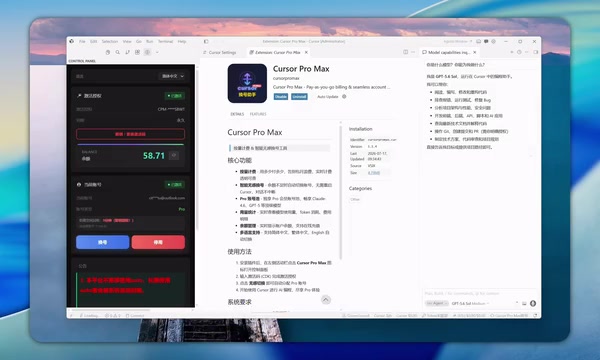
This product claims to use a pay-per-use model: each user is assigned a dedicated legitimate Pro Plan account, with balances that never expire until the quota is exhausted. Calculated at 75% off the official price, a 100 RMB top-up yields approximately 1000 RMB worth of official quota, which converts to roughly $137 in usable credits at a 7.3 exchange rate.
Pay-as-you-go is a standard billing model in cloud services, where users only pay for resources actually consumed. In AI model calling scenarios, the billing unit is typically the Token — the smallest semantic unit after text is segmented by a tokenizer. Taking Claude Sonnet as an example, its official API pricing is approximately $3 per million input tokens and $15 per million output tokens. Token unit prices vary dramatically across models, allowing users to choose models of different costs based on task complexity — cheap models for simple tasks, premium models for complex reasoning — to optimize overall spending.
Full Model Access Without Degradation
The product emphasizes it's "not a relay proxy" — meaning it doesn't route through an API proxy and doesn't tamper with frontend code. According to their demo, going into Cursor's settings page directly verifies the account as legitimate Pro status, with all officially supported models (including high-precision models like Claude Sonnet and Opus, as well as low-cost basic models) fully unlocked and freely switchable.

This is their key selling point — avoiding the common issues with relay proxy solutions such as "model degradation," "response lag," and "limited functionality."
So-called "relay" solutions refer to third-party service providers setting up proxy servers between users and the AI service provider, forwarding user requests to official APIs. This architecture has several known issues: first, increased latency as requests must pass through additional intermediate nodes; second, limited functionality since relays can typically only call standard API interfaces, unable to use Cursor's native Tab completion, multi-file context indexing (Codebase Indexing), and other deeply integrated features; third, the "degradation" phenomenon where some relay providers secretly replace premium model requests with cheaper models to save costs. The product's claimed "no relay" means users communicate directly with Cursor's official servers as Pro account holders, theoretically obtaining the complete native experience.
Transparent Consumption Records for Verification
The product has built an independent logging system where every consumption is recorded in detail: remaining balance, model used per request, official billing standard, output token count, consumption timestamp — all clearly visible, and they claim to support real-time reconciliation against Cursor's official records.

Operational Mechanism: Account Pools and Smart Rotation
The core technical logic of this Cursor pay-per-use plugin deserves in-depth analysis.
No Modification of Cursor's Native Code
The product claims the plugin retains only two functions: smart account rotation and consumption billing records, without modifying any of Cursor's native code. This means users still use the official native software and can theoretically update to the latest version at any time without waiting for plugin version compatibility.
The Economic Logic of Large-Scale Account Pools
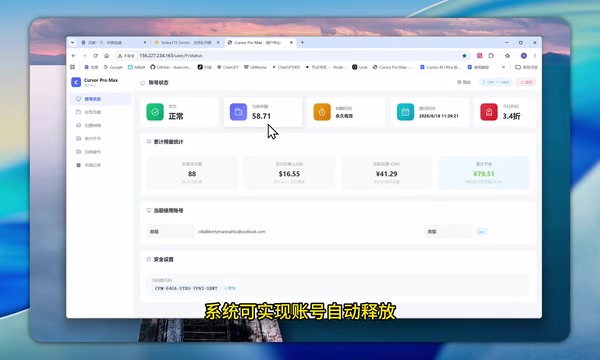
The product's cost advantage comes from bulk-purchased Cursor Pro account pools. Through a self-built smart quota management system, they achieve automatic account release and seamless switching:
- The system detects prolonged inactivity and automatically releases idle accounts back to the pool
- When the user resumes, a fresh Pro account is instantly matched and billing begins
- When the current account's quota is exhausted, the system automatically rotates to a new account
An account pool is a resource reuse architecture common in gray-market services, with principles similar to Connection Pool design. The service provider batch-registers or purchases large numbers of Pro accounts and dynamically assigns them to active users through a scheduling system. When users are inactive, their occupied accounts are reclaimed to the idle pool for other users. This time-division multiplexing mechanism means the number of simultaneously maintained online accounts is far fewer than total registered users, creating arbitrage opportunities. Its economic model resembles airlines' overbooking strategy — reducing unit costs based on the statistical assumption that not all users will be active simultaneously.
Essentially, this is an arbitrage model of "account reuse + bulk purchasing" — the per-unit cost of bulk purchasing is lower than individual subscriptions, and the product provider profits from the margin created by economies of scale.
Sober Analysis: Three Risks Behind the Low Price
Despite the attractive pitch, from a technical observation perspective, such Cursor account-sharing schemes have unavoidable problems.
Risk One: Questionable Account Compliance
Regardless of how much the marketing emphasizes "legitimate official Pro accounts," the practice of distributing accounts through third parties with multi-user rotational sharing fundamentally violates Cursor's Terms of Service (ToS). Cursor has risk control mechanisms for cross-location logins and abnormal usage patterns — risks of "machine code bans" and "account suspensions" always exist. The so-called "smart rotation" actually demonstrates that individual accounts cannot be used stably long-term.
Cursor's risk control system includes multi-dimensional detection: Hardware Fingerprinting identifies device uniqueness and prevents the same account from frequently switching between multiple devices; IP behavior analysis detects whether an account logs in from different geographic locations within short timeframes; usage pattern analysis examines whether request frequency, token consumption rate, and other metrics match normal individual usage patterns. Once risk control rules are triggered, consequences range from rate limiting and degradation to outright account bans and associated machine code lockouts. Devices with locked machine codes cannot use Cursor's Pro features even with different accounts — this constitutes direct harm to end users.
Risk Two: "No Relay" Claims Are Hard to Verify
The product repeatedly emphasizes "no relay, no tampering," but for ordinary users, these claims are difficult to independently verify. Since the plugin can achieve "account rotation" and "pay-per-use billing," it necessarily inserts some form of interception or proxy logic between the client and Cursor's servers. Whether users' code snippets and AI conversation content pass through third-party servers is a data security concern that cannot be easily ruled out.
In AI-assisted programming scenarios, context sent to models typically contains project source code, configuration files, API keys, and other highly sensitive information. Even if the plugin claims not to modify Cursor's native code, implementing account rotation functionality necessarily requires intervention at the authentication layer — whether modifying locally stored authentication tokens, hijacking OAuth callback flows, or intercepting authentication requests through a local proxy. All these operations mean third-party code gains control over the user's session. The deeper issue is: even if the current version genuinely doesn't collect data, whether future plugin updates will introduce data collection logic is completely unauditable by users. This fragility in the trust chain is the fundamental security challenge faced by all third-party plugins.
Risk Three: The Trust Cost of Prepaid Models
The promise of "permanently valid balances" depends entirely on the product provider's continued operational capability. Once the service provider disappears, or Cursor officially conducts mass bans on the account pool causing costs to skyrocket, users' prepaid balances become unrecoverable. Services in this gray area lack any third-party fund guarantees or refund mechanisms.
Conclusion: A Rational View of Cursor Cost-Saving Schemes
For developers with limited budgets who heavily use AI programming tools, such 75%-off Cursor pay-per-use solutions do hold appeal. The product's design around billing transparency and account rotation mechanisms shows some thoughtfulness.
However, it's essential to clearly recognize that: the cost of low prices is often a trade-off in compliance, stability, and data security. For personal learning and tech exploration, the risks may be within acceptable bounds; but for professional developers working on commercial projects or handling sensitive code, subscribing directly to Cursor's official Pro Plan is truly the worry-free and secure choice.
The value of technical tools must ultimately be built on a foundation of sustainability and trust. Before choosing any third-party Cursor refill solution, be sure to weigh the money saved against the potential hidden costs you might pay.
Related articles

Apple HomeView Hands-On Review: Is the $300 Smart Home Hub Worth It?
Apple HomeView hands-on: a $300 smart home hub with facial recognition for quick account switching, but no App Store or voice recognition. Is the wall-mounted version worth it? Should you buy the first generation?

Meta Muse Wonder Launch: What It Means for Meta's Return to the Frontier AI Race
Meta releases Muse Wonder and WonderFull, benchmarks reach the frontier, community feedback is polarized. An in-depth look at Meta's return to the frontier AI race, its personal agent strategy, and Zuckerberg's different path.

Apple Home Smart Home Lineup Leaked: LG and Schneider Team Up, UWB Door Lock on Board
Apple Home ecosystem gains new LG and Schneider devices: UWB smart lock with proximity unlock, 2.5K dual-camera doorbell, privacy indoor camera, and AirPods-like seamless pairing.