Deep Analysis of the Manchester Airport 80GB Data Breach and Defensive Takeaways

Manchester Airport's 80GB breach exposes critical gaps in post-perimeter data exfiltration defense.
The FulcrumSec ransomware group claims to have exfiltrated 80GB from Manchester Airports Group, highlighting how automated threats outpace human response. This analysis examines why perimeter defenses fail once credentials are compromised, and evaluates four key strategies — volume thresholds, destination allowlists, behavioral anomaly detection, and data classification with least privilege — for limiting blast radius in critical infrastructure environments.
Incident Overview: Manchester Airports Group Hit by 80GB Sensitive Data Breach
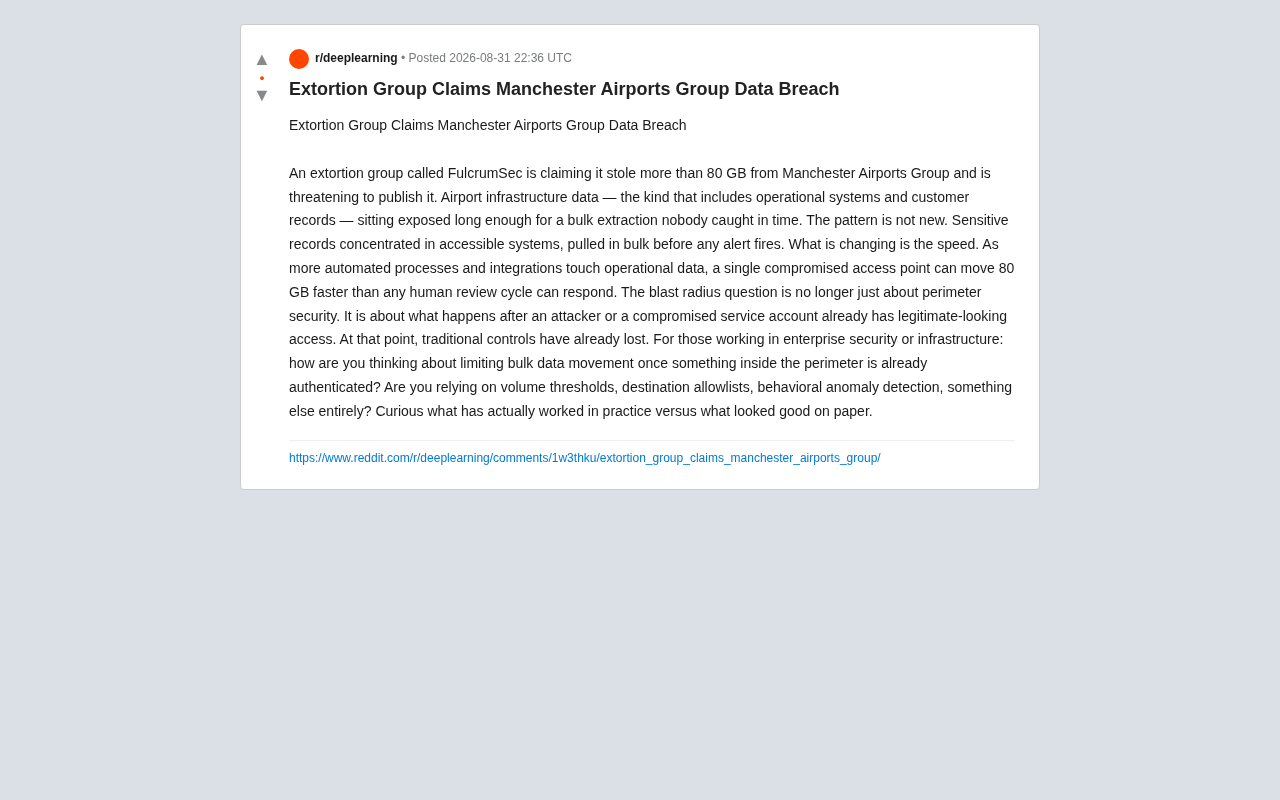
A ransomware group known as FulcrumSec recently claimed to have stolen over 80GB of data from Manchester Airports Group (MAG), threatening to publicly release it. According to the group, the stolen data involves airport infrastructure information — potentially including operational system data and customer records.
FulcrumSec is one of the rapidly proliferating ransomware groups in recent years. The current ransomware ecosystem has evolved from early "encryption-only" extortion to "double extortion" and even "triple extortion" models — attackers not only encrypt data but also exfiltrate it and threaten public release, and may even pressure victims' customers or partners. Under this model, even organizations with comprehensive backup and recovery capabilities still face compliance penalties and reputational damage from data leaks. The rise of Ransomware-as-a-Service (RaaS) platforms has further lowered the barrier to entry, enabling criminals with limited technical skills to launch sophisticated attacks.
As one of the UK's largest airport operators, MAG manages Manchester Airport, London Stansted Airport, and East Midlands Airport, handling over 60 million passengers annually. As Critical National Infrastructure (CNI), airport information systems encompass multiple highly sensitive subsystems including flight scheduling, baggage handling, Flight Information Display Systems (FIDS), security screening data, and border control interfaces. The deep interconnection between these systems means that a data breach in any single component could produce cascading effects.
Here's a telling detail: the attack pattern itself is nothing new — sensitive data stored centrally in accessible systems, bulk-extracted before any alerts fire. What's truly alarming is the speed and scale of the attack. The fact that 80GB of data could be fully exfiltrated without any human review intervention indicates a clear time gap in existing detection and response mechanisms. Modern enterprise networks typically have outbound bandwidth ranging from hundreds of Mbps to several Gbps, meaning 80GB of data could theoretically be transferred in just minutes. While Data Loss Prevention (DLP) systems can monitor outbound traffic, their detection capabilities are significantly diminished when facing encrypted channels (such as TLS/HTTPS), cloud storage synchronization, and legitimate API calls. Additionally, attackers frequently leverage "Living off the Land" techniques — using legitimate built-in system tools (such as PowerShell, WMI, cloud sync clients) for data transfer, making these activities virtually indistinguishable from normal operations in logs.
For critical infrastructure, the unique challenge of airport systems lies in the deep interweaving of operational data and customer privacy data. Once breached, the impact extends far beyond privacy compliance — it can reach into physical security and operational continuity.
Automated Threats Are Expanding the Blast Radius of Data Breaches
Data Exfiltration Speed Now Exceeds Human Response Cycles
This incident reveals an accelerating trend: as more automated processes and system integrations connect to operational data, the damage achievable from a single compromised access point has far surpassed the response capability of human review cycles.
In the past, attackers needed days or even weeks to gradually infiltrate and slowly exfiltrate data to evade detection. In highly integrated, automated environments, a single compromised service account can complete an 80GB bulk transfer in an extremely short time. By the time alerts finally trigger, the data has typically already left the organization's perimeter.
Zero Trust Challenges After Perimeter Defense Failure
Traditional security thinking has long focused on perimeter defense — firewalls, intrusion detection, and access control. But the core question raised by this incident is: what happens when an attacker or hijacked service account already possesses seemingly legitimate access credentials?
At that point, traditional perimeter controls have effectively failed. The attacker is no longer an "intruder" but an "internal accessor" holding valid credentials. The defensive focus must shift from "preventing entry" to "limiting the damage possible after entry." This is precisely the assumption that Zero Trust Architecture repeatedly emphasizes: always assume the perimeter has been breached.
Zero Trust Architecture was first proposed by Forrester Research in 2010, later widely popularized through Google's BeyondCorp project, and formally defined by the National Institute of Standards and Technology (NIST) in SP 800-207. Its core philosophy is "never trust, always verify" — every user, device, or service must undergo identity verification, authorization checks, and continuous evaluation each time it accesses a resource, regardless of its location in the network. Implementing Zero Trust requires the coordination of multiple technical capabilities including microsegmentation, continuous authentication, least-privilege access, and encrypted communications. However, in the critical infrastructure domain, numerous legacy systems don't support modern identity protocols, and the convergence of OT (Operational Technology) and IT systems introduces additional compatibility challenges, making full Zero Trust implementation a lengthy migration process.
Four Defensive Strategies: How to Restrict Bulk Data Movement After Internal Authorization
Once an entity has been authenticated inside the perimeter, how do you limit its ability to perform large-scale data exfiltration? Here are several common approaches, each with its own strengths and weaknesses.
Volume Thresholds
By setting data transfer caps within a given time window, transfers exceeding the threshold trigger alerts or are blocked. This approach is intuitive and easy to implement, but the difficulty lies in threshold calibration: too low causes frequent false positives that disrupt normal operations; too high may allow slow, persistent "low-and-slow" exfiltration to pass through. For airport systems that inherently require large-volume legitimate data processing, relying solely on thresholds is often inadequate.
On the technical implementation side, volume threshold controls are typically deployed through network traffic analysis tools (such as NetFlow/sFlow analyzers), DLP gateways, or CASB (Cloud Access Security Broker) solutions. Specific implementations include: setting data transfer quotas per user or service account within defined time periods (e.g., hourly or daily), triggering SIEM (Security Information and Event Management) alerts when quotas are exceeded, and automatically blocking network connections for severe overages. In airport environments, business scenarios like flight data pushes, passenger information exchanges, and baggage tracking systems inherently generate massive legitimate data flows, making baseline modeling and threshold calibration an ongoing operational challenge.
Destination Allowlists
Only permitting data to flow to pre-approved destinations. This works well in environments with clear structure and limited external integrations. However, modern systems have increasingly numerous external integrations, making allowlist maintenance costly and difficult to cover data exfiltration through legitimate channels (such as authorized cloud services).
Behavioral Anomaly Detection
Based on learned normal access patterns, this approach identifies behavior that deviates from the baseline — for example, a service account suddenly initiating large-scale reads during non-business hours. This is currently one of the more advanced approaches, but it relies on high-quality behavioral baselines and still faces sensitivity challenges when confronted with "low-speed, human-mimicking" attack techniques.
The core technology behind behavioral anomaly detection is UEBA (User and Entity Behavior Analytics). UEBA systems use machine learning algorithms to build multi-dimensional baseline models of historical behavior for users, devices, and service accounts, covering hundreds of feature dimensions including login times, access frequency, data read volumes, geolocation, and device fingerprints. When an entity's behavior significantly deviates from its historical baseline — for example, a service account that typically reads only small configuration files during business hours suddenly begins bulk downloading databases at 3 AM — the system calculates a risk score and triggers a tiered response. However, advanced attackers have learned "slow exfiltration" strategies, controlling data exfiltration rates within the noise range of normal business traffic, transmitting only small amounts of data at a time while mimicking normal access time patterns, thereby evading detection mechanisms based on statistical deviation.
Data Classification and Least Privilege
True defense in depth often requires returning to the fundamentals of data governance: is sensitive data overly centralized? Have service accounts been granted read permissions far beyond their actual needs? Classifying data, isolating it, and strictly enforcing the principle of least privilege can fundamentally shrink the "blast radius" when any single point is compromised.
Data Classification is the cornerstone of information security governance, typically categorizing data by sensitivity level into public, internal, confidential, and top secret, with each level corresponding to different storage encryption, access control, and transmission rules. In Europe, under GDPR (General Data Protection Regulation), passenger personal data (PII) in airport systems is strictly protected, with violations potentially resulting in fines of up to 4% of global annual revenue or €20 million, whichever is higher. The Principle of Least Privilege (PoLP) requires that each user or service be granted only the minimum level of permissions necessary to complete their specific tasks. In practice, this needs to be supported by Role-Based Access Control (RBAC), Attribute-Based Access Control (ABAC), and regular Access Reviews. A common pain point for many organizations is "privilege creep" — over time, accounts accumulate permissions far beyond their actual needs, and cleaning up these historical authorizations often involves complex business process dependency analysis.
Three Key Security Takeaways from the Manchester Airport Data Breach
Shifting from "Preventing Intrusion" to "Controlling Damage"
The Manchester Airport incident once again confirms: the security focus is shifting from "keeping attackers out" to "limiting what attackers can do once inside." This doesn't mean abandoning perimeter defense, but rather acknowledging that the perimeter will inevitably be breached at some point, and therefore defenses must be built under the assumption of compromise.
Detection Speed Must Match Data Movement Speed
When automation enables 80GB of data to be exfiltrated in minutes, relying on "after-the-fact manual review" is thoroughly obsolete. Real-time, automated detection and response capabilities are a critical gap that critical infrastructure must close. Specifically, this means organizations need to deploy SOAR (Security Orchestration, Automation and Response) platforms with automated orchestration and response capabilities, compressing the entire detection-analysis-response workflow from "hours" to "seconds." Meanwhile, NDR (Network Detection and Response) technology, through deep packet inspection and metadata analysis of full traffic, can identify anomalous transfer patterns and automatically trigger blocking policies before data leaves the network perimeter.
The Gap Between Paper Plans and Real-World Effectiveness Cannot Be Ignored
Which solutions actually work in practice, and which just look good on paper? Thresholds, allowlists, and behavioral analysis all look perfect in presentations, but in real, complex, highly integrated production environments, they typically require a combination of multiple approaches with continuous tuning — not reliance on any single "silver bullet." This reality also echoes the "continuous improvement" philosophy emphasized in the NIST Cybersecurity Framework (CSF) — security is not a one-time deployment project but rather requires continuous validation of defense system effectiveness through red team/blue team exercises, penetration testing, and incident post-mortems, with ongoing iterative optimization based on the evolving threat landscape.
Conclusion
Regardless of how much of FulcrumSec's claims are ultimately verified, this incident provides a sobering reminder to the entire industry: in an era where automation and system integration are increasingly embedded in operational cores, the threat of data breaches is no longer just about "who got in" — it's about "how much they can take and how fast" once inside. For guardians of critical infrastructure, reassessing the visibility and controllability of internal data flows may be more urgent than reinforcing the perimeter.
Related articles

Is the Agent Harness Dead? Cursor's Early Engineer Breaks Down the Real Architecture of AI Coding Agents
Cursor early engineer Jediah breaks down the real architecture of the agent harness: why "the harness is dead" is only half right, how the data flywheel lets the harness obsolete itself, and how Grokbot, software factories, and primitive design open new frontiers for agents.

Python Visitor Pattern and Better Alternatives Explained
A deep dive into Python's visitor pattern and four alternatives: method pattern, pattern matching, dictionary mapping, and functools.singledispatch. Choose the best decoupling design by change frequency.

357 Days of Deep Experience: Why Omarchy Made Me Stop Distro-Hopping
A 357-day deep dive into Omarchy: 59-second install, out-of-the-box audio and GPU support, the Quattro QuickShell rewrite migration pains, and why Arch users should try it.