Deep Dive into LangChain's Three Core Modules: A Complete Guide to Agent Architecture Thinking

Master LangChain's Chain, LangGraph, and Agent architecture thinking to build truly intelligent AI applications.
This article breaks down LangChain's three-module ecosystem — Chain for deterministic pipelines, LangGraph for reflective state-driven Agents, and autonomous planning that hands decision-making to the LLM. Through RAG and ReAct examples, it builds the architectural thinking that separates top AI engineers from the rest.
In interviews for large language model application development, one question consistently stands out as a true differentiator: How do you design an Agent architecture capable of autonomous reasoning and self-correction? If your answer is simply "write better prompts," then you're missing the most critical competitive edge in AI application development — architectural thinking.
This article is based on the LangChain tutorial series by Bilibili creator Roland (IT路上一起进步). We'll break down the subject from a foundational design perspective: how do top-tier engineers use architectural thinking to harness large language models? Mastering this mindset is far more valuable than memorizing any API.
LangChain Is More Than Just a Code Library
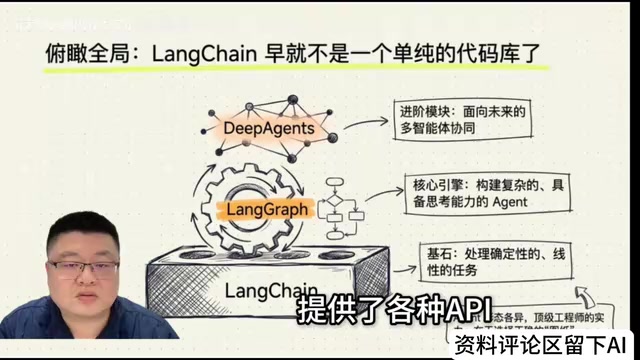
Many people still think of LangChain as "just a Python library," but it has long evolved into a full Agent ecosystem with three major modules:
- LangChain: The foundational layer, designed for deterministic, linear tasks;
- LangGraph: The next-generation core engine, built for constructing complex Agents with real reasoning capabilities;
- DeepAgent: An advanced module focused on multi-agent collaboration and deep application scenarios.
Why split something as conceptually simple as "building an Agent" into so many modules? The fundamental reason is that Agents come in many forms, and different forms demand different construction approaches. LangChain provides a wealth of APIs, but the design thinking behind those APIs is the truly scarce capability.
Layer One: Chain — Deterministic, Pipeline-Style Tasks
Core Idea: The Chain
The essence of the LangChain module can be distilled into a single word — Chain. Think of it like a factory assembly line: step one completes and hands off to step two, step two completes and hands off to step three, each link feeding the next in a single direction.
At the code level, LangChain introduces the elegant LCEL (LangChain Expression Language), which uses a single pipe operator | to connect tasks in sequence. This design philosophy draws directly from Unix/Linux pipe mechanics — as far back as 1973, Bell Labs' Unix system was already using cat file.txt | grep keyword | sort to chain independent programs via pipes. LCEL brings this idea into LLM application development, allowing components like Retriever, PromptTemplate, LLM, and OutputParser to snap together like LEGO bricks. Each component only needs to implement a unified Runnable interface, with native support for streaming, batch processing, and async calls. The underlying logic is crystal clear: the output of one component becomes precisely the input of the next, with data flowing in a single direction down the pipeline.
Implementing RAG with Chain
Take the popular RAG (Retrieval-Augmented Generation) pattern as an example. Implementing it with Chain is a standard four-step process:
- Receive the user's question;
- Use the question to retrieve the most relevant reference documents from a vector database;
- Assemble the reference documents and the question into a complete prompt;
- Send the complete prompt to the LLM to generate an answer.
RAG was formally introduced in 2020 by the Meta AI research team in the paper Retrieval-Augmented Generation for Knowledge-Intensive NLP Tasks. Its core motivation was to address the "hallucination" problem in large models — the knowledge stored in model parameters has a time cutoff and cannot cover private domain data. The technical approach: external documents are chunked, converted into vectors via an Embedding model, and stored in a vector database (such as Pinecone, Chroma, or Milvus). At query time, the user's question undergoes the same vectorization, and the most relevant document chunks are retrieved via cosine similarity, then injected into the prompt as context. This architecture upgrades "parametric memory" to "external memory" and is currently the most mainstream technical solution for enterprise knowledge base Q&A.
String these four steps together with LCEL and a basic RAG system is up and running. When you need to expand document sources, just add custom components to the chain.
The Core Limitation of Chain
Chain's strength is stability and predictability. Its weakness is equally apparent: there's no going back. If the documents retrieved in step two are irrelevant or incorrect, the LLM has no opportunity to correct course — it can only keep generating based on flawed inputs.
This fundamentally limits Chain to the role of a "pipeline worker" — it cannot become an Agent capable of independent reasoning.

Layer Two: LangGraph — Teaching an Agent to Reflect
Core Idea: The Graph
To give Agents the ability to reason and self-correct, LangGraph was born. Its core concept is the Graph — think of it as the familiar flowchart. Importantly, LangGraph uses a directed graph rather than the directed acyclic graph (DAG) used by traditional workflow tools like Apache Airflow. This distinction is critical. DAGs inherently prohibit cycles, but "reflect and retry" is fundamentally a loop — something simply impossible in a DAG architecture. LangGraph's graph structure draws inspiration from Automata Theory's finite state machine (FSM) concept, making Agent behavior formally verifiable in theory and allowing developers to intuitively describe complex business logic through visual flowcharts.
LangGraph provides three core concepts for this flowchart:
- State: The Agent's global memory, storing conversation history and all intermediate results;
- Node: Python functions that actually execute tasks — calling an LLM, performing a search, completing a specific action — with results written back to State;
- Edge: The routing logic, determining where the flow goes after a Node completes. Edges can statically point to the next node, or be designed as functions that take State as a parameter and dynamically determine the next node based on processing results.
Adding Reflection to RAG
With Graph, you can give RAG a "reflection" capability. After step four generates an answer, add a validation node: pass the user's question and the generated answer back to the LLM and ask, "Is this answer reliable?"
If the LLM determines the answer is off-target, an Edge routes the flow back to step two to retrieve again and regenerate. This is the classic ReAct (Reasoning + Acting) pattern. ReAct originated from a 2022 paper by Princeton University and Google, which found that models fall into error loops when executing actions without a reasoning chain, while pure chain-of-thought reasoning can't access real-time information. ReAct alternates between "Thought → Action → Observation" steps, forming a reflective loop. In LangGraph's implementation, these three steps map to different Nodes, with the loop termination condition controlled by conditional logic in the Edges — directly translating academic theory into executable engineering architecture.
With Graph, an Agent truly gains the ability to reflect, self-correct, and iterate.
Layer Three: Autonomous Planning — Handing Decision-Making to the LLM
From "Hardcoded Flows" to "Dynamic Construction"
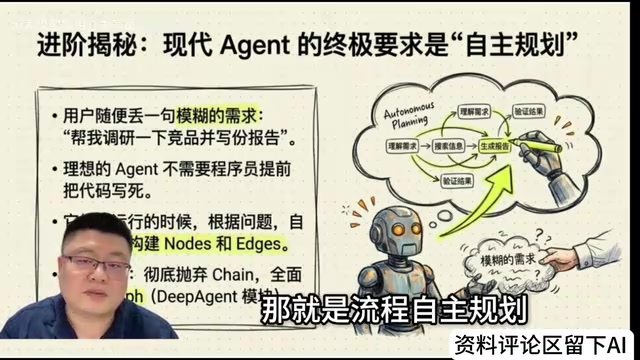
Modern Agents have one more advanced requirement: autonomous workflow planning.
In practice, a user might toss in a vague request like "help me research competitors and write a report," and the Agent must break down the task on its own: what to do first, what to do next, and how to aggregate the final result. In technical terms, this means letting the LLM dynamically construct Chains or Graphs at runtime based on the user's question, rather than having engineers hardcode the workflow logic upfront.
LangChain's Official Answer: Go All-In on Graph
When faced with the "Chain or Graph" question, LangChain's official stance is unambiguous: abandon Chain entirely and go all-in on Graph.
Dig deeper into LangChain and you'll find that both the DeepAgent module and the simpler Agent interfaces are all "drawing graphs" under the hood using LangGraph. What we call autonomous planning essentially comes down to: engineers prepare the State and Nodes in advance, then let the LLM dynamically construct the Edges based on the task — you tell the LLM "I need to accomplish this goal, help me fill in the Edge logic."
The Essence of Agent Products: LangChain's Philosophy Made Concrete
Look closely at the various Agent products on the market and they all follow the same fundamental pattern:
- The platform centrally maintains State (usually called "memory");
- It provides a toolbox of Nodes: local file operations, web retrieval, content summarization, and various Skills from open-source marketplaces;
- The middle layer — task decomposition, result aggregation, and other decision-making processes — is handled entirely by prompting the LLM with carefully crafted instructions.

This also explains a common phenomenon: the more rigorous an Agent is, the more Tokens it consumes — because the prompt engineering behind it becomes correspondingly more complex. Take GPT-4o as an example: each reflection-validation loop requires an additional LLM call, and combined with the accumulated historical context in State, the actual Token consumption for a single user request can be 5 to 20 times that of a simple Q&A exchange. This has driven two important engineering optimization strategies: first, a "short-circuit strategy" — setting a maximum retry count in the Edge logic to prevent infinite loops; second, a "tiered model approach" — using a smaller model (such as GPT-4o-mini) for validation nodes while reserving the full model for core generation nodes, striking a balance between cost and quality. Understanding Token economics is a prerequisite for moving Agents from the lab into production.
The Architectural Dividing Line
Returning to the original question, the difference between the two construction paths is now clear:
- Chain (unidirectional pipeline): Best for tasks with a fixed, known workflow — stable and predictable, but lacks self-correction capability;
- Graph (state-driven cyclic graph): Best for complex Agent scenarios where the workflow is uncertain and requires reflection and autonomous planning.
The evolution of modern Agents is fundamentally about progressively transferring human decision-making to the LLM. At the current stage, LLMs primarily take on the role of "autonomously abstracting business workflows" (i.e., dynamically constructing Edges), while building State and Nodes still relies on human effort or human-AI collaboration.
If in the future the construction of State and Nodes can also be automated by LLMs, then we're truly not far from the scenarios depicted in science fiction. Have you grasped this layer of Agent architectural thinking?
Key Takeaways
Related articles

Disaster and Glory of the Apollo Program: The History We Must Revisit Before Returning to the Moon
From the fatal Apollo 1 fire to Apollo 8's daring lunar orbit to Apollo 11's successful landing—revisiting the disasters, fears, and compromises of the Apollo program and their lessons for today's return to the Moon.
Netflix Trust Exercise Turns Into Firing Trap: Where Are the Boundaries of Corporate Trust?
A Netflix employee was fired after sharing private info in a trust exercise. We analyze the risks of corporate trust exercises and how employees can protect themselves.

AMD CDNA5 Architecture Deep Dive: Technical Evolution and the AI Computing Competition Landscape
Deep analysis of AMD's CDNA5 architecture covering Chiplet packaging upgrades, HBM memory evolution, and low-precision compute optimization, examining how AMD challenges NVIDIA's AI chip dominance.