Deep Dive into MCP: The Hidden Performance Traps Behind AI Agent Tool Calls

MCP standardizes AI Agent tool calls, but JSON-RPC overhead causes severe bottlenecks in high-concurrency scenarios.
MCP (Model Context Protocol) abstracts every AI Agent tool call as a JSON-RPC message, delivering standardization and security isolation. But in production, engineers found that hundreds of short-lived concurrent tasks make JSON-RPC serialization and per-execution connection handshakes stack into unbearable latency — freezing systems for 45 seconds in extreme cases. The debate pits security (SSE multiplexing for runtime isolation) against availability (if the system is down, isolation is meaningless). The team ultimately bypassed MCP to connect directly to the database, trading isolation for uptime — pointing toward hybrid architectures as a viable path forward.
What MCP Actually Is
MCP (Model Context Protocol) is a standard proposed by Anthropic to govern how AI Agents interact with external tools. According to the official specification, every tool call an Agent makes is essentially a JSON-RPC message sent to a standardized context server for processing. The core goal of this design is to allow different tools, data sources, and models to interoperate in a unified way — without reinventing the wheel for every integration.
Architecturally, MCP provides an abstraction layer: instead of touching database drivers or raw sockets directly, an Agent expresses its intent through protocol-wrapped messages. This standardization delivers composability and security isolation — but as real-world engineering practice reveals, it also introduces non-trivial overhead.
JSON-RPC (JSON Remote Procedure Call) is a lightweight remote procedure call protocol that encodes requests and responses in JSON format. Each call requires constructing a JSON object containing a method name, parameters, and a request ID; the server parses it, executes the operation, and returns a result. Compared to direct function calls or native socket communication, JSON-RPC has three unavoidable steps on every interaction: serialization, network transmission, and deserialization. In low-frequency call scenarios this is nearly imperceptible, but in millisecond-level, high-concurrency Agent task pipelines, these steps stack up into measurable latency. MCP chose JSON-RPC as its underlying communication format precisely for its language-agnostic nature, debuggability, and broad toolchain support — but this also means every tool call routed through MCP carries this serialization overhead.
Real-World Performance Bottlenecks
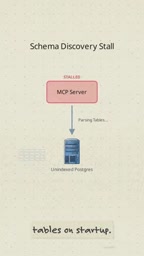
This material documents a set of problems that engineers encountered in production. One engineer reported that Claude completely froze for 45 seconds inside a schema discovery loop — because the MCP server was attempting to parse a massive, unindexed Postgres table on startup, dragging down the entire process.
The crux of the issue is the compounding effect of call patterns and protocol overhead. The team had hundreds of short-lived Agent tasks simultaneously hammering the same bottleneck. Each task had to go through a full JSON-RPC encode/decode cycle, and wrapping a database driver inside JSON-RPC adds latency on the critical path.

When high concurrency meets heavyweight protocol wrapping, the result is the runtime freezing under load. For Agent systems that require fast responses, this kind of stall is catastrophic.
The Tug-of-War Between Security Isolation and Performance
The other side of the debate laid out the rationale for the protocol's existence. Using SSE (Server-Sent Events) transport for multiplexing isolates the Agent runtime and limits raw socket exposure. In other words, the JSON-RPC handshake and connection negotiation that occur on every execution are there for security reasons — to avoid the attack surface that comes with uninsulated direct connections.

But the case for direct connection pushed back bluntly: if the entire runtime freezes under load, perfect socket isolation is meaningless. Negotiating a connection handshake on every execution is a "CPU tax" that simply cannot be afforded in high-frequency, short-lived task scenarios.

This is the classic tradeoff in protocol design: security isolation requires abstraction layers and handshake procedures, and those abstraction layers are themselves a performance cost. The cleanliness that standardization provides can become a drag under extreme concurrency.
SSE (Server-Sent Events) is a one-way push mechanism built on HTTP, where the server can continuously push events to the client over a single persistent HTTP connection without the client needing to poll. MCP uses SSE to achieve transport-layer multiplexing, meaning multiple logical tool calls can share the same underlying connection, avoiding a separate TCP connection per call. But SSE is fundamentally still an HTTP-layer abstraction — each call still requires completing the JSON-RPC layer's handshake and negotiation. This is fundamentally different from directly holding a database driver connection pool and reusing connections. The former has a protocol layer on the critical path of every tool call; the latter can amortize the one-time cost of connection establishment across the entire connection lifetime. In high-frequency, short-lived task scenarios, the throughput difference is particularly pronounced.
The Decision They Made
The team's solution was contentious: bypass MCP's JSON-RPC handshake for database driver calls, stop using the protocol wrapper, and switch to direct execution with direct table connections — to keep the Agents alive.
This decision was fundamentally trading security isolation for performance and availability. It exposed a reality: standard protocols are designed for generality and security, but when a specific workload (large numbers of unindexed tables, massive volumes of short-lived tasks) doesn't match the protocol's assumptions, engineering teams will often cut a hole in the hot path.
It's worth noting that direct table connections aren't without cost. They reintroduce the socket exposure risk that MCP was designed to isolate, and they mean this portion of calls falls outside unified context management. It works as a short-term fix, but long-term maintenance requires additional security compensating controls.
Schema Discovery is the process by which an Agent automatically explores and retrieves metadata about database tables — such as table structures, field types, and indexes — before executing database operations. For Agents that need to dynamically generate SQL or adapt to different data sources, this step is typically unavoidable. The problem is that if a database contains a large number of tables and lacks indexes, schema discovery itself becomes a full scan that can take far longer than the actual business query. When this process is wrapped in MCP's JSON-RPC call chain and triggered simultaneously by hundreds of concurrent tasks, a single 45-second block rapidly cascades into a system-wide avalanche. A common engineering optimization for this is to locally cache or pre-load schema information, converting dynamic discovery into a static lookup — fundamentally eliminating the repeated overhead on this hot path.
Implications for Agent System Architecture
This brief exchange distills a pervasive tension in real-world AI Agent engineering: protocol standardization vs. raw performance.
MCP, as an emerging standard, solves the fragmentation problem in tool integration — but it isn't optimized for every load pattern. For low-frequency, heavyweight tool calls, the overhead of JSON-RPC wrapping is negligible. But for scenarios where hundreds of short-lived tasks are firing at high frequency, the CPU cost of each handshake gets dramatically amplified.
The practical takeaway: when adopting standard protocols like MCP, always load-test against your actual call patterns and identify hot paths. For critical paths where protocol overhead is genuinely unacceptable, consider a hybrid architecture — route most traffic through the standard MCP channel to enjoy isolation and composability, while a small number of extreme hot spots use a controlled direct-connection bypass with independent security hardening. Standards aren't dogma; matching the workload is the essence of engineering.
Related articles

Inside ASUS ROG's 20th Anniversary Limited Edition Bundle: The Rarest PC Build Ever Documented
LTT builds ASUS ROG's 20th Anniversary limited edition PC: gold-plated motherboard, 256GB RAM, RTX 5090 Astral, skeleton case. A deep dive into flagship over-engineering.

Submitting ARR Papers to EACL: Do You Need to Revise Before Committing?
Should you revise your ARR paper before committing to EACL? This article explains the ARR commitment mechanism and the difference between commitment and camera-ready versions.

OpenAI SDK v3.27.0 Released: Introducing Prewarmed Hosted Environments
OpenAI SDK v3.27.0 introduces prewarmed hosted environments to reduce cold start latency in managed inference. A backward-compatible minor release, safe to upgrade.