Deep Dive into Ollama: How a 14-Person Team Built the Docker of AI Through Distribution
Ollama bridges the local AI ops gap with one command — its moat is ecosystem reach, not original code.
Built by the co-creators of Docker Desktop, Ollama transplants containerization thinking into model distribution, wrapping quantization selection, driver setup, and VRAM layer-splitting inside a single `ollama run` command. Its architecture delegates all inference to llama.cpp and MLX subprocesses — zero original inference code. The real moat isn't technical IP; it's the network effect of 8.9M monthly developers and 40,000+ integrations locked to its local API. Key weaknesses include only three global KV quantization tiers (two generations behind academic SOTA), MTP speedup data limited to Apple Silicon, and the engineering bandwidth risk of 14 people maintaining four parallel workstreams.
One ollama run command — find the model, pull the model, run the model, all in one shot. Quantization tiers, driver configuration, VRAM layer-splitting — all the operational grunt work is handled for you. This project, built by a team of just 14 people, serves 8.9 million monthly developers and 85% of Fortune 500 companies.
It sounds like a fairy tale. But when you pull it apart, you realize Ollama's real value isn't in its inference engine — it hasn't written a single original line of inference code — it's in bridging the operational chasm between "downloadable" and "actually running." This article, based on a deep-dive breakdown, reconstructs Ollama's technical foundations, its moats, and its genuine weaknesses layer by layer.
The Ops Hell Behind a Single Command
Open-source model weights are everywhere. So why can't most people get them running locally? The answer lies in the entire operational hell between "downloadable" and "actually running."
Which GGUF quantization tier should you pick? How do you match your driver to your CUDA version? What do you do when VRAM runs short and you need to split layers? All this fragmented grunt work locks out the vast majority of non-inference-experts from running models locally.
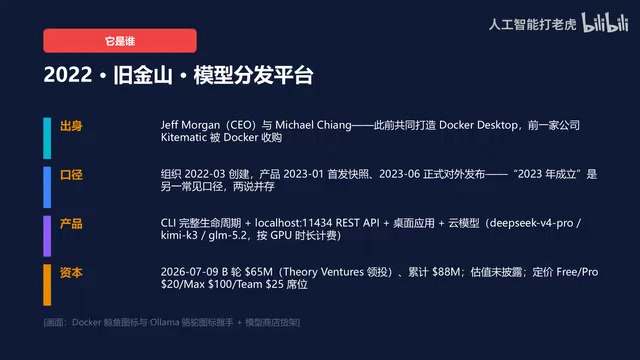
Ollama's founders, Jeff Morgan and Michael Chang, previously co-built Docker Desktop. Their earlier startup, Kitematic, was acquired by Docker — and they brought that containerization mindset with them. They transplanted the Docker model of containerized distribution wholesale onto model serving: one command buries everything — finding, pulling, and running a model — inside it.
On the left is the DIY world: look up quantization tiers yourself, debug drivers yourself, tune VRAM layer splits yourself. On the right is Ollama's answer: one command handles everything, with quantized variants and size tiers pre-prepared by the host. For integrators, a local REST API on port 11434 with dual OpenAI and Anthropic compatibility layers means zero-modification onboarding for existing tooling.
Four Numbers and Two Ways to Read Them
Let's look at a few strikingly contrasting numbers — and also squeeze out some of the inflation in how they're reported.
- GitHub stars: 178,000+ — top-tier in the AI ecosystem. But TechCrunch's count was 176,000. Both figures coexist, so take them with a grain of salt.
- User scale: 8.9 million monthly developers, 40,000+ community integrations, 85% Fortune 500 coverage.
- Team and funding: Just 14 people total; $88 million raised cumulatively, with a $65 million Series B led by Sierra Ventures.
- Speed gains: MTP speculative decoding nearly doubled tokens per second on coding benchmarks — from 50.2 to 95 — but this is the official figure for Apple Silicon. No equivalent public data exists for NVIDIA scenarios.
All four metrics look impressive, but every single one needs a caveat. Fourteen people serving nearly 10 million developers is a leverage miracle — and also the biggest single point of risk.
The Technical Foundation: Main Process Orchestrates, Inference Is Outsourced
Ollama's architectural core is simple: the main process manages scheduling; inference is delegated to subprocesses.
Incoming requests queue through a scheduler. Default parallelism is config-controlled; multimodal is forced to one. Whether each layer lands on GPU or CPU is determined by VRAM prediction — taking the lower of "predicted free" and "GPU-reported free." The source code comment explains why: CUDA's VRAM reporting has latency. When VRAM runs short, a replenishment logic kicks in, evicting old models and reloading as needed.
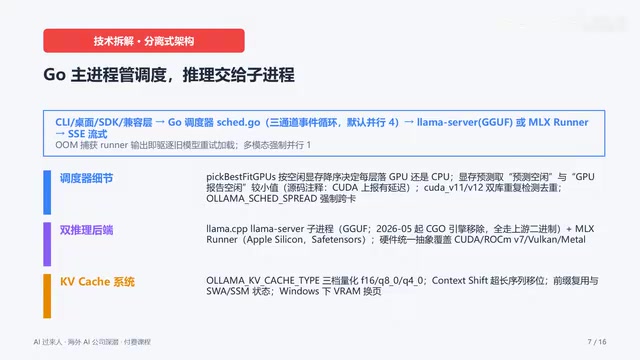
Inference runs on a dual backend: GGUF goes to a llama-server subprocess from llama.cpp; Apple Silicon has a separate MLX Runner. You may not have noticed, but as of May 2026, Ollama removed its own CGO engine entirely — GGUF inference now routes exclusively through the upstream binary. KV Cache supports three quantization tiers: F16, Q8_0, and Q4_0. The hardware abstraction layer covers four paths: CUDA, ROCm, Vulkan, and Metal.
The distribution mechanism is pure Docker-style: content-addressed blocks plus a Manifest describing model layer composition; a Modelfile template defines the base model, parameters, prompt template, and adapters. Two quality-assurance details reveal real depth: multimodal and positional embedding tensors that standard quantization tools discard are copied back from the original high-precision files; and DeepSeekAd's MLA tensors are forced to stay in high precision even when the overall model is compressed to Q4.
A note on GGUF and llama.cpp: GGUF (GPT-Generated Unified Format) is a model file format defined by the llama.cpp project, designed to pack model weights, quantization parameters, and metadata into a single file for cross-platform loading. Quantization refers to compressing model weights from 32-bit or 16-bit floating point down to lower precision (e.g., 8-bit or 4-bit integers) to reduce VRAM usage and speed up computation, at the cost of minor precision loss. llama.cpp is a pure C/C++ inference engine originally built to run LLaMA-series models on consumer-grade CPUs, later expanded to support GPU acceleration and a wide range of model architectures. Ollama contains zero original inference code — its role is to launch llama.cpp's llama-server binary as a subprocess, handling only scheduling, VRAM prediction, and API-layer wrapping. This is exactly why "the performance ceiling is set by upstream" — Ollama's inference performance cap is simply the current version of llama.cpp's cap.
Four Moat Cards: Only the Ecosystem Is Truly Irreplicable
Breaking down Ollama's moat into four cards — the first three are only moderately strong; the last is nearly impossible to replicate.
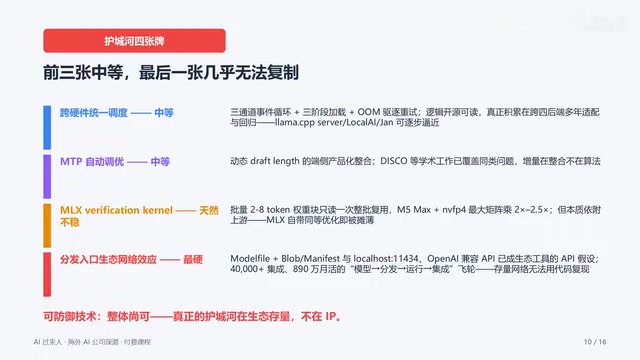
Card one — cross-hardware unified scheduling: A three-channel event loop with three-stage eviction; the logic is open-source and readable. The real accumulated value is years of adaptation and regression testing across four hardware backends — but llama.cpp server and LocalAI can gradually close this gap.
Card two — MTP auto-tuning: The incremental improvement is in client-side productization and integration. Academic work like Disco already covers the same problem space.
Card three — MLX-validated kernels: Weight-fast in batch scenarios, with up to 2–2.5× speedup on large matrix operations — but fundamentally dependent on upstream; if MLX ships equivalent optimizations natively, the advantage evaporates.
Card four — distribution entry point network effects: This is the hardest card. The local API port and OpenAI compatibility layer have become the implicit API assumption baked into ecosystem tooling. The installed base of 40,000+ integrations and 8.9 million monthly active users constitutes a network that cannot be replicated with code.
The conclusion is clear: the defensible technology is decent overall, but the real moat is the ecosystem installed base — not intellectual property.
MTP (Multi-Token Prediction) is a variant of speculative decoding. Traditional autoregressive language models predict one token at a time. MTP lets the model predict multiple future tokens in a single forward pass, then uses the main model to verify — accepting correct tokens and discarding wrong ones. Since verification is much cheaper than generation, overall throughput can increase substantially. Ollama's MTP speculative decoding nearly doubles tokens per second on Apple Silicon coding benchmarks (50.2 → 95), as mentioned above. Two caveats apply: first, MTP's speedup is highly dependent on output "predictability" — code completion tasks (with high repetition) tend to benefit far more than open-ended dialogue; second, Ollama's MTP implementation is "auto-tuned" (no manual draft model configuration required), but the core algorithm has long been covered in academic literature. The differentiation lies mainly in the convenience of client-side productization, not in algorithmic originality.
Four Real Weaknesses: Don't Just Read the Press Release
Time for some cold water. Ollama has four weaknesses that can't be ignored.
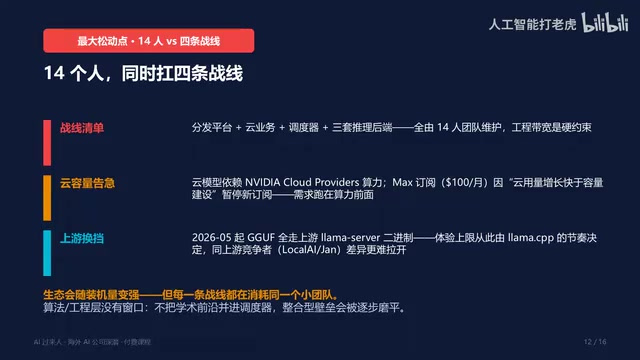
Deep upstream dependency at the inference layer: The engines are entirely llama.cpp and MLX. As of May 2026, even the CGO engine was removed. The experience ceiling is directly determined by upstream, and competitors in the same ecosystem share the same upstream — differentiation is diluted.
No precision research: KV Cache globally offers only three tiers, with no per-layer mixed-precision exposure. KIVI's 2-bit approach and KVQuant's million-token context support are already out ahead. The quantization and speculative decoding frontiers aren't in Ollama's hands; Q4_0 is already two generations behind academic state of the art.
Lopsided performance evidence: Nearly all of the ~90% MTP speedup has only been tested on Apple Silicon (M-series + Gemma). There is no equivalent public data for NVIDIA/CUDA scenarios.
Security exposure: ETH Zurich's "Mind the Gap" paper demonstrated that gaps in GGUF quantization mappings can be exploited to inject hidden malicious behavior. The wider the distribution surface, the wider the attack surface.
KIVI and KVQuant are the two academic quantization schemes mentioned above — understanding them helps calibrate how large Ollama's precision gap actually is. The KV Cache is the mechanism Transformer inference uses to cache intermediate attention computation results; it grows linearly with context length and is the VRAM bottleneck for long-context inference. KIVI (2023) proposes per-channel 2-bit quantization of the KV Cache while retaining a small number of "outlier" channels at full precision — achieving near-zero accuracy loss on multiple models. KVQuant (2024) extends support to context windows in the tens of millions of tokens and introduces per-layer non-uniform quantization strategies. By contrast, Ollama's KV Cache quantization offers only F16, Q8_0, and Q4_0 as global options, with no ability to apply differentiated treatment by layer or channel. In long-context scenarios, this means Ollama either uses more VRAM to maintain precision, or applies coarse-grained quantization to save space while losing more quality — losing on both fronts compared to fine-grained academic approaches.
Key Trade-offs and Final Verdict
Ollama buries all the complexity inside a single command — and in doing so, also buries the quantization depth. What it gains in return is a zero-configuration experience and maximum distribution surface: 8.9 million monthly active users, 85% Fortune 500 coverage, a local API with dual compatibility layers for zero-friction ecosystem onboarding, and a "your data is never used for training" privacy promise that spans both local and cloud deployments.
The cost: quantization limited to fixed GGUF tiers plus three global KV options; a completely non-original inference kernel with full upstream dependency; and temporary lack of parallel support for multimodal models.
The sharpest tension: the distribution network itself is the product — but it's sandwiched between upstream and integrators. Upstream can ship their own optimizations; integrators can embed llama.cpp directly. Either side can route around Ollama.
The bigger fragility point is those 14 people: a distribution platform, a cloud business, a scheduler, and three inference backends — four simultaneous fronts maintained by a tiny team. On the cloud side, the Max subscription even temporarily halted new sign-ups because demand outpaced available compute.
The window is layered: the distribution entry point is difficult to dislodge for 12+ months, but the KV quantization precision gap means an open-source combination stack could potentially overtake it in 3–6 months. A question to leave you with: if llama.cpp officially launched its own model registry and one-click CLI tomorrow, would you migrate? When model supply explodes, whoever controls distribution controls the entry point to open-source AI.
Related articles

iPhone Duo Review Controversy: Why Apple's First Foldable Is Said to 'Should Be Called an iPad'
The Vergecast debates the iPhone Duo review controversy: is a 7 fair? Why are apps struggling? Why critics say it 'should be called an iPad'? We unpack Apple's first foldable's positioning mismatch and first-gen compromises, plus AI security flaws and agentic shopping.

Meta vs. Publishers: The AI Data Battle Over Terms of Service Changes and the Future of the Internet
Meta changed its business account terms to allow AI training on linked website data, sparking backlash from publishers and creators. Industry groups demanded negotiations, forcing Meta to remove 'training' wording and delay the effective date. The dispute reveals the deeper battle over data authorization and the future of the internet in the AI era.

When Outside Xbox Meets Blood on the Clocktower: A Legion Match in Minecraft
Outside Xbox guests Ellen and Mike play Minecraft Blood on the Clocktower in a Legion game. How can three good players fight an evil majority amid information noise? This article breaks down Legion mechanics, information-role mind games, and the endgame reversal.