Gemini 4 Neon Hands-On: Data Visualization Shines, But Can't Beat Opus

Neon ranks third on benchmarks but trails Opus in quality; dynamic data visualization is its edge.
Google's Gemini 4 Neon ranks third on Agent Arena, but a creator's comparison across 3D scenes and UI tasks shows its generation quality only matches Opus from six months ago. Scenes like Istanbul and the White House look cartoonish and oversaturated, complex coordination tasks expose physics and detail weaknesses, and sibling Soul offers better quality at half the price. Its standout is dynamic data visualization, where cleaner, more focused output beats Astra and forms a Gemini-series strength. Neon sits in the second tier, close to the frontier.
Google has been releasing models at a rapid pace recently, and Gemini 4 Neon is one of the more widely discussed. A Bilibili creator ran a series of 3D scene generation and UI design tasks, pitting it against sibling models Astra, Soul, and Carbon as well as competitors Opus and Fable. The conclusion is telling: Neon shows unique strengths in dynamic data visualization, but its overall generation quality never reaches the frontier level embodied by Opus.
Strong Benchmark Scores, but the Quality Gap Is Visible
On the Agent Arena leaderboard, Neon ranks third, ahead of Astra and Sonic but behind Fable and Opus. The creator points out a clear discrepancy between external benchmarks and subjective generation experience—the Arena index gap between Neon and Fable exceeds 100 points, and he considers that ranking reasonable.
The first comparison is an Istanbul scene. Neon's output was described as "a bit cartoonish, too saturated," while Fable's shimmering water surface and restrained colors were clearly the result of careful tuning. Switching to a White House prompt, Opus delved much deeper into realism and overall completeness, while Neon's output remained at the level of "Opus's god-tier model from six months ago."

A telling detail: sibling model Soul, at roughly half of Neon's price, delivers more realistic motion and richer content. This makes Neon's cost-effectiveness awkward—higher cost, but no meaningful quality gap.
Agent Arena is a public benchmark for AI Agent capabilities. It has different models generate results on the same tasks, then accumulates Elo-style ratings through pairwise comparisons by users or reviewers to form a final ranking. Its hallmark is closeness to real-world use cases, covering 3D generation, UI design, data visualization, and more. But note that Arena scores reflect "relative win rates" rather than absolute quality: a model can accumulate a high score simply by winning consistently on many easy or medium-difficulty tasks, while obvious weaknesses on a few hard tasks have limited impact on the total. This is the structural reason behind the article's "discrepancy between benchmarks and subjective experience"—a high ranking does not mean every type of generation reaches frontier level.
3D and Complex Tasks: Coordination Remains a Weakness
The creator designed a set of high-coordination-difficulty tests requiring the model to integrate multiple elements in a single generation. The car-disassembly track prompt produced results that were "absurdly bad, debris everywhere," exposing Neon's struggle with physical simulation and complex element coordination. The transition from Roman-era London to a modern city was "okay," but far from impressive.
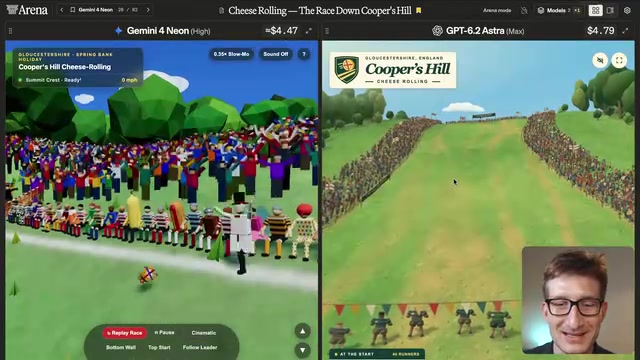
In a crowd simulation task, Astra generated a wide variety of faces, while Neon's individuals "looked more like assorted geometric shapes." The creator's analysis is insightful: this kind of task isn't testing 3D per se, but the difficulty of coordinating various elements and the effort invested in details. Once task complexity rises, Neon's completeness drops noticeably.
Game scene generation is another window. Neon's controls "aren't bad," but the visual quality lags clearly behind Astra; Soul, at one-third of Neon's price, offers a more comfortable environment and smoother motion. The creator acknowledges Neon has merits in dynamic expression, but overall quality remains in the previous tier.
Compositional consistency refers to a model satisfying multiple mutually constraining conditions within a single generation—for example, making a car's disassembled parts follow physical logic, or making every face in a crowd both distinct and consistent with the overall style. These tasks are hard because the model must simultaneously maintain consistency of global structure and local detail in latent space; any conflicting constraint manifests as visual breakdown or homogeneous elements. Evaluations typically observe three dimensions: "element diversity," "physical plausibility," and "detail fidelity." Insufficient diversity shows up as faces turning into geometric shapes, implausible physics as debris everywhere, and insufficient detail as a sharp drop in completeness once complexity rises. This explains why simple scenes show no gap while complex tasks quickly separate the tiers.
Dynamic Data Visualization: Neon's Real Strength
The turning point comes with data visualization tasks. The creator expected Neon to continue its mediocre performance, but the opposite happened—in data processing and visualization, Neon even outperformed Astra. The reason: Astra and the GPT series tend to pile up large amounts of UI elements around the frame, while Neon's presentation is cleaner and more focused.
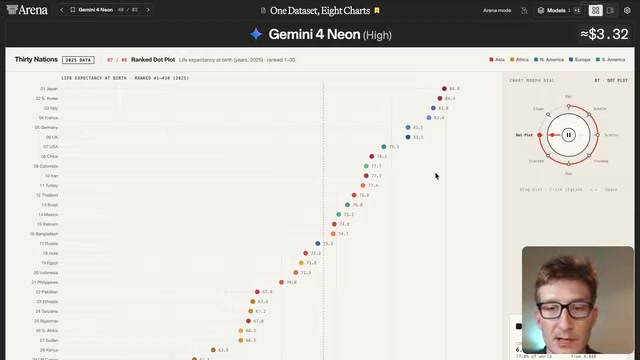
The creator distilled a pattern: Neon and subsequent Gemini-series models seem to have developed a strength in "more dynamic data visualization." Magazine covers, animated charts, and visualized white-collar work scenarios are areas where Neon is relatively adept. This capability carries through the entire Gemini product line.
But stability issues persist. The same model performs poorly on some UI generation tasks—messy layers, unclear information hierarchy, and even a supermarket price-comparison site that "takes two screens of scrolling to understand." The creator suspects this may relate to the model over-stacking elements and abnormal token consumption.
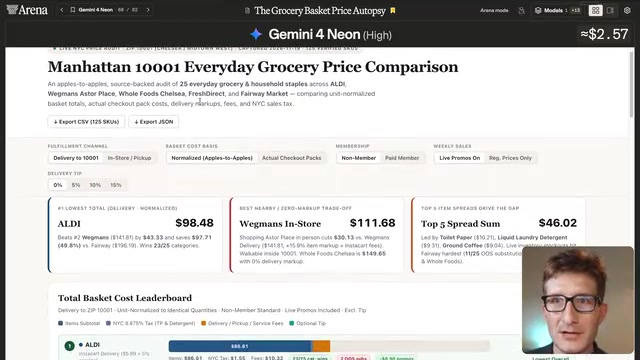
Dynamic data visualization here means the model not only generates static charts but also produces visuals with animated transitions, dynamic charts, and contextualized information presentation—for example, magazine-cover-style infographics or data panels in white-collar work scenarios. The key difference from ordinary image generation is that the model must understand the hierarchical and logical relationships between data and present only necessary elements with restraint. Astra and the GPT series tend to stack UI decorative elements to appear "rich," which instead creates information hierarchy chaos; Neon's advantage comes from cleaner composition and a more focused visual center. However, this capability is sensitive to prompts and token budgets—once there are too many elements, the model can still fall into layer chaos, indicating this strength is not yet stable.
Google's Model Strategy: Diversity Over Single-Point Breakthroughs
An easily overlooked observation is Google's model matrix strategy. The creator notes that Google did not distill directly from Opus but insisted on in-house development, giving it multiple models from different lineages—Astra, Soul, Carbon, and Neon each with different emphases. This diversity is valuable in itself, as users can choose different models based on task type.
The cost is that no single model reaches frontier level across all dimensions. Neon performs well on creative dynamism and text chat (ranking high on Text Arena), but struggles noticeably with coordinating complex tasks. The creator's final judgment: Neon is in the second tier, very close to the frontier, but "no matter how I write the prompt, it can't reach Opus's level."
For scenarios requiring ultimate generation quality, Opus costs about 10x more (roughly $36 per run), but the creator considers the premium justified. Neon's value lies in covering most everyday needs at a lower price while offering differentiated advantages in the data visualization niche. What's really worth watching is whether future Arena scores can align with this kind of actual generation experience.
One-line Summary
Neon ranks third on benchmarks but trails Opus in generation quality, with dynamic data visualization as its differentiated strength.
Paragraph Summary
Google's Gemini 4 Neon ranks third on Agent Arena, but a creator's side-by-side comparison across 3D scenes and UI design tasks found its actual generation quality is only on par with Opus from six months ago. In scenes like Istanbul and the White House, Neon's visuals are cartoonish and oversaturated, clearly lagging in realism; complex coordination tasks like the car-disassembly track and crowd simulation expose weaknesses in physics and detail, while sibling Soul delivers better quality at half the price. The turning point comes in dynamic data visualization: Neon's output is cleaner and more focused, outperforming Astra's UI-stacking style and forming a strength of the Gemini series. The creator believes Google's insistence on in-house development across multiple model lineages brings diversity, but no single model reaches the frontier across the board—Neon sits in the second tier, close to the frontier.
Related articles
Gemini 4 Neon Community in Practice: 9 Case Studies on Scenes, Games, and 3D Animation
A Bilibili community collection of Gemini 4 Neon practice cases, featuring 9 scene generation, game prototype, and 3D animation examples with model PK comparisons.

Gemini 4 Neon vs Carbon Benchmark: How Big Is the Gap in Performance and Cost?
Gemini 4 Neon vs Carbon tested: Neon's default tier hits 59.6, matching the flagship, at double the speed and a quarter cheaper, but Carbon leads research computing by 8.5 points. Carbon is 50% off until end of November; Neon's price edge starts in December.

Hands-On with Gemini 4 Neon: 8 Scenarios — Can It Really Replace Opus 5.5?
Hands-on with Gemini 4 Neon across 8 scenarios: AEI score 61 (third), Cursor Bench 4.1 at 65.4%, $3/$15 pricing. 95% usable on article-to-video, but Blender 3D modeling fails. More like a fast Kimi K3 than an Opus 5.5 replacement.