Gemini 4 Neon vs Carbon Benchmark: How Big Is the Gap in Performance and Cost?

Gemini 4 Neon vs Carbon: speed and cost-effectiveness versus rigorous reasoning.
Based on benchmark data from evaluator R's Facial Analysis, Gemini 4 Neon's default tier scores 59.6, nearly matching Carbon's 60, and reaches 61 at max thinking with double the output speed. Neon excels at coding and chart parsing; Carbon leads research and physics computation by 8.5 points. Neon is a quarter cheaper at list price, but Carbon's 50%-off promotion through November 30 makes it cheaper until then. Neon's highest tier burns far more tokens at $6.44 per task, so route by scenario and timing.
The head-to-head benchmark between Google's newly launched Gemini 4 Neon and its own flagship Carbon was recently published in full by respected evaluator R's Facial Analysis. This in-house showdown sees each model win on different fronts—overall intelligence scores, task-specific performance, and inference cost—and which one is the better deal depends on your use case and timing.
Overall Intelligence Leaderboard: Neon's Default Tier Matches the Flagship
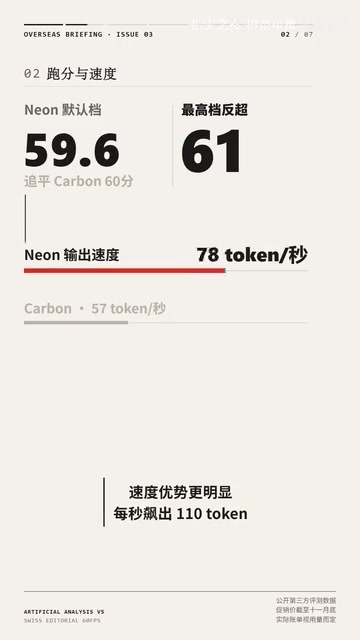
On the overall intelligence leaderboard, Neon's default tier scored 59.6, essentially tied with Carbon's 60. Cranked to its highest thinking level, Neon climbs to 61 and overtakes Carbon. This shows that Neon's default configuration is already very close to flagship level, and with reasoning maxed out it can even edge slightly ahead.
The speed advantage is even more obvious. Neon outputs 110 tokens per second, twice as fast as Carbon. On the same complex task, Neon saves roughly 40% of the time. For workflows that require high-frequency calls and batch processing, this speed gap translates directly into an efficiency gap.
According to hands-on data from a Bilibili review video, Neon's overall performance at the default tier is enough to cover most everyday tasks—there's no need to force the thinking tier higher just to chase points.
Task Breakdown: Wins and Losses on Both Sides—No All-Rounder
In detailed hands-on tests the two models each have their strengths. Neon performs better on coding, intelligence-style questions, and parsing complex PDF charts—its chart-parsing accuracy is 5 percentage points higher. These tasks typically involve multimodal understanding and structured extraction, and Neon's architecture has clearly been optimized for them.
Carbon holds its ground in its own strong suits. On research tasks and physics computation scenarios, Carbon reaches 69% accuracy, 8.5 percentage points ahead of Neon. Its doubling rate is pushed down to 11.4%, indicating it is more stable in scenarios requiring rigorous reasoning and numerical computation.
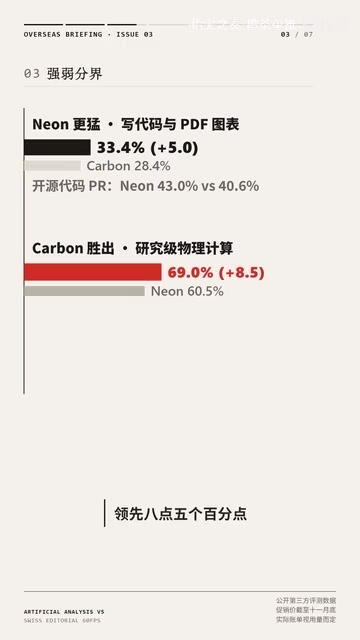
This divergence means model selection can't rely on overall scores alone. Choosing Neon for chart parsing and code generation, and Carbon for research computation and physics modeling, is the more pragmatic strategy. The evaluator also recommends routing by task type rather than applying a one-size-fits-all approach.
The "doubling rate" mentioned in the article is a metric used in the evaluation to measure the stability of a model's output. It typically refers to the proportion of inconsistent, erroneous, or redundant answers a model produces across multiple samples or repeated inferences. The lower the value, the more stable and reproducible the model's output. Carbon pushing its doubling rate down to 11.4% on research tasks means its answers fluctuate less when rigorous reasoning and numerical computation are required, making it better suited to research and engineering scenarios with high demands on result consistency.
Cost Comparison: A Quarter Cheaper at List Price, but Check the Date
API pricing is another focal point of this comparison. Neon's standard price is $3 per million input tokens and $15 per million output tokens—a quarter cheaper than Carbon's list prices of $4 and $20. With input caching enabled, you save another 95%, down to $0.15. Running engineering tasks at normal list prices, Neon's default tier saves 20–30% per job.
But check the calendar before you commit. Carbon is running a launch 50%-off promotion through November 30—$2 input and $10 output. So before the end of November, Carbon is actually about a third cheaper than Neon. Only when prices revert to list on December 1 does Neon's price advantage officially kick in.
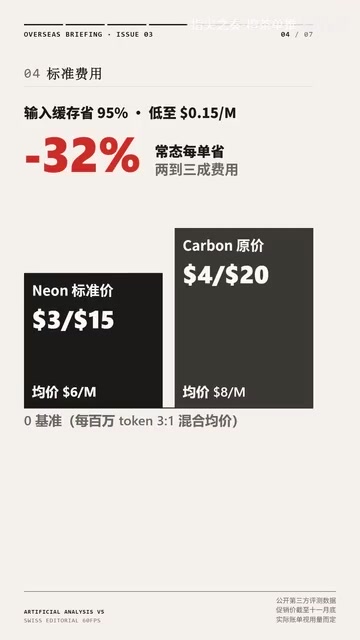
This time window is the easiest trap to fall into when selecting a model. If your tasks are concentrated before the end of November, Carbon's 50%-off price is clearly the better deal; compare at list price after December, and Neon's cost-effectiveness emerges.
Input caching (Prompt Caching) is a common cost-optimization mechanism in today's LLM APIs: when multiple requests contain the same prefix content (such as system prompts, long documents, or codebase context), the provider caches the computation for that portion, and subsequent requests reuse the cache at a very low price instead of being billed again. Neon's price dropping to as low as $0.15 per million tokens with input caching enabled is exactly this mechanism at work. For batch tasks that repeatedly carry the same long context, caching can significantly lower the actual bill.
Hidden Costs: High Thinking Tiers Burn a Lot of Tokens
Maxing out Neon's highest tier gets you 61 points, but the price is a sharp rise in token consumption. The full evaluation burned 283 million tokens, nearly 80 million more than Carbon, averaging $6.44 per task.
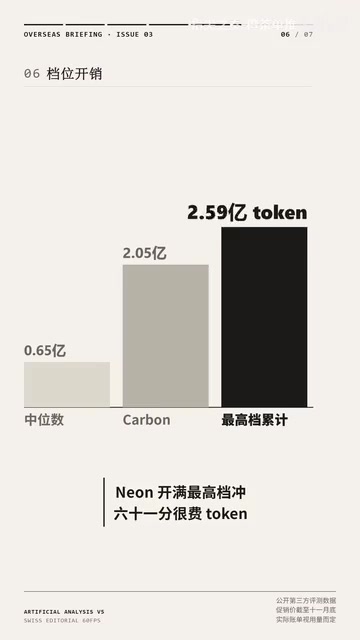
This means maxing out the thinking tier isn't very cost-effective. For everyday use, setting the thinking level to medium balances quality and cost—there's no need to burn through your token budget for a few points. The evaluator's advice is likewise to use the medium-to-high tier for regular work and only max it out for critical tasks.
"Thinking tier" refers to the depth and length of a model's internal reasoning before it gives a final answer. The higher the tier, the more intermediate reasoning tokens the model generates, and the higher the token consumption and cost per task. In the article, maxing out Neon's highest tier raises its overall score only from 59.6 to 61, while the full evaluation consumes nearly 80 million more tokens than Carbon and averages $6.44 per task—showing diminishing marginal returns at high tiers. In practice, weigh quality against cost; the medium tier is often already at the cost-effectiveness inflection point.
Selection Advice: Route by Scenario and Timing
Putting the benchmark data together, a few pragmatic conclusions emerge. Before the end of November, take advantage of the 50%-off promotion and choose Carbon—it's the best deal. After November, for everyday coding and reading spreadsheets, use Neon at the default or medium-high thinking tier: twice the speed and cheaper. For important, engineering-heavy tasks such as research computation and physics modeling, Carbon remains the safer choice.
The two sibling models aren't substitutes—their positioning is complementary. Neon focuses on speed and cost-effectiveness, suited to high-frequency, multimodal, structured-extraction work; Carbon is more solid on rigorous reasoning, suited to high-value, low-tolerance scenarios. Routing the two by task is more cost-effective than stubbornly sticking to a single model.
One-line Summary
Gemini 4 Neon vs Carbon benchmark: speed and cost-effectiveness versus rigorous reasoning.
Paragraph Summary
Based on full benchmark data from respected evaluator R's Facial Analysis, this article compares Google's Gemini 4 Neon with the flagship Carbon. Neon's default tier scores 59.6, nearly matching Carbon's 60, and overtakes it at 61 with the highest thinking tier; it also outputs 110 tokens per second, twice as fast. Neon wins on coding and chart parsing, while Carbon leads by 8.5 percentage points on research and physics computation. Neon is a quarter cheaper at list price, but Carbon's 50%-off promotion through November 30 makes it cheaper until then. Neon's highest tier sharply increases token consumption, averaging $6.44 per task, making it less cost-effective. The conclusion: route by scenario and timing.
Related articles
Gemini 4 Neon Community in Practice: 9 Case Studies on Scenes, Games, and 3D Animation
A Bilibili community collection of Gemini 4 Neon practice cases, featuring 9 scene generation, game prototype, and 3D animation examples with model PK comparisons.

Gemini 4 Neon Hands-On: Data Visualization Shines, But Can't Beat Opus
Bilibili creator tests Gemini 4 Neon: third on Agent Arena, strong at dynamic data visualization, but lags Opus and Fable in 3D and complex coordination.

Hands-On with Gemini 4 Neon: 8 Scenarios — Can It Really Replace Opus 5.5?
Hands-on with Gemini 4 Neon across 8 scenarios: AEI score 61 (third), Cursor Bench 4.1 at 65.4%, $3/$15 pricing. 95% usable on article-to-video, but Blender 3D modeling fails. More like a fast Kimi K3 than an Opus 5.5 replacement.