Hands-On with Gemini 4 Neon: 8 Scenarios — Can It Really Replace Opus 5.5?

Gemini 4 Neon ranks third on benchmarks and shines at coding and long tasks, but it's no drop-in replacement for Opus 5.5.
The article hands-on tests Gemini 4 Neon, Google's fourth model released in two weeks. On paper it ranks third on the AEI Intelligence Index with 61 points, above Opus 5.5's 59, scores 65.4% on Cursor Bench 4.1, and prices at $3 input / $15 output per million tokens (as low as $0.15 on cache hits). Eight real-world scenarios show strong completion on article-to-video, an interactive periodic table, SVG drawing, and code-performed music, but it struggles with spatially precise tasks like Blender 3D character modeling. The author concludes it's more like a "high-speed version of Kimi K3" — faster, broader in world knowledge, lighter in rhythm — suited as a daily development workhorse rather than a replacement for Opus 5.5 across all scenarios.
Google has released its fourth model in two weeks, and Gemini 4 Neon's positioning is rather delicate — officially slotted between Carbon and Hydrogen, with an emphasis on coding and long-horizon tasks. There's already plenty of chatter online claiming it can replace Opus 5.5, but after running eight real-world scenarios over a full day, the conclusion may not be what you expect.
Let's start with the verdict: its benchmark scores do land in the top three, but it's not the kind of drop-in replacement you can swap in without thinking. It's more like a primary development model with faster reasoning, broader world knowledge, the same price, but a lighter rhythm — some have described it as "a high-speed version of Kimi K3."
On Paper: Third on the Leaderboard, with Pricing and Caching as Highlights
Neon's official positioning leans toward coding and long-horizon tasks, with lighter parameters, noticeably faster inference, a 1M-token context window, and four levels of thinking depth. On pricing: $3 per million input tokens and $15 per million output tokens, dropping to as low as $0.15 when cache hits — which Google says saves up to 95%. Users with a Google AI Pro or Ultra subscription can use it right now.
On the leaderboards, it scores 61 on the AEI Intelligence Index, third overall, above Opus 5.5's 59 and GPT 6.2's 57. On Cursor Bench 4.1 it hits 65.4%, 7.3 percentage points higher than Opus 5.5; Graphworks comes in at 95.2%. That said, Opus 5.5 still edges ahead on two hardcore coding metrics — Terminal Bench and FrontierTier Code. Ties Arena gives it 1518 points for third place, and Agent Arena 1333, just 3 points behind Opus 5.5's 1336. The paper numbers do look good, but what matters is how it performs on real work.
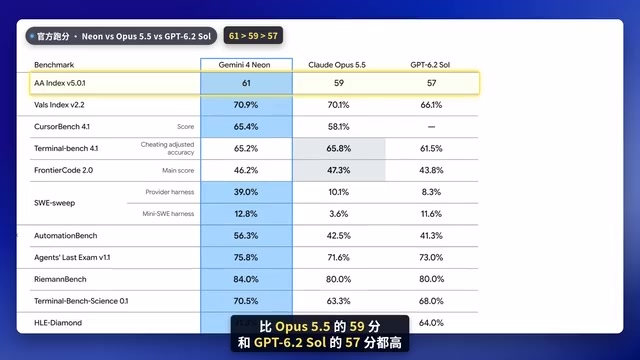
The AEI Intelligence Index is short for Artificial Excellence Index, a third-party benchmark for overall large-model capability, typically weighted across multiple academic and engineering tasks, with scores roughly in the 40–70 range. A gap of 61 versus 59 is therefore usually read in practice as "a slight lead within the same tier" rather than a generational difference.
Cursor Bench is a coding benchmark maintained by the Cursor team, focusing on a model's ability to edit across multiple files, understand dependencies, and follow instructions in a real IDE environment, scored by pass rate. 65.4% means roughly two-thirds of the given task set were judged usable deliverables.
Prompt Caching is a key mechanism for reducing long-context costs: the server caches recurring prefixes (such as system prompts or codebase context), and subsequent requests that hit the cache are billed at a very low rate. The $0.15 per million tokens mentioned here is the input price after a cache hit — indeed close to a 95% reduction versus the standard $3 input price, but only if the request prefix stays stable; otherwise the cache can't be reused.
Eight Real Scenarios: It Can Work, But There Are Limits
Article-to-Explainer Video: 95% Usable, Editing Still Needs a Human
The most practical test was handing an AI knowledge-management article to Neon and having it generate an explainer video directly in code. The first pass came out 95% usable — perfectly adequate as a starting point. That said, the editing rhythm still needs polishing by hand; relying on it alone to produce a hit still falls a bit short. For people who write long-form content regularly, this is essentially another content-distribution channel.

Interactive Periodic Table and Pure-Code Visual Effects
Asked to build an interactive periodic table with no design prompt and no skills attached, clicking on neon, carbon, or hydrogen pops up 3D atomic models and the elements' actual forms — clean layout, all requirements met. A pure-code black hole traversal — accretion disk, gravitational lensing, the sense of momentum as the camera pushes in — all came through; it's impressive for pure-code effects, though still a distance from cinematic, and the overall look is comparable to the GPT 6.2 Sol tested earlier.
Code-Performed Music and Small SVG Tasks: Right on the First Try
Having it perform Ryuichi Sakamoto's "Merry Christmas Mr. Lawrence" in code — the melody and harmony feel right, though the synth timbre is unmistakable. A pure-SVG cyclist: the frame and the bird's proportions landed on the first try; a quick addition of a Chinese poster, one line per world, with a clean layout and a stable visual center. The Kamis tea-pouring animation is complete from pouring to the water level rising, though the spout and splashes remain somewhat flat. A code-drawn Mona Lisa: the pose and composition are recognizable, but the brushwork on the face is rather rough.

Blender 3D Character Modeling: Top Models All Get Stuck
The hardest task was Blender 3D character modeling. Given a set of character three-view and top-view references and told to connect to real Blender to model, the resulting face came out flat and the hands stiff. Sculpting faces and fingers from flat coordinates is still something today's large models can't do well — several top models tested on this task have all failed so far, and Neon is no exception.

The "four levels of thinking depth" mentioned in the article corresponds to a configurable reasoning budget mechanism: before giving a final answer, the model first generates an internal chain of thought. The higher the level, the more thinking tokens are allowed and the better suited it is to complex reasoning, but latency rises accordingly. The point of adjustable levels is to split "fast" and "deep" into two independent knobs — use a low level for everyday code edits to gain response speed, and switch to a high level for architecture design or tricky bugs. This is also the technical root of the article's claim that it "doesn't get stuck in ultra-long thinking at the drop of a hat": the rhythm is controlled by the caller, rather than the model deciding on its own whether to think for a long time.
Not a Replacement, But a Different Trade-off
After eight scenarios, the opening question has an answer: rather than calling Gemini 4 Neon a replacement for Opus 5.5, it's more like a high-speed version of Kimi K3. Input and output are likewise $3 and $15, but reasoning is much faster, it doesn't get stuck in ultra-long thinking at the drop of a hat, world knowledge is broader, and the quota from a Google subscription is quite generous. It suits everyday development where rhythm comes first, rather than pursuing extreme hardcore coding metrics in every scenario.
What's more worth watching next is its stability as a long-term primary development model — between third place on paper and actually being your daily driver, what's often missing is a few weeks of continuous use. Which model is your current daily coding workhorse? Do you think Neon can handle your needs?
One-line Summary
Gemini 4 Neon ranks third on benchmarks and excels at coding and long tasks, but it's no drop-in replacement for Opus 5.5.
Paragraph Summary
This article hands-on evaluates Gemini 4 Neon, Google's fourth model released in two weeks. On paper it ranks third overall on the AEI Intelligence Index with 61 points, above Opus 5.5's 59, scores 65.4% on Cursor Bench 4.1, and is priced at $3 input / $15 output per million tokens, dropping to $0.15 on cache hits. Eight real-world scenarios show high completion on tasks like article-to-explainer video, an interactive periodic table, SVG drawing, and code-performed music, but it struggles with tasks requiring spatial precision like Blender 3D character modeling, getting stuck just like several top models. The author concludes it's more like "a high-speed version of Kimi K3" — faster reasoning, broader world knowledge, a lighter rhythm, suited as a daily development workhorse rather than a replacement for Opus 5.5 in every scenario.
Related articles
Gemini 4 Neon Community in Practice: 9 Case Studies on Scenes, Games, and 3D Animation
A Bilibili community collection of Gemini 4 Neon practice cases, featuring 9 scene generation, game prototype, and 3D animation examples with model PK comparisons.

Gemini 4 Neon vs Carbon Benchmark: How Big Is the Gap in Performance and Cost?
Gemini 4 Neon vs Carbon tested: Neon's default tier hits 59.6, matching the flagship, at double the speed and a quarter cheaper, but Carbon leads research computing by 8.5 points. Carbon is 50% off until end of November; Neon's price edge starts in December.

Gemini 4 Neon Hands-On: Data Visualization Shines, But Can't Beat Opus
Bilibili creator tests Gemini 4 Neon: third on Agent Arena, strong at dynamic data visualization, but lags Opus and Fable in 3D and complex coordination.