DeepAgents Deep Dive: A Practical Guide to Enterprise-Grade Universal Agent Development

DeepAgents is LangChain's enterprise runtime layer — this guide covers its execution model and a design-to-code project walkthrough.
This article traces the evolution from LangChain → LangGraph → DeepAgents and explains when to use each: LangChain for chained calls, LangGraph for complex branching, and DeepAgents for enterprise needs like sandboxing, file systems, and Skill invocation. It outlines the standard agent execution pipeline and walks through a Figma AI-style design-to-code engine featuring parallel sub-agent orchestration, low-code JSON generation, and MCP-driven pixel-perfect code output.
What Is DeepAgents: A New Member of the LangChain Family
DeepAgents is a relatively new framework within the LangChain ecosystem, and its positioning is distinctly different from both LangChain and LangGraph. Understanding the evolution of these three frameworks is essential to grasping the value DeepAgents brings.
LangChain was originally built to solve the problem of chained calls — providing a unified API interface for AI development. Whether it was model integration or organizing execution pipelines, it offered standardized abstractions. LangGraph went a step further, handling more complex logic such as cyclic structures or conditional branching within execution flows, using a graph-based approach to orchestrate agent execution paths.
DeepAgents addresses a more complete set of enterprise-level requirements. It supports local file system operations, sandbox mechanisms, and Skill (capability) invocation. The exact way tools like Codex and Claude Code invoke Skills — and how agents execute the content defined within those Skills — is precisely the capability boundary that DeepAgents aims to standardize.
A brief note on the LangChain ecosystem's evolution is worthwhile here. LangChain was born in late 2022, with its core value being a unified LLM abstraction layer that let developers access OpenAI, Anthropic, HuggingFace, and other models through a consistent interface, chaining together Prompt → model → output parsing steps via the concept of Chains. As application complexity grew, LangGraph was released as a standalone package in early 2024, introducing Directed Graphs to express state-machine-style execution logic — supporting loops, conditional branches, and multi-agent collaboration that LangChain's native Chains struggled to express. DeepAgents represents a further "runtime layer" abstraction: it doesn't just care about logical orchestration, but about the execution environment itself — process isolation, file system mounting, and Skill registration and discovery. This three-layer evolution is essentially the path AI applications must travel from "prototype" to "production system."
Three Core Questions: From Interview Prep to Real-World Practice
Three progressively deeper questions around DeepAgents are worth exploring — they also happen to map directly to common assessment points in AI architecture interviews.
How to Build a General-Purpose Agent
The first question is foundational: how do you build a general-purpose agent? In interviews, this often comes up as: "Have you ever built a general-purpose agent similar to OpenClaude or Codex? Walk me through how you did it." This requires developers to have a clear understanding of the agent's complete execution pipeline.
Framework Selection Judgment
The second question is mid-to-senior level: what are the differences between LangGraph, LangChain, and DeepAgents, and how do you make a technology selection decision in practice? This tests understanding of each framework's capability boundaries — use LangChain for simple chained tasks, LangGraph for complex branching logic, and DeepAgents when you need enterprise-grade capabilities like file system access, sandboxing, and Skill invocation.
Ability to Design a Codex-Like Agent
The third question is the most challenging: if you were asked to design an AI Agent similar to OpenClaude, Claude Code, or Codex on top of DeepAgents, do you have your own design approach and a sense of the core code implementation? This directly tests the ability to translate architectural thinking into working solutions.
The Complete Execution Pipeline of a General-Purpose Agent
The complete workflow of a general-purpose agent can be broken down into a clear pipeline. Once the agent is invoked, it selects a model based on the prompt, loads the model, loads the Skills, then maps to the current local code execution sandbox, completing DeepAgents initialization.
It then completes results via streaming, invokes the tool engine to execute tasks, the LLM processes and retrieves the incoming content, and once processing is complete, the result is returned. The final step is shutting down the current local Sandbox and returning the final output.
It's worth emphasizing that this pattern is not unique to any single tool. Whether it's OpenClaude, Codex, or Claude Code, their underlying execution paradigms essentially all follow this same pipeline: select model → load Skills → map sandbox → stream execution → tool call → LLM processing → return result → close sandbox. Mastering this main thread means mastering the core skeleton of mainstream AI coding agents.
The Sandbox mechanism's role in this pipeline deserves special mention. The sandbox's core function is isolation: code or commands generated by AI execute in a controlled environment, without arbitrary access to or modification of the host machine's file system, network, or processes. Common implementations include Docker containers, gVisor, and WebAssembly runtimes. For coding-focused agents (such as Codex and Claude Code), the sandbox also serves a "replayable execution" purpose — a clean environment is created at the start of each task and destroyed upon completion, ensuring tasks don't interfere with one another. This explains why "map sandbox" and "close sandbox" exist as distinct steps in the pipeline rather than simply running code directly on the host machine. DeepAgents' abstraction over sandboxes means developers don't need to worry about the underlying container implementation — a unified API handles environment creation, code injection, and teardown.
Project in Practice: A Figma AI-Style Design-to-Code Engine
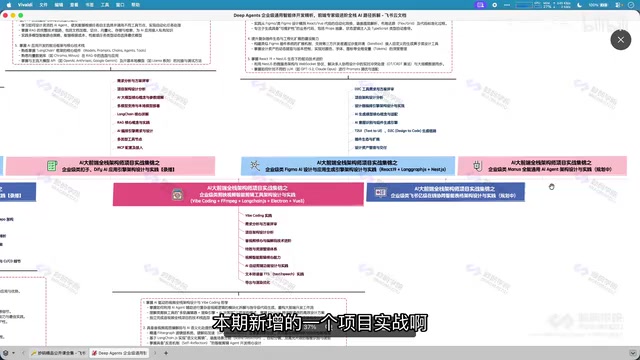
A key hands-on project featured in the course is a design and application generation engine similar to Figma AI. It can invoke local Codex or Claude Code to implement a complete flow: "generate a design from a single natural language sentence, then convert that design to code with one click."
Parallel Orchestration of Main Agent and Sub-Agents
Taking website generation as an example: the entire flow starts with a local model performing a plan to determine how many modules to split the work into. Sub-routing then directs different agents to handle different parts of the development. The system first determines the full execution pipeline, then defines the design style, and upon receiving the style and direction, creates the corresponding layout containers.
During actual execution, the system uses a Hub (main agent) plus Sub-Agent architecture. For a page with four sections, multiple sub-agents can be spun up to handle design and development work in parallel — the top-level Hub serves as the main orchestrator while multiple sub-agents execute concurrently, dramatically improving generation efficiency.
Integration with Low-Code Platforms
The elegance of this approach lies in its deep integration with low-code platforms. Everything AI generates carries layout information: horizontal and vertical arrangement, content spacing, type, width, height, color, color values, positioning — all properties are included. This information fundamentally comes from the low-code platform's data structure.
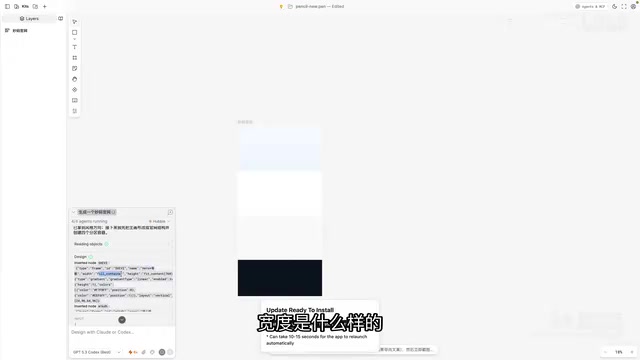
With the low-code platform, you can have AI generate JSON based on established data specifications. Once this JSON is generated, it's injected directly into the output and paired with the low-code platform's existing editing workflow — position adjustments, positioning mode changes, horizontal and vertical arrangement — allowing users to visually edit the generated content directly.
100% Pixel-Perfect Code Conversion via MCP
After editing, the final step is code conversion via MCP (Model Context Protocol). You can encapsulate a custom design MCP, use it to connect to the design's frame URL, and in the editor, retrieve the JSON via MCP with a single click — converting it directly into final React code.
In this process there is "not a single pixel of design deviation" — whatever the design shows is reproduced 100% faithfully in code. This is exactly the design-to-code workflow that major tech companies are broadly adopting: natural language input converts to a design, and a single click converts that design to code — a complete closed loop.
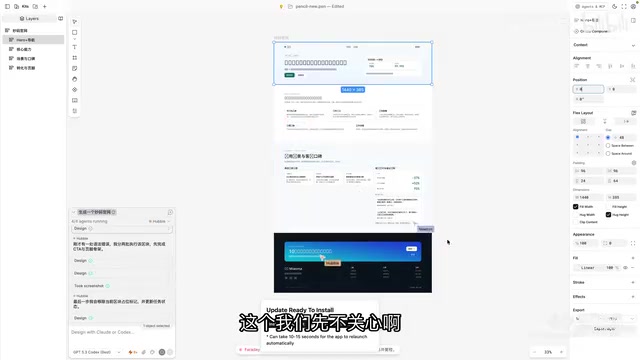
It should be noted that some garbled text appearing in the demo is caused by text rendering conflicts — this is an engineering detail to be optimized and does not affect the demonstration of the overall flow.
MCP (Model Context Protocol) is an open protocol proposed and open-sourced by Anthropic in late 2024, aimed at standardizing communication between AI models and external tools and data sources. Before MCP, every AI application had to develop its own adapter layer for different tools (databases, file systems, design tools, code editors), making maintenance costs extremely high. MCP defines two roles — "MCP Server" and "MCP Client": tool providers implement MCP Servers to expose capabilities, AI applications act as MCP Clients to call those capabilities, with JSON-RPC as the unified communication protocol. The "encapsulate a design MCP" approach mentioned in the article essentially exposes the low-code platform's design data (JSON containing layout, dimensions, color, and other attributes) through a standard MCP Server interface, allowing Claude or other MCP-compatible models to directly read the structured data of design files. This drives precise code generation and avoids the information loss that comes with screenshot-based recognition.
Frontend Expertise and Its Role in AI Integration
Although DeepAgents is an AI-layer framework, for frontend developers, foundational frontend knowledge and core principles are often more important than AI knowledge alone. Design-to-code projects and Figma AI-style engines are particularly competitive precisely because they require developers to have both solid frontend skills (layout, rendering, componentization) and AI agent orchestration capabilities.
For developers looking to transition from frontend into AI architecture roles, understanding DeepAgents' execution paradigm, mastering parallel orchestration of main and sub-agents, and connecting the low-code-to-MCP conversion pipeline are the key paths to building differentiated, competitive expertise.
Related articles

Penguin Moves Up Publication of 'Smarter Than Us': An AI Risk Guide for General Readers
Penguin moves up publication of 'Smarter Than Us,' an AI guide co-written with Patchen Barss that explains how AI works and lays out its many risks for non-technical readers.

From Photons to Production: An Open-Source Computer Vision Engineering Reading Path
Reddit user open-sources a computer vision engineering reading path with 16 chapters from image formation to production deployment, emphasizing primary sources, dependency order, and reproducible benchmarks to help engineers understand why models fail and build reliable vision systems.

Prompt Failures? The Truth About Why AI Agents Struggle in Production—and How to Fix It
A Reddit developer built Agents with Copilot and Gemini but faced unstable behavior. This article analyzes three gaps in prompt engineering for Agent scenarios and offers three practical paths to reliable Agent deployment, including structured prompts, workflow-first approaches, and building an evaluation loop.