DeepAgents in Practice: A Deep Dive into Sandbox Backends and Agent Skills

How DeepAgents' sandbox backend and Agent Skills combine to build secure, reusable AI Agent systems.
This article breaks down the practical principles of DeepAgents' sandbox backend and explains why sandboxes must work with the Agent Skills mechanism. The sandbox provides secure isolation for code execution, Skills provide reusable capability units, and together they form the complete execution loop for reliable AI Agents.
Introduction: Why DeepAgents and Agent Skills Matter
As LLM application development enters more advanced territory, simple conversational Agents can no longer meet the demands of complex scenarios. Developers are increasingly focused on how to give AI Agents the ability to autonomously execute code, invoke tools, and run in securely isolated environments. Against this backdrop, DeepAgents' Sandbox Backend and Agent Skills mechanism have become core framework capabilities that AI/LLM application development engineers must master.
It's worth first clarifying what DeepAgents is. DeepAgents is a Deep Agent design paradigm that has emerged around the LangChain ecosystem. Its core idea is to enable Agents not only to perform single-turn tool calls but also to engage in long-term planning, task decomposition, subtask delegation, and persistent memory management—much like a human engineer. Compared to the traditional ReAct (Reasoning + Acting) loop, DeepAgents emphasizes the introduction of explicit planning tools, a virtual file system (for storing intermediate artifacts), and a sub-agent mechanism, thereby supporting more complex, longer-chain tasks. To understand DeepAgents' sandbox backend, you must view it within this overall architecture: the sandbox is the execution layer where the Agent's actions are grounded, while planning, memory, and Skills form the cognitive and capability layers above it.
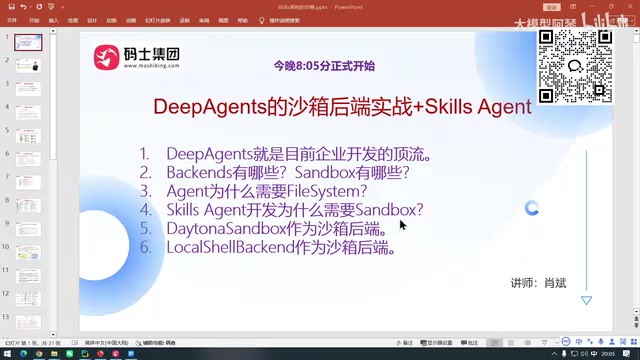
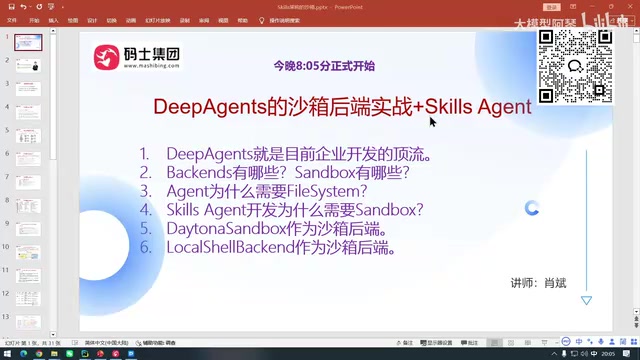
This article is based on the hands-on course content from Bilibili instructor Xiao Bin (a seasoned developer with 16 years of IT programming experience). It focuses on breaking down the practical principles of the DeepAgents sandbox backend, and explains why the sandbox must work in conjunction with the Skills mechanism to deliver value.
The Sandbox Backend: The Foundation for Secure Agent Execution
Why Agents Need Sandboxes
A core pain point in modern AI Agent architectures is this: when an Agent needs to execute code, run commands, or manipulate the file system, running these directly in the host environment introduces enormous security risks. Malicious or buggy code could damage the system, leak data, or even cause irreversible losses.
The role of the Sandbox is precisely to provide an isolated execution environment. Code generated by the Agent runs inside the sandbox, fully isolated from external systems, so even if something goes wrong, it won't affect the host machine. This is a prerequisite for building reliable, controllable Agent systems.
In engineering practice, sandboxes typically follow several mainstream approaches: OS-level isolation using container technologies (such as Docker and gVisor), strong isolation using virtual machines (such as Firecracker microVM, which underpins AWS Lambda), and lightweight isolation based on language runtimes (such as WebAssembly and Pyodide). In the AI Agent space, cloud sandbox services like E2B, Modal, and Daytona have rapidly emerged in recent years, specifically designed to provide isolated execution environments for LLM-generated code with sub-second startup and on-demand teardown. Which approach to choose is essentially a trade-off among startup speed, isolation strength, and resource overhead. Understanding these underlying differences helps developers select the appropriate sandbox backend in production based on their security level and latency requirements.
Why the Sandbox Cannot Stand Alone
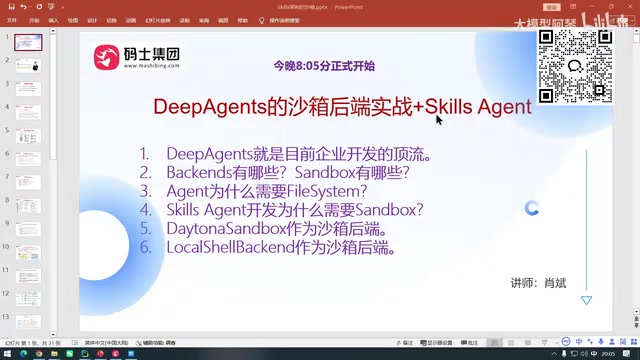
Throughout the course, the instructor repeatedly emphasizes one key point: discussing the sandbox in isolation is meaningless. This statement captures the essence of sandbox backend design—the sandbox is merely an execution container; it produces no value on its own. What truly makes the sandbox valuable are the "Skills" running inside it.
In other words, the sandbox is the "stage," and Agent Skills are the "actors." To understand DeepAgents' sandbox in practice, you must simultaneously understand how the Skills mechanism is scheduled, executed, and managed within the sandbox. This is precisely why this course covers the sandbox backend and Agent Skills together.
Agent Skills: Giving Agents Reusable Capability Units
What Are Agent Skills
Agent Skills can be understood as modular encapsulations of an Agent's capabilities. Each Skill represents a reusable capability unit—it might be data processing, an API call, a file operation, or specialized logic for a particular domain.
This design offers several notable advantages:
- Modularity: Capabilities are broken down into independent units, making them easier to maintain and extend
- Reusability: Write once, call anywhere, reducing development costs
- Composability: Multiple Skills can work together to accomplish complex tasks
- Security and Control: Skills run inside the sandbox, effectively isolating risks
The modular philosophy of Agent Skills is closely aligned with several standardized approaches to capability integration that are taking shape across the industry. The most fundamental is OpenAI's Function Calling, which allows models to trigger external functions via structured JSON output. Going a step further is Anthropic's MCP (Model Context Protocol), introduced in 2024, which aims to establish a unified communication standard between tools, data sources, and Agents—akin to a USB interface for the AI world. Agent Skills can be seen as a layer of capability encapsulation and abstraction built on top of these underlying protocols—it focuses not just on "how to call" but more on "how to organize, reuse, and compose" these capabilities. Running Skills inside a sandbox further addresses the security concerns arising from the questionable trustworthiness of third-party capability code.
The Synergy Between Skills and the Sandbox
When an Agent receives a task, it plans which Skills to invoke, then deploys those Skills into the sandbox environment for execution. The sandbox is responsible for providing the isolated runtime, while the Skills provide the concrete capability implementations. Only when combined do the two form a complete Agent execution loop.
This is the essence of the DeepAgents framework: decoupling "secure isolation" from "capability encapsulation," yet tightly binding them together through a unified scheduling mechanism. Grasping this point means grasping the entire framework's design philosophy.
A Practical Perspective: From Principles to Engineering Implementation
Insights from an Experienced Developer
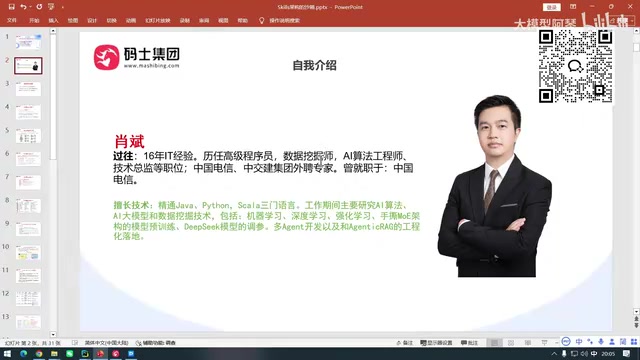
The course instructor, Xiao Bin, is a seasoned developer with 16 years of IT programming experience. He candidly admits that he has spent most of his time in frontline development rather than management, giving him a deep understanding of implementation details at the code level. This "hands-on" perspective is especially valuable for understanding frameworks like DeepAgents—because a framework's value must ultimately be proven through engineering implementation.
Recommended Learning Path for DeepAgents
For developers hoping to master DeepAgents + Agent Skills, the following learning path is recommended:
- Understand the isolation principles of the sandbox: Figure out why isolation is needed and how it is implemented
- Master the encapsulation conventions for Skills: Learn how to package business capabilities into standardized Skills
- Practice scheduling and coordination: Understand how an Agent plans and schedules multiple Skills to accomplish tasks
- Pay attention to security boundaries: Be clear about what the sandbox can and cannot protect against
Avoiding Common Detours
Many developers fall into two pitfalls when learning Agent frameworks: one is overly focusing on the technical implementation of the sandbox while neglecting Skills design; the other is merely piling up Skills without considering security isolation. The correct approach is to understand both as an integrated whole—the sandbox provides the security boundary, Skills provide the capability implementations, and neither can be missing.
Conclusion: The Key to Building Reliable Agent Systems
DeepAgents' sandbox backend and Agent Skills mechanism represent an important direction in the current engineering of AI Agents. They solve two core problems:
- How to let Agents securely execute code and operations (the sandbox)
- How to make an Agent's capabilities reusable and extensible (Skills)
For AI/LLM application development engineers, mastering this framework is not just an improvement in technical skills but also a necessary path to understanding modern Agent system design. As the course emphasizes, the sandbox and Skills are complementary parts of a whole; only by understanding them together can you truly build reliable, controllable, and scalable AI Agent applications.
Note: This article is based on the hands-on course content from Bilibili instructor Xiao Bin and represents a single source. For specific implementation details, we recommend further verification against official documentation and real projects.
Key Takeaways
Related articles

The Truth Behind Codex 'Build a Website in 5 Minutes': AI Isn't Creating Sites—It's Helping You Copy Them
Exposing the truth behind viral Codex 5-minute website videos: creators aren't building original sites with AI—they're copying shared prompts or scraping others' work. Learn AI coding tools' real limits.

Getting Started with AI Agent Development: A Complete Guide from Concept to Practice
A comprehensive guide to AI Agent architecture and development, covering automated marketing, intelligent customer service, and investment analysis scenarios with single and multi-agent collaboration.

The Truth Behind Codex 'Build a Website in 5 Minutes': AI Isn't Creating Sites — It's Helping You Copy Them
Exposing the truth behind viral Codex 5-minute website videos: creators aren't building original sites with AI — they're copying shared prompts or scraping others' work.