DeepAgents Sub-Agent in Practice: Sub-Agent Mechanics and Framework Positioning Explained
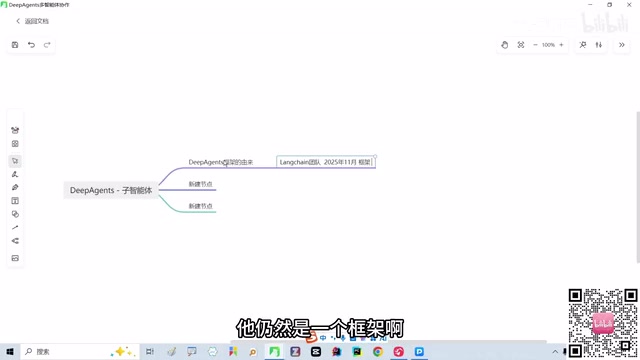
DeepAgents is an agent assembly framework from the LangChain team, with sub-agents as the core mechanism for reliable long-running agents.
DeepAgents is an agent framework launched by the LangChain team around November 2025. Its goal isn't just to make agents run, but to make them run reliably over the long term. Built on LangChain (capabilities like model wrappers, RAG, tool calling, memory) and LangGraph (runtime mechanics like state, loops, branching, checkpoint recovery), DeepAgents acts like Spring Boot for the Spring family. Its core mechanism is sub-agents, supporting sync and async modes for strongly dependent vs. parallelizable tasks.
What Is DeepAgents: Yet Another Layer in the LangChain Ecosystem
The LangChain team launched DeepAgents around November 2025. It's an agent framework for building agents that handle complex, long-horizon tasks. The core goal is clear: make it easier for developers to create agents that can run reliably over long periods. Note the keyword here is stable — not whether it can run, but whether it can keep running reliably.
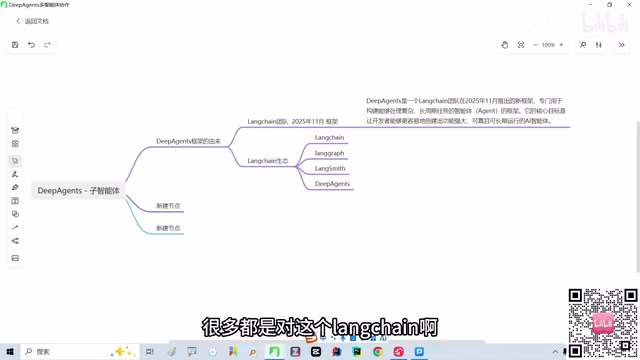
Many people's first reaction is: we already have LangChain, and LangGraph, so why another framework? Isn't this reinventing the wheel? In reality, DeepAgents isn't built from scratch — it stands on the shoulders of LangChain and LangGraph.
If you've learned Java, here's an analogy that makes it click quickly: LangChain provides the various components (model wrappers, RAG, tool calling, memory management, context handling), LangGraph provides the runtime mechanics (state management, loops, branching, checkpoint recovery), and DeepAgents occupies the same position Spring Boot does within the Spring family — assembling low-level capabilities into a complete, out-of-the-box solution. In day-to-day development, you build projects directly with Spring Boot without worrying much about Spring MVC's underlying details. DeepAgents follows the same philosophy.
Sub-Agents: The Core Mechanism of DeepAgents
Why Sub-Agents Are Needed
When a single Agent faces complex tasks, stuffing all logic into one execution chain quickly hits a bottleneck: context bloat, muddled responsibilities, and difficulty debugging. The sub-agent mechanism solves exactly this — decompose complex tasks and hand them off to dedicated sub-agents.
DeepAgents supports both synchronous and asynchronous sub-agents. In sync mode, the main agent waits for the sub-agent to finish before continuing. In async mode, sub-agents can execute in parallel, and the main agent doesn't have to block and wait. Which mode to choose depends on whether dependencies exist between tasks.
The Logic Behind Choosing Sync vs. Async
Synchronous sub-agents fit strongly dependent scenarios: subsequent steps need the sub-agent's output as input and can't proceed without it. Asynchronous sub-agents fit independent parallelizable tasks: multiple subtasks don't depend on each other, and parallel execution can significantly cut total time.
This design isn't complicated conceptually, but in practice you need to consider state management, error propagation, result aggregation, and more — and these happen to be covered by LangGraph's underlying capabilities.
What Is a Sub-Agent
In the context of agents, a sub-agent refers to an independent Agent instance spawned by a main agent (Main Agent or Orchestrator Agent) to handle a specific subtask. Each sub-agent typically has its own prompt, toolset, and execution context, can independently complete a full reasoning-action loop (like a ReAct loop), and ultimately returns results to the main agent.
The essence of a sub-agent is an engineering approach of "task decomposition + responsibility isolation." It borrows from microservices and function decomposition in software engineering: breaking a large, hard-to-maintain execution flow into several clearly bounded small units. This brings three direct benefits: first, each sub-agent's context window only carries information relevant to itself, avoiding context explosion in the main chain; second, a sub-agent's failure can be locally isolated and won't directly pollute overall state; third, sub-agents can be reused, replaced, and tested independently.
Compared with "Tool Calling," a sub-agent is not a stateless function but an Agent with autonomous decision-making ability — it might call tools multiple times, reflect, correct itself, and then return results. This is key to understanding why DeepAgents adds another layer of encapsulation on top of LangGraph.
Concurrency and Result Aggregation in Asynchronous Sub-Agents
Although asynchronous sub-agents can significantly compress total time, they introduce a class of common concurrency programming problems that need to be considered upfront in design:
- Result aggregation order: The order in which multiple sub-agents return results is usually non-deterministic. The main agent needs to assemble results based on task identifiers rather than return order, otherwise mismatches occur.
- Error propagation strategy: When one sub-agent fails, should the whole thing fail, degrade gracefully, or retry? This needs to be explicitly defined at the orchestration layer rather than relying on default behavior.
- State consistency: When concurrently writing to the same shared state, merge strategies (overwrite, append, deduplicate) must be considered. LangGraph's state update semantics have clear conventions for this.
- Resources and rate limiting: Excessive async concurrency may trigger model API rate limits, requiring concurrency caps or task queues.
These details explain why "sync vs. async" isn't just a matter of writing await or not — it's an architectural choice at the task orchestration level.
Framework Layering: The Relationship Between LangChain, LangGraph, and DeepAgents
Understanding these three layers is a prerequisite for mastering DeepAgents. LangChain is the capability layer, providing components like model wrappers, RAG, tool calling, and memory management. LangGraph is the runtime layer, handling execution mechanics like state, loops, branching, and checkpoint recovery. DeepAgents is the assembly layer, integrating the capabilities of the previous two into a stronger, more autonomous agent.
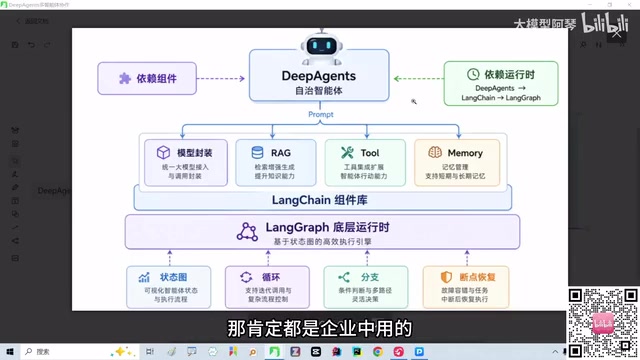
This layered architecture isn't just an academic concept — it's already been adopted in enterprise projects. When building agents that need to run reliably over long periods, DeepAgents-based solutions are becoming a mainstream choice.
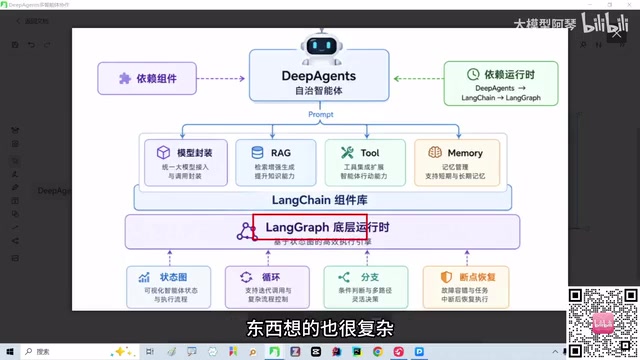
For developers who've only touched Python fundamentals or introductory LangChain, there's no need to overcomplicate LangGraph. It's essentially the Agent's execution chassis — after a user asks a question, the Agent needs to analyze the problem, call tools, supplement information, manage memory, and LangGraph handles the scheduling and state maintenance for these steps.
LangGraph's State and Graph Execution Model
LangGraph's core abstraction is the "Graph." It models an Agent's execution as a directed graph: nodes (Node) represent a computation or model call, edges (Edge) represent the direction of state flow, and the entire graph runs around a shared state object (State).
State in LangGraph is typically a TypedDict or Pydantic object. Node functions receive the current state and return updates to it, and the framework merges the updates back. This design makes process control essential for agents — "loops," "branches," "conditional jumps" — explicitly readable rather than hidden inside while loops and if-else statements.
Additionally, LangGraph has built-in checkpointer mechanisms that persist state at each step to memory, SQLite, or Postgres, enabling checkpoint recovery, human-in-the-loop, and fault-tolerant execution of long-running tasks. The "long-term stable operation" that DeepAgents emphasizes is largely built on LangGraph's state management and persistence capabilities.
Getting Started: Suggestions and Learning Path
If you already understand LangChain basics, the learning curve for DeepAgents isn't steep. Two areas need filling in: first, LangGraph's state flow and branch control mechanisms; second, sub-agent creation and scheduling patterns.
From a practical standpoint, start by running a simple synchronous sub-agent case to understand message passing and result return between main Agent and sub-Agent, then gradually introduce async parallelism and more complex task orchestration. LangSmith can serve as a monitoring tool to observe each step's state changes during Agent execution.
DeepAgents is still iterating rapidly, but sub-agents as its core abstraction are worth mastering first. Once you understand this mechanism, going through official docs and source code will be much smoother.
Related articles

Gmod TTT: Boba's Winning Streak and Game Design Insights
An in-depth analysis of Gmod TTT's role system, creative items, and social gameplay mechanics, exploring the relationship between randomness design and game balance through Boba's winning streak phenomenon.

FlexBudget: Fair Comparison of KV Cache Eviction Strategies Under a Unified Compute Budget
AMD engineer proposes FlexBudget at PyTorch Conference: a training-free fair comparison method for KV cache eviction rules using fixed kernels and memory budgets, all in core PyTorch.
