Deepmark In-Depth Review: Using Semantic Search to Rediscover Your Forgotten Bookmarks

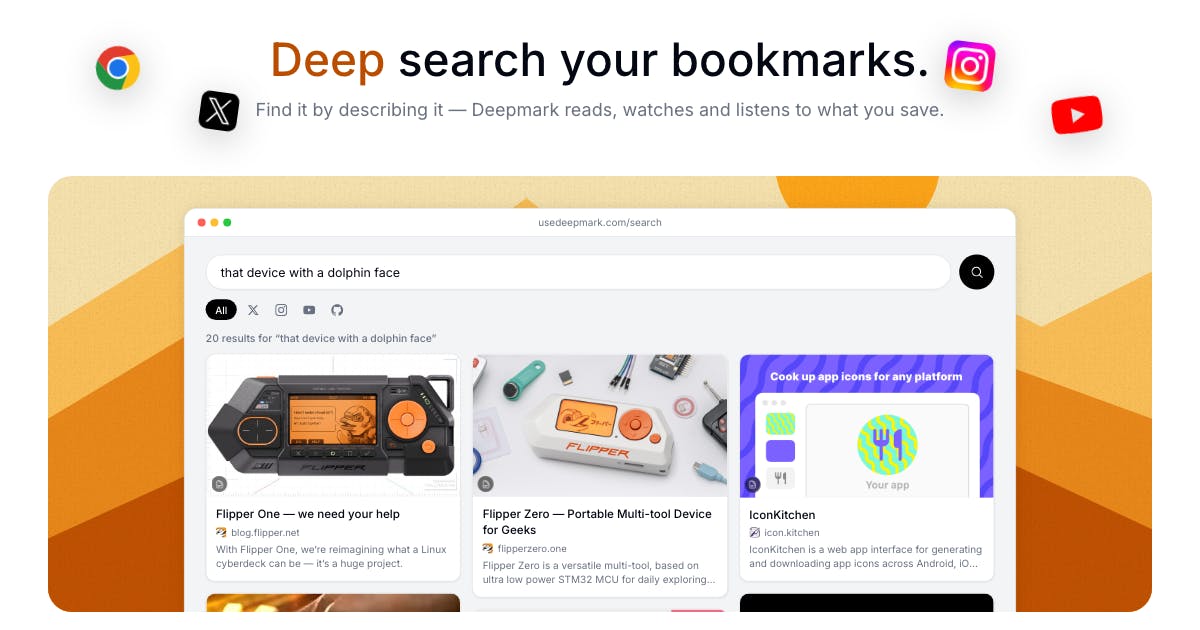
Deepmark uses AI semantic search to help you find saved bookmarks by content rather than title.
Deepmark is a new AI-powered bookmark management tool that aggregates saves from browsers, X, Instagram, and YouTube into a single private library with semantic search. It uses multimodal parsing—including video transcription, OCR, and image understanding—to vectorize content, enabling natural language queries that find items by meaning rather than keywords. With sub-100ms search across 10,000+ items and MCP protocol support for AI agent integration, it represents a shift from passive storage to active knowledge management.
The Old Problem with Bookmark Management: Easy to Save, Hard to Find
Almost every heavy internet user has experienced this: you come across a great article, a useful video, or a stunning image, save it with a quick click, and never open it again. When you actually need it, you find yourself scrolling through hundreds or thousands of bookmarks in vain—because you can't remember what it was titled in the first place.
What's worse, our "saves" are scattered across multiple platforms: browser bookmarks, X (Twitter) likes, Instagram saves, YouTube's Watch Later... They don't communicate with each other, each operating as an isolated information silo.
This predicament is no accident. The field of Personal Knowledge Management (PKM) has undergone several paradigm shifts: early bookmark managers (like Delicious and Pinboard) relied on manual tag-based classification; later note-taking tools (like Evernote and Notion) introduced full-text search but still required active user organization; bi-directional linking tools (like Roam Research and Obsidian) attempted to surface knowledge connections through associative relationships. However, none of them truly solved the problem of "automatic understanding of cross-platform saves." From Tiago Forte's PARA method to today's AI-driven automatic semantic indexing, PKM is rapidly evolving from "humans adapting to tools" toward "tools adapting to humans."
Deepmark, a recent newcomer on Product Hunt, targets precisely this pain point. Its core proposition cuts right to the chase: search your bookmarks by content, not by title. After launch, it quickly garnered 80 upvotes, ranking 12th on that day's leaderboard, and was categorized across Chrome Extensions, Productivity, and Artificial Intelligence.
How Deepmark Works: From Title Indexing to Semantic Understanding
Deepmark's approach is to aggregate your scattered saves—browser bookmarks, X favorites, Instagram saves, YouTube Watch Later—into one private personal library, then let you search using natural language.
Multimodal Deep Content Parsing
Unlike traditional bookmark tools that only index titles and URLs, Deepmark actually "reads and understands" the content of each saved item. According to its official description, the processing pipeline includes:
- Reading full webpage text: Crawling and parsing the actual textual content of pages;
- Transcribing videos and Reels: Converting audio content into text;
- Describing and OCR-ing key frames: Performing image understanding on video frames and recognizing text within them;
- Unified vectorization (Embedding): Converting all the above information into vectors for semantic search.
This pipeline involves multiple cutting-edge branches of current AI technology. Video transcription (Speech-to-Text) typically relies on models like OpenAI's Whisper or Google's Speech-to-Text API, which can convert audio content in multiple languages into text with high accuracy. OCR (Optical Character Recognition) extracts text from images, and modern OCR engines like Google Vision API and PaddleOCR can handle complex layouts and multilingual mixed-typesetting scenarios. "Describing key frames" falls under Image Captioning, typically handled by multimodal large models (such as GPT-4V, LLaVA, Qwen-VL), which can generate natural language descriptions of image content. Unifying this heterogeneous information into retrievable vectors requires a carefully designed processing pipeline to coordinate inputs and outputs across modules, while handling deduplication, concatenation, and weight allocation.
The Core of Semantic Search: Vectorization Technology
The results of this pipeline are quite intuitive. The official team gives a representative example: when you search for "that short video about the one-pot pasta technique," even if the word "pasta" never appears anywhere in the video, Deepmark can still accurately locate it. This is the fundamental advantage of semantic search over keyword matching—it understands the meaning of content, not just the literal words.
To understand the technical foundation of this capability, you need to understand how Embedding works. Vectorization is the process of converting unstructured data like text, images, and audio into high-dimensional mathematical vectors, where distance relationships in mathematical space reflect the semantic similarity between original content. For example, "意大利面" (Italian noodles in Chinese) and "pasta" would be very close in vector space, despite being different character strings in different languages. This technology relies on large-scale pre-trained neural network models (such as OpenAI's text-embedding-ada-002 or open-source BGE and E5 series models), which learn deep associations between vocabulary and concepts by training on massive corpora. During retrieval, the system converts the user's query into a vector as well, then uses Approximate Nearest Neighbor (ANN) search algorithms to find the most similar entries in the vector database.
Performance and Developer Ecosystem
Processing Speed and Retrieval Performance
Deepmark provides two key performance metrics: a new save is parsed and becomes searchable in approximately 90 seconds; and in a library with over 10,000 items, search response time stays under 100 milliseconds.
For a tool that performs video transcription, image OCR, and vector embedding, a 90-second ingestion delay is acceptable—after all, these are intensive multimodal processing tasks. The millisecond-level retrieval speed indicates that its underlying vector retrieval architecture is quite solid. Common vector databases include Pinecone, Milvus, Weaviate, and Qdrant, which are designed specifically for fast retrieval of high-dimensional vectors and can achieve millisecond-level responses across millions or even hundreds of millions of records. Deepmark achieving sub-100-millisecond retrieval at the ten-thousand-item scale indicates it employs mature ANN indexing strategies (such as HNSW or IVF algorithms) capable of supporting real-world usage scenarios at scale.
MCP Service Integration for AI Agents
Notably, Deepmark also offers a hosted MCP (Model Context Protocol) server. This means your AI agents can directly search your personal collection library.
MCP is a protocol standard open-sourced by Anthropic in late 2024, designed to provide large language models with a unified way to connect to external data sources and tools. Its design philosophy is similar to what the USB protocol does for hardware devices—providing a standardized interface that allows any compatible AI model to seamlessly access any compatible data service. In the MCP architecture, an "MCP server" exposes specific data or capabilities (such as searching a bookmark library), while an "MCP client" (typically integrated into an AI assistant) makes requests according to the protocol specification. Currently, mainstream AI products like Claude, Cursor, and Windsurf already support MCP, and the open-source community is rapidly producing various MCP server implementations.
This design is quite forward-looking. As MCP gradually becomes the de facto standard for connecting large language models to external tools and data sources, opening a personal knowledge base to AI agents effectively upgrades Deepmark from "a search tool for humans" to "a memory layer for AI." Deepmark's hosted MCP server means users don't need to deploy their own infrastructure—their personal collection library can be directly called by MCP-compatible AI agents. Imagine your AI assistant automatically pulling relevant materials from your years of accumulated saves when answering questions—this is the ideal form of personal knowledge management.
In-Depth Assessment: Strengths and Potential Challenges
Core Strengths
Deepmark has identified a real and widespread need. The fragmentation of cross-platform saves and the dilemma of "saved but can't find" is a universal pain point for virtually all information workers. Its combination of multimodal parsing + semantic search truly transforms "saves" into "usable knowledge"—this direction is undoubtedly correct.
Additionally, its emphasis on a "private personal library" is a plus in an era of increasing data privacy awareness; and its native MCP support positions it at the forefront of AI application evolution.
Issues to Watch
However, tools like this face some real-world challenges. First is platform authorization and stability—aggregating data from third-party platforms like X, Instagram, and YouTube often relies on official APIs or unofficial scraping methods. The former is constrained by platform policies, while the latter may break at any time.
The severity of this challenge should not be underestimated. Take X (formerly Twitter) as an example: since Elon Musk's acquisition, its API access policies have undergone dramatic tightening, with free basic API quotas drastically reduced and premium access starting at several hundred dollars per month. While Instagram and YouTube offer official APIs, access permissions for users' private data (such as saved lists and Watch Later) are extremely limited, typically requiring active user OAuth token authorization, and platforms may change API terms or scope at any time. Some tools opt for a browser extension approach, reading data by simulating the user's login session, but this violates most platforms' terms of service and tends to break when platforms update their frontend code. This contradiction between platform "walled garden" strategies and user data portability is a structural problem that the entire data aggregation space has long faced.
Second is processing costs. Video transcription, image OCR, and vector embedding are all computationally intensive tasks. As user libraries grow, backend costs will rise significantly, directly impacting pricing and business model sustainability. Taking OpenAI's Whisper API as an example, audio transcription costs approximately $0.006 per minute, while image understanding API calls cost between $0.01-$0.05 each—when a user's library contains thousands of video items, ingestion processing costs alone could reach tens of dollars, placing significant pressure on freemium models.
Finally, there's the ceiling on search quality. The semantic search experience heavily depends on the quality of the underlying embedding model. Whether it can maintain accuracy across Chinese, multilingual, and specialized domain scenarios still needs real-world validation. Current general-purpose embedding models perform excellently in English scenarios, but accuracy may noticeably decline in Chinese semantic understanding, cross-language retrieval (such as searching English content in Chinese), and highly specialized vertical domains (such as medical or legal terminology).
Conclusion: From Passive Storage to Active Knowledge Management
Deepmark represents a clear evolutionary direction for personal knowledge management tools: from "storage" to "understanding," from "manual retrieval" to "AI collaboration." It transforms the act of saving from a passive archiving action into an active, always-accessible knowledge asset. This precisely echoes the core proposition of the "Second Brain" philosophy—externally sourced information, after systematic processing, should become an extension of personal creativity rather than dead data forgotten in digital corners.
For users long frustrated by bookmark management, Deepmark's "search by content" experience is genuinely compelling. Whether it can continue to refine data source stability, cost control, and search accuracy will determine how far it can go. But at least in terms of concept and product positioning, it has already delivered a convincing answer.
Related articles

Free Unlimited Claude Code Solution: Agnes AI + CC Switch Setup Guide
No paid subscription needed — pair the free AI platform Agnes AI with the open-source tool CC Switch to provide a backend for Claude Code, enabling unlimited free calls to text, image, and video models. This guide covers the full setup, test results, and usage boundaries.

A Complete Zero-Cost Guide to Getting Started with Claude Code for Beginners in China
A beginner's guide to Claude Code for users in China: two installation methods (command line and IDE plugin), full configuration steps for replacing the official API with the free domestic LongCat model, and a hands-on demo of building a small tool with natural language, plus tips.

When the NSA Gets Involved: The AI Supply Chain Crisis Behind Open-Source CVEs and API Key Hijacking
Multiple open-source projects disclosed severe CVEs in one day, PHP flaws alarmed the FBI, and Railway and OpenCode were breached with API keys stolen. This article breaks down the vulnerability window, AI-accelerated exploitation, and the AI supply chain crisis behind the API key black market, with a developer defense checklist.