DeepMind Genie 4 Released: Real-Time Interactive World Model Speaks Natively for the First Time

Genie 4 makes world models controllable in real time and natively audible, but it is still not a perfect physics engine.
Google DeepMind released the next-generation world model Genie 4, with two core changes: the world can be controlled in real time, and the world can produce sound itself. Users can navigate in real time with a keyboard, rotate the camera, and use natural language to change the weather or add characters while it is running. Even without input commands, the model advances physical coherence on its own based on causality. It is the first world model to generate native sound in real time; ambient sound, music, and interactive dialogue are output synchronously with the running world, achieving spatiotemporal audio-visual consistency. Capabilities are supported by Gemini Omni anchoring realistic appearance and entity behavior, and Gemini 3.8 Flash ensuring multi-step causality. Currently only a research preview for trusted testers, content carries SynthID watermarks, and the official team admits there are still hard flaws such as detail drift, lack of object persistence, and physical clipping.
Google DeepMind has just released its next-generation world model, Genie 4. If world models previously gave the impression of "generating a video you can only watch," the core changes this time lie in two points: the world can be controlled in real time, and the world can produce sound itself. Genie 4 brings interactivity and native audio into the world model at the same time, making it possible to "walk in, change things on the fly, and hear it too."
From "Watching Video" to "Walking Into the World": Real-Time Interaction Becomes the Main Thread
The most direct breakthrough of Genie 4 is high-fidelity real-time interactive simulation. Users can navigate in real time with a keyboard like in a game, freely rotate the camera to explore the scene, and the world responds instantly rather than waiting for a pre-rendered video to finish generating.
Even more imaginative is real-time shaping via natural language. You can input commands at any time while the scene is running—for example, type a line to make a sunny day suddenly turn into a rainstorm, or add a completely new character out of thin air. The world is not passively played-back material, but a state space that continuously responds to current input.

Even if you stop typing and give no commands, Genie 4 will advance the world's physical coherence on its own based on scene causality. This feature means the model internally has a self-consistent inference logic for "what will happen next," rather than stitching frames together. Dynamic realism comes from exactly this.
World Model refers to a class of models that let AI learn the operating rules of an environment so as to predict "the next state of the world." Unlike video generation models that only fit pixel distributions, it attempts to maintain an inferable state space internally. Early representative works in the industry include Google's Dreamer series and DeepMind's Genie series, the latter known for "generating playable 2D platform games from a single image." World models usually distinguish between two routes: "imaginative" and "interactive." The former unfolds long sequences offline, while the latter emphasizes low-latency real-time response. Genie 4 belongs to the latter; its technical difficulty lies in compressing each inference step to the millisecond level to satisfy interaction while maintaining long-term state consistency—which is also the root of the "object persistence" problem mentioned later.
Native Sound for the First Time: Audio and Vision Naturally Interlock in Space and Time
More noteworthy than the visuals is the audio. Past world models basically relied on post-production dubbing, with sound and visuals as two independent pipelines; Genie 4 is the first world model to generate native sound in real time. From the ambient sound of rain falling on eaves and saxophone music being played in the scene to real-time interactive dialogue with generated characters, everything is output synchronously by the model while the world is running.

The significance of this "native" quality lies in spatiotemporal consistency: sound is not pasted on, but generated within the same world state as the visuals, so audio and vision naturally interlock in space and time. For immersion, this is closer to a qualitative change than merely increasing resolution—the rain you hear comes from the eaves you are looking at.
Native multimodal generation means the model jointly models multiple modalities in the same latent space or state representation, rather than assembling an independent image model plus an audio model. In the traditional "post-production dubbing" workflow, audio-visual alignment relies on manual work or additional timestamp-matching modules; native joint generation automatically binds the semantics and spatial location of sound to visual events—for example, whichever eaves the raindrops fall on in the image, the sound comes from the corresponding direction and material. A typical challenge of this kind of architecture is information competition between modalities: the number of visual tokens far exceeds that of audio, making it easy for the audio branch to underfit during training, which leads to problems such as insufficient spatial precision in real-time audio.
Coordination Behind the Scenes: The Gemini Family Divides the Work
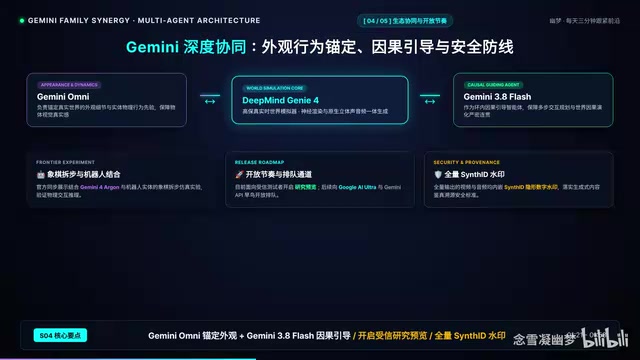
Genie 4's capabilities are not a single-point breakthrough, but deeply coordinated with the Gemini family. Gemini Omni is responsible for anchoring the appearance and entity behavior of the real world, ensuring that the generated world "looks real and moves in line with common sense"; at the same time, Gemini 3.8 Flash is introduced as a guiding agent to ensure the coherence of multi-step causal logic.
The official team also simultaneously demonstrated a chess setup experiment combined with Gemini 4 Argon and a robot, linking the world model with embodied intelligence and reasoning models in the same scene. The value of such a demonstration is not chess itself, but showing that the world model can serve as an "interactive environment layer" that can be called by other agents.
Release Cadence and Boundaries: Still a Research Preview
In terms of release cadence, Genie 4 is currently just opening a research preview to trusted testers, and later it will open a queue to Google AI Ultra and Gemini API early birds, and the full output video will also be displayed on Gemini 4. Both video and audio are marked with invisible SynthID watermarks to identify AI-generated content.
What needs to be viewed calmly are the technical boundaries. According to feedback from trusted testers and official statements, Genie 4 has huge potential in film and television previsualization, immersive reconstruction of old photos, and game prototype exploration, but the official team also admits that it is not a perfect physics engine: in long-duration rendering, there are still hard flaws such as detail drift, lack of object persistence, complex physical clipping, poor text readability, and insufficient spatial precision in real-time audio.

These defects point to the same essential problem: the stability with which the world model maintains the "world state" is still limited. Short-term interaction is impressive enough, but as time lengthens, whether objects are still in their original places and whether physics still makes sense will begin to loosen. Genie 4 is still in the research evolution stage.
SynthID is an invisible digital watermarking technology launched by Google DeepMind. It can embed imperceptible signals into images, audio, video, and text, and use a dedicated detector to identify whether content is AI-generated. Unlike explicit labeling, the watermark is encoded during the generation process and has some robustness against routine cropping and compression. It provides a technical means for content provenance, but it is not omnipotent: strong adversarial transformations can still weaken the signal, and detection capabilities are mainly in the hands of the provider.
Object permanence was originally a term in developmental psychology, referring to an individual's understanding that an object still exists after it leaves sight. In generative world models, it refers to whether the model can stably maintain the identity, position, and quantity of objects in a scene under long time sequences and large viewpoint changes. When it is missing, phenomena such as objects disappearing out of thin air, duplicate copying, and deformation drift—"detail drift"—occur. The essence is that the model's state memory capacity is limited, and errors accumulate over time steps. This is also one of the key gaps between current world models and true physics engines.
What This Means
The real highlight of Genie 4 is not "yet another video generation model," but that world models are beginning to acquire two infrastructure capabilities: controllability and native multimodal output. Controllability means it can be used as an environment, and native audio means immersion no longer needs an add-on. For directions such as film and television previsualization, game prototyping, and embodied intelligence training, this provides a new working medium.
But it is still too early to treat it as a perfect physics engine. Viewing technical boundaries rationally is the correct way to follow the frontier.
One-line Summary
Genie 4 makes world models controllable in real time and natively audible, but it is still not a perfect physics engine.
Paragraph Summary
Google DeepMind has released the next-generation world model Genie 4. There are two core changes: the world can be controlled in real time, and the world can produce sound itself. Users can navigate in real time with a keyboard, rotate the camera, and use natural language to change the weather or add characters while it is running. Even without input commands, the model will advance physical coherence on its own based on causality. It is the first world model to generate native sound in real time; ambient sound, music, and interactive dialogue are output synchronously with the running world, achieving spatiotemporal audio-visual consistency. Its capabilities are supported by Gemini Omni anchoring realistic appearance and entity behavior, and Gemini 3.8 Flash ensuring multi-step causality. Currently it is only a research preview for trusted testers, content carries SynthID watermarks, and the official team admits there are still hard flaws such as detail drift, lack of object persistence, and physical clipping.
Related articles

A 19-Year-Old's Rental Horror Story: Ceiling Collapse, Bug Infestation, and the Lessons It Taught Me
At 19, my first off-campus rental brought bug infestations, no heat, a collapsed ceiling, and a ruined laptop with no renter's insurance. Here are the hard-won lessons for first-time student renters.

Veda Nurse's Cranial Nerve Exam: Why ASMR Role-Play Is Going Viral
Bilibili creator Veda's cranial nerve exam ASMR video goes viral, blending humor and sensory triggers through nurse role-play. This article analyzes its unique appeal and the audience psychology behind ASMR role-play.

LG Cinebeam AI Review: 120-Inch Giant Screen + 3000 Lumens, a New Choice for the Living Room Theater
LG Cinebeam AI projector review: 3000 ANSI lumens, 4K, 100 inches from about 8 cm and 120 inches from about 18 cm. Built-in webOS, AI Concierge voice recommendations, AI Sound Pro 11.1.2 virtual surround, and Game Optimizer—positioned for fixed living room installation, complementing the portable Cinebeam S.