DeepSeek 4.1 Flash Hands-On: The Strongest Open-Source Model and DeepInfer's Ambitions

DeepSeek releases 4.1 Flash and open-sources DeepInfer, with hands-on capability at about 80% of frontier models.
DeepSeek released the 4.1 Flash model alongside the open-source inference engine DeepInfer. The model uses a mixture-of-experts architecture with 552 billion backbone parameters and only about 16 billion activated during inference, leading mainstream open-source models on multiple benchmarks. DeepInfer disclosed a 96% input cache hit rate, 155 trillion tokens per day per cluster, and an estimated 80% gross margin, supporting both NVIDIA and Huawei chips. In tests, it became the first model to pass the "find the frog" visual test and approached top closed-source models in deep research, but still showed clear shortcomings in complex tasks like 3D games and listing reconstruction, with overall intelligence at about 80% of frontier models. The full test suite cost about $6, and weights are open on Hugging Face and ModelScope.
DeepSeek has once again pushed the ceiling of open-source models higher. This release isn't just a model—there's also an inference engine called DeepInfer, and the latter may be more worth a closer look than the model itself.
One Release, Two Big Things
According to a hands-on video relayed by a Bilibili creator, DeepSeekAd released the 4.1 Flash version while open-sourcing the inference engine DeepInfer. The model is an update rather than an entirely new architecture—a mixture-of-experts structure with 552 billion backbone parameters and roughly 16 billion actually activated during inference, which keeps capabilities high while lowering operating costs.
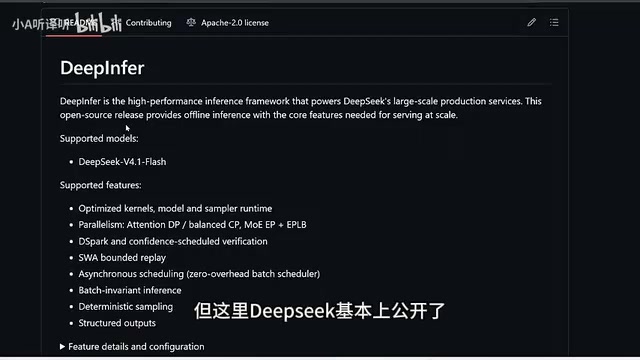
What really excited the reviewer was DeepInfer. This engine reveals the optimization details of how DeepSeek serves millions of user requests across thousands of GPUs—information that frontier labs typically classify as top secret. Comments from multiple sources point to the same conclusion: releasing the inference engine is a bolder move than releasing the model.
Mixture-of-Experts (MoE) is a sparse architecture that activates only part of a model's parameters during inference. A traditional dense model invokes all parameters on every forward pass, whereas MoE splits the feed-forward network into multiple "experts" and uses a routing network to decide which experts to activate based on the input. Of DeepSeek 4.1 Flash's 552 billion backbone parameters, only about 16 billion are activated per inference—precisely thanks to this sparse activation mechanism. The benefit is that while total parameter count determines knowledge capacity, actual computation and memory bandwidth overhead are greatly reduced, keeping capabilities strong while lowering serving costs. The cost is higher engineering complexity in training and inference, with routing balance and expert-parallel communication being major challenges.
Hands-On Testing: From Motion Video to 3D Games
The reviewer didn't stop at benchmarks but ran a series of complex tasks using an agent framework. The first task was to make a motion-graphics explainer video with white text on a black background, on the theme of how Eratosthenes measured the Earth's circumference with a stick and its shadow. DeepSeek planned the scenes itself, called Gemini TTS to generate voiceover, and completed the animation with open-source motion graphics tools. The final quality was considered close to frontier closed-source models, and the task consumed about 22 million tokens with a 99% cache hit rate.
The 3D game task better reveals the boundaries. The prompt required making a procedural third-person game in Unreal Engine, with the character selecting animations from external platforms, assets generated in Blender, and a "critic agent" launched to score against AAA art director standards, iterating until it reached 8.5. The result: it ran 16 rounds and scored at most 5.5. The reviewer's judgment: the design framework is there—the character can move, sprint, and jump between buildings—but it's still far from AAA quality, with overall intelligence at roughly 80% of frontier models.

Long-Tail Capabilities: Surprises and Shortcomings
In an Airbnb listing reconstruction task, it took page photos and rebuilt the building and interior in Blender, rendering a walkthrough video in about 1 hour 37 minutes. The results weren't ideal: the bed shape was wrong, light fixture positions were incorrect, pillows passed through the sofa, kitchen chairs clipped into the table, and the slanted wall next to the pool wasn't rendered. It understood part of the spatial layout but lacked detail fidelity. The reviewer noted that such tasks are nearly impossible for other open-source models, so this still counts as a worthwhile attempt.
The composition task showed a similar "close but not equal" pattern. It had to find plugins in a DAW itself, download samples, and complete mixing and mastering. The first round sounded muddy, and the second round improved after human feedback. The reviewer said its melodies resembled outputs from multiple models, with quality about 80–90% of top closed-source models.
The brain scan tumor identification test got all six questions wrong. The reviewer wasn't surprised, noting that even the best models can only get about one question right on this task.
The Frog Test and Deep Research
The most viral was "find the frog." An image hides a frog, and the model was asked whether there's an animal in the image and to circle it. It split the image into multiple regions, repeatedly cropped and zoomed, adjusted contrast and saturation, analyzed color channels, and even tried reading EXIF metadata (which had been removed), ultimately locating and circling the frog. According to the reviewer, this is the first model to pass this test—closed-source models including Opus and the GPT series had previously failed to find it.
The deep research task required analyzing the β-amyloid mechanism and tau protein propagation, and critically evaluating cognitive and imaging results from recent Phase III clinical trials. It generated an HTML report with a table of contents, charts, comparison tables, and full citations in 20 seconds. The reviewer considered it on par with top closed-source models in synthesizing data, and more meticulous than some models.
What DeepInfer Discloses
The numbers DeepInfer disclosed are quite aggressive: a single cluster processes 155 trillion tokens per day, revenue of $38 per GPU-hour, implying a gross margin of about 80%, with compute costs accounting for only about 20%. The 96% input cache hit rate is key—most computation is reused directly rather than recomputed.
A sober caveat: DeepInfer is not a complete production system. The full infrastructure for caching and load balancing hasn't been released, so reproducing its economics isn't realistic—installing the engine doesn't mean replicating the business model. But the disclosed parts still have high research value.
Another underappreciated detail is hardware compatibility: DeepInfer not only runs on NVIDIA chips but also supports the Huawei ecosystem. For teams affected by export restrictions, this means an additional path that doesn't depend on a single vendor.
Input cache hit rate refers to the proportion of a request's input tokens in an inference service that hit previously computed and cached key-value states (KV Cache), thereby avoiding recomputation in the forward pass. In large-model serving, system prompts, long documents, and the historical parts of multi-turn conversations are often reused extensively. Caching the computation results of these prefixes and reusing them in subsequent requests can significantly reduce GPU compute consumption. A 96% hit rate means the vast majority of input computation is skipped—one of the core reasons DeepInfer can push compute costs down to around 20% and estimate an 80% gross margin. However, high hit rates depend on request patterns and the degree of prefix reuse, and not all business scenarios can achieve them.
Benchmarks and Cost
From public benchmarks, 4.1 Flash exceeds its predecessor by several percentage points on most dimensions such as intelligent coding, common sense, and automation, leads open-source models like GLM5.3 and Kimi K3, and is roughly on par with some top closed-source models. On lower-level GPU code benchmarks it ranks third, behind only the latest closed-source models but ahead of several competitors.
Cost is the most visceral impact: the entire test suite cost about $6. Some tasks ran for hours continuously, yet the bill was still only a few dollars. Open weights are downloadable on Hugging Face and ModelScope, and the community has already released quantized versions—the most compressed version is dramatically smaller but still requires high-end GPUs.
One sentence from the reviewer captures what this release means: getting this level of intelligence, running it locally offline, and giving away the secrets of inference optimization for free—that's almost unimaginable by frontier lab conventions.
Open weights and quantized versions are another key cost-side point of this release. DeepSeek published the model weights on Hugging Face and ModelScope, and the community quickly released quantized versions at different precisions—compressing model size and memory footprint by lowering weight numerical precision (e.g., from 16-bit to 8-bit or 4-bit). Quantization can greatly lower the deployment barrier, letting models run on fewer or older GPUs, but it usually brings some accuracy loss, more pronounced with more aggressive compression. The article notes the most compressed version is dramatically smaller but still requires high-end GPUs, indicating that even a quantized 552-billion-parameter MoE model still has considerable memory and bandwidth requirements—local offline running isn't something ordinary consumer hardware can easily handle.
One-line Summary
DeepSeek releases the 4.1 Flash model and open-sources the DeepInfer inference engine, with hands-on capability reaching about 80% of frontier models.
Paragraph Summary
DeepSeek released the 4.1 Flash model alongside the open-source inference engine DeepInfer. The model uses a mixture-of-experts architecture with 552 billion backbone parameters and only about 16 billion activated during inference, leading mainstream open-source models on multiple benchmarks. DeepInfer disclosed details including a 96% input cache hit rate, 155 trillion tokens processed per day per cluster, and an estimated gross margin of about 80%, while supporting both NVIDIA and Huawei chips. In hands-on tests, the model became the first to pass the "find the frog" visual test, and its deep research tasks approached top closed-source models, but complex tasks like 3D games and listing reconstruction still showed clear shortcomings, with overall intelligence at about 80% of frontier models. The entire test suite cost about $6, and weights are now available for download on Hugging Face and ModelScope.
Related articles

AgentTrust: Adding Zero Trust and Human Approval to AI Agents
AgentTrust debuts on Hacker News, offering zero-trust security and human approval for AI agents. This article analyzes its action-level permission checks, human approval gates, and audit traceability, and discusses differences from existing AI observability tools and deployment limitations.

New Framework for Nonlinear Concept Erasure: Conditional Autoencoder Enables Precise Erasure and Steering
This paper proposes a conditional autoencoder framework that provides formal guarantees for nonlinear concept erasure, achieving a better utility-erasure trade-off without target-task labels and unlocking representation steering with faster convergence.

Serbia's Election Shake-Up: Vučić Concedes Defeat as Student Movement Makes History
Serbian President Vučić concedes defeat in the snap parliamentary election as a student-led opposition camp wins a historic victory. Analysis of the student movement's rise, the geopolitical impact, and Serbia's political future.