DeepSeek 4.1 Flash vs. Gemini 4 Argon: Which Wins Across Six 3D Tests?

DeepSeek 4.1 Flash and Gemini 4 Argon each win three of six 3D tests; cost-effectiveness depends on the use case.
Bilibili creator "Genius Frog" compared DeepSeek 4.1 Flash and Gemini 4 Argon across six tasks covering 3D game development, 3D scene generation, and video generation. DeepSeek won in the Subway Surfers recreation, photo-to-3D world generation, and complex city scenes with NPC planning, showing more solid modeling and scene logic; Gemini won in the 3D boss battle, 15-second text animation pacing, and storyboard narrative animation, with smoother interaction and stronger visuals. Each won three of six tasks. The creator gave no final "king of cost-effectiveness" verdict, recommending DeepSeek for scene generation and logic planning, and Gemini for animation rhythm and cinematic feel. Results are based on a single subjective test and should be verified against individual needs.
Background of the Two New Models
According to the second episode of the "Who Is the Strongest Large Model Series" test video released by Bilibili creator "Genius Frog," the two models compared this time are DeepSeekAd 4.1 Flash and Gemini 4 Argon, both released around the same period. The test focused on three directions—3D game development, 3D scene generation, and video generation—and designed six specific tasks in an attempt to find the "king of cost-effectiveness."
The video compares the two models task by task, showing differences in code generation and visual effects. The core results are analyzed below.
The capability boundary of large models "writing code to generate 3D content": This type of test essentially examines a large model's ability to treat "code as rendering"—the model does not directly output 3D assets, but instead generates runnable HTML/JavaScript code (often using WebGL libraries such as Three.js), which the browser renders into a 3D scene in real time. Therefore, evaluation results are affected by two factors at once: first, the model's understanding of spatial geometry, lighting, and physical logic; second, its ability to organize code for graphics APIs and the game loop (input handling, collision detection, animation interpolation). This is also why the same model performs noticeably differently across tasks: code-logic tasks (such as traffic lights and NPC paths) test reasoning, while visual tasks (such as modeling quality and camera composition) test aesthetics and asset organization.
Task 1: 3D Subway Surfers Recreation
The models were asked to recreate the classic endless runner game. The version generated by DeepSeek 4.1 Flash ran smoothly, with jumping, left-right movement, and sliding all free of bugs, and the building modeling detail was on par with the previous generation V4 Pro. Gemini 4 Argon also implemented the basic mechanics, but the slide action lacked a "mysterious ability," and the modeling was relatively rough. The creator considered DeepSeek's result better for this task.
Task 2: 3D Boss Battle Game
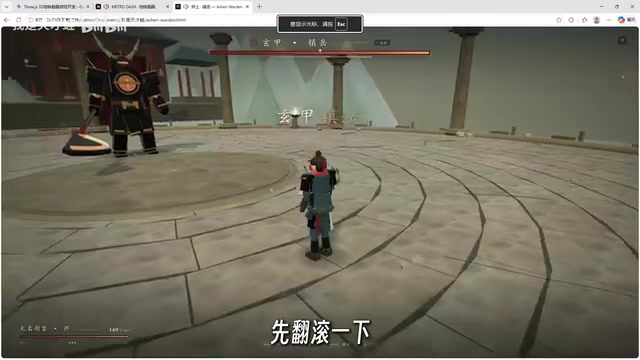
The goal was a 3D-style boss battle game. The DeepSeek version had a small bug where the character automatically rolled back after dodging, the boss modeling resembled the style of "National Treasure Agent," and the phase-two skill triggered normally, making for a decent overall experience. The Gemini version had a more design-forward game title, more comfortable sprinting and hit feedback, bug-free rolling and jumping, and could even land a three-hit combo to stun the boss, clearly winning on smoothness. The creator rated Gemini better.
Task 3: Generating an Explorable 3D World from a Photo
A photo of a tea room was provided as input, with the requirement to generate a freely explorable 3D scene. DeepSeek had higher fidelity, with excellent maple-leaf paper modeling and fallen-leaf texture, but the building interior was an empty shell. Gemini's overall modeling "went a bit too far," with red spots and unknown symbols appearing on the ground, and the fallen leaves looked more like sticky notes with a monotonous style. The creator preferred DeepSeek's ground effect.
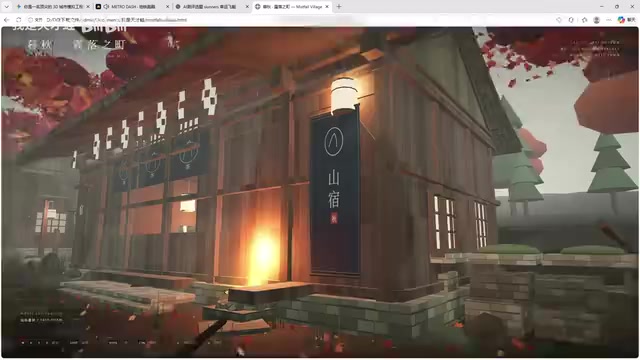
The technical meaning of image-to-3D and "explorable scenes": Generating a freely navigable 3D world from a single photo as input is a problem of single-view 3D reconstruction and scene completion. The model needs to infer depth, occlusion relationships, and camera viewpoint from the 2D image, and "fill in" the parts outside the photo that are not visible. The failures mentioned in the evaluation, such as "the interior is an empty shell" and "red spots appear on the ground," are typical failure modes of this type of task: the model lacks constraints for unseen areas and is prone to artifacts, repeated textures, or semantic errors. Currently, mainstream approaches still generate approximate scenes rather than precise reconstructions, so "fidelity" and "explorability" are often difficult to achieve at the same time.
Task 4: Complex Scene and NPC Behavior Planning
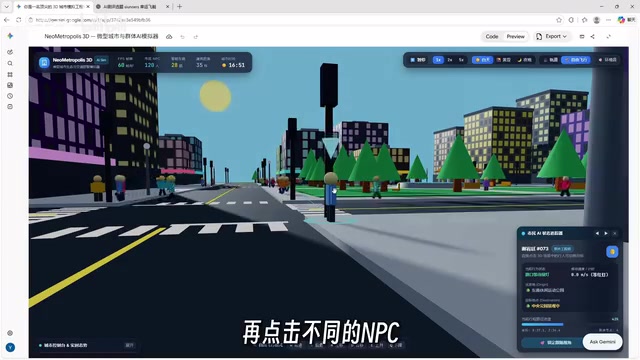
The task examined city traffic, NPC paths, and interactions. The DeepSeek version was rich in detail: vehicles waited at red lights, sidewalks followed traffic-light logic, NPCs could be clicked to follow the camera view and had different names, and the modeling quality was high, with only the streetlights slightly tilted. The Gemini version had brighter colors, but the trees and houses were roughly modeled, NPCs' legs crossed when walking, and the traffic lights did not light up, making the traffic system hard to evaluate; NPCs clustered to cross the road while there were no vehicles. The creator considered DeepSeek better.
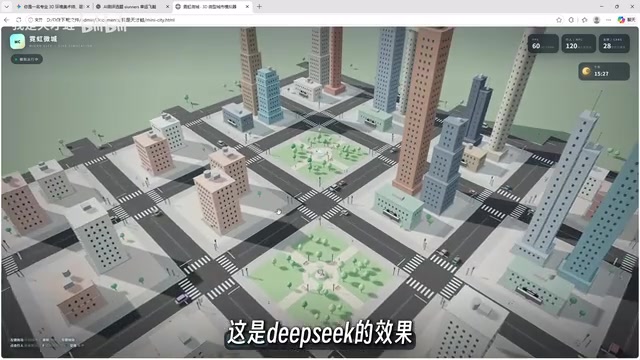
NPC behavior planning and state machines: The tasks "vehicles wait at red lights" and "NPCs cross the road according to traffic lights" involve implementing behavior logic in game AI, usually organized through finite state machines (FSMs) or behavior trees. The large model needs to translate behavior rules described in natural language into state transition conditions and trigger events, and ensure that multiple agents do not conflict. In the evaluation, "NPCs clustered to cross the road while there were no vehicles" and "the traffic lights did not light up" indicate that the model may have implemented only local logic without establishing global traffic scheduling and state synchronization. This dimension distinguishes a model's grasp of systemic logic more than modeling alone.
Task 5: 15-Second 3D Text Animation
Comparing the 15-second 3D text animations generated by the two models, the creator said he preferred DeepSeek's modeling quality, while Gemini performed better on musical rhythm and animation pacing; each had its strengths.
Task 6: Storyboard Narrative Animation Generation
Character reference images and a storyboard plot were provided, with the requirement to generate a code-based animation. The DeepSeek version had blurry image quality, abrupt sound, and abstract controls. The Gemini version had better modeling and image quality, a stronger cinematic storyboard feel, BGM that rose and fell with the plot, and fewer bugs. The creator considered Gemini superior.
Making storyboards and cinematic language computable: Storyboard narrative animation requires the model to understand the correspondence among "camera—frame—time," break the text script into shot sizes (long shot, medium shot, close-up), camera movement (dolly in/out, pan, tilt), and transition pacing on the timeline, then convert these into camera parameter keyframes and animation timelines in code. The evaluation's "cinematic storyboard feel" and "BGM that rises and falls with the plot" point precisely to this cross-modal orchestration ability—it depends simultaneously on narrative understanding, temporal planning, and audio beat alignment, and is currently one of the weaker and most differentiating aspects of multimodal large models.
Test Conclusions and Cost-Effectiveness Considerations
Across the six tasks, DeepSeek 4.1 Flash was superior in Subway Surfers, 3D world generation, and complex scene construction, while Gemini 4 Argon performed better in the boss battle, text animation pacing, and storyboard narrative animation, with each winning three tasks. The creator did not directly give a final conclusion on the "king of cost-effectiveness," but from the experience details, DeepSeek was more solid in 3D modeling and scene logic, while Gemini was more appealing in interaction smoothness and visual expressiveness.
At the end of the video, viewers were invited to comment on the test direction they would like to see next, with an emphasis on "one-click triple support." For developers, if the focus is scene generation and logic planning, DeepSeek is worth attention; if the pursuit is animation rhythm and cinematic feel, Gemini is more suitable.
The above conclusions are all based on the creator's subjective experience from a single test. Model capabilities may change with version updates, so it is recommended to verify against your own needs.
One-line Summary
DeepSeek 4.1 Flash and Gemini 4 Argon each won three of six tests; cost-effectiveness depends on the use case.
Paragraph Summary
Bilibili creator "Genius Frog" conducted a six-task comparison of the concurrently released DeepSeek 4.1 Flash and Gemini 4 Argon, covering 3D game development, 3D scene generation, and video generation. The results showed that DeepSeek was better in the Subway Surfers recreation, photo-to-3D world generation, and complex city scenes with NPC planning, with more solid modeling detail and scene logic; Gemini won in the 3D boss battle, 15-second text animation pacing, and storyboard narrative animation, with more appealing interaction smoothness and visual expressiveness. Each won three of the six tasks, with no absolute winner. The creator did not give a final "king of cost-effectiveness" conclusion, but instead recommended choosing by need: DeepSeek for scene generation and logic planning, Gemini for animation rhythm and cinematic feel. The conclusions are based on a single subjective experience and should be verified against individual needs.
Related articles

Free Unlimited Claude Code Solution: Agnes AI + CC Switch Setup Guide
No paid subscription needed — pair the free AI platform Agnes AI with the open-source tool CC Switch to provide a backend for Claude Code, enabling unlimited free calls to text, image, and video models. This guide covers the full setup, test results, and usage boundaries.

A Complete Zero-Cost Guide to Getting Started with Claude Code for Beginners in China
A beginner's guide to Claude Code for users in China: two installation methods (command line and IDE plugin), full configuration steps for replacing the official API with the free domestic LongCat model, and a hands-on demo of building a small tool with natural language, plus tips.

When the NSA Gets Involved: The AI Supply Chain Crisis Behind Open-Source CVEs and API Key Hijacking
Multiple open-source projects disclosed severe CVEs in one day, PHP flaws alarmed the FBI, and Railway and OpenCode were breached with API keys stolen. This article breaks down the vulnerability window, AI-accelerated exploitation, and the AI supply chain crisis behind the API key black market, with a developer defense checklist.