DeepSeek Adjusts Search Billing, Google Releases New Gemini Model
DeepSeek switches search billing to Tokens, Google launches a new model, and OpenAI and Alibaba Cloud disclose new progress.
This tech news roundup focuses on billing, models, and infrastructure. DeepSeek adjusts tool call pricing: web search and reading automatically triggered by the model are no longer billed per call; retrieved content enters context and is billed uniformly by Token usage, effective at noon on the 18th; standalone search or scraping APIs remain at 5 yuan per 1,000 successful requests, and developers who heavily use search augmentation need to re-estimate costs. Google releases a new model for complex programming and long tasks, supporting 1 million Token context, with API pricing at $3 per million input Tokens and $15 per million output Tokens, and opens Project Genie, an interactive world, to Ultra users. OpenAI discloses that AI-assisted chip design reduced some cell areas by about 13% and improved combined metrics by up to 14%, and lists the GPT 6.1 series as deferred in a safety statement. Alibaba Cloud AI cloud and compute service revenue exceeds 60 billion yuan, up 53% year over year; Anthropic prices its IPO at $83 per share, about $81.3 billion in total, and is expected to list on Nasdaq on November 19.
DeepSeek Adjusts Search Tool Call Billing, Changing Developer Bill Structure
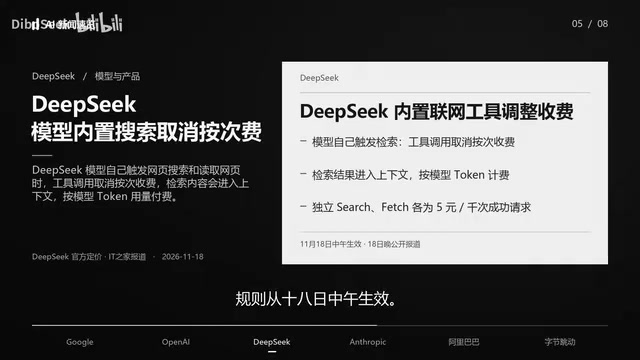
According to a Bilibili video report, DeepSeekAd has adjusted its billing rules for model-side tool calls: when the model autonomously triggers web search and web page reading, it is no longer billed by number of calls. Instead, retrieved content enters the context and is billed uniformly by model Token usage. The new rules took effect at noon on the 18th.
If developers directly call the standalone search or scraping APIs, the two services are each billed at 5 yuan per 1,000 successful requests. This change means that search behavior automatically triggered through the model has its cost folded into Token consumption, shifting the billing model from "per call" to "per usage."
For developers who frequently use search augmentation, call costs need to be re-estimated. Embedding search capability into the model context also makes the cost structure closer to the actual scale of generated content, rather than simply the number of requests.
What Is "Model-Side Tool Calling"
Tool Calling refers to a model proactively invoking external functions or services (such as web search, code execution, database queries) during inference to obtain information, then returning the results to the model to continue generation. Unlike developers manually orchestrating "search first, then ask," model-side tool calling lets the model decide when to call and how many times.
Under per-call billing, each search trigger incurs a fixed fee regardless of how much content the model actually processes; after switching to Token-based billing, the retrieved web page body is fed into the model as context, and its length directly determines cost. Therefore, a single search that captures long web pages may cost more than per-call billing; conversely, short retrievals are cheaper. Developers can control costs by limiting the number of returned results, trimming web page body text, and setting context truncation.
Google Releases New Model Focused on Complex Programming and Long Tasks
Google launched a new model codenamed Gemini Smear, focused on complex programming and long-task scenarios. In the official demo, the model was used to build a web-based skiing simulator capable of skiing different routes on real mountain terrain.
The model supports a 1 million Token context window, with API pricing at $3 per million input Tokens and $15 per million output Tokens. AI Studio has already begun opening access, and the Gemini app is also rolling out to Pro and Ultra users.
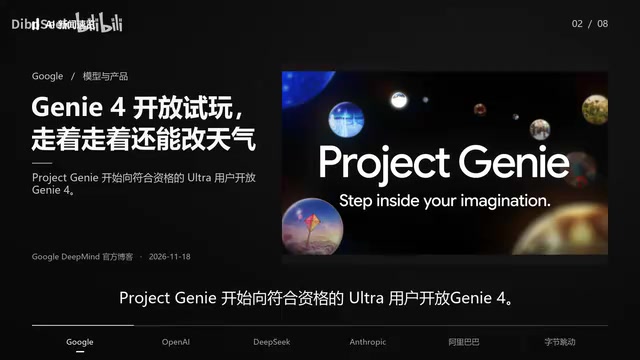
Google's other update feels more like previewing a new game: Project Genie has begun opening to eligible Ultra users. With Gemini 4, users can step into an interactive world, wander around while typing to change the weather, add characters, and have ambient sound and dialogue change with the scene. Users can also browse a community gallery to see other people's creations. Pro users can join the waitlist first.
Context Window and Long-Task Programming
The context window refers to the total number of Tokens a model can "see" in a single request, including input prompts, conversation history, tool return content, and model output. 1 million Tokens is roughly equivalent to hundreds of thousands of Chinese characters or the scale of a medium-sized code repository, enabling the model to read multiple source files in one session and maintain long-chain reasoning — the foundation of "long task" scenarios.
But long context is not free: input Tokens are billed by usage, and the longer the context, the higher the cost per request. In actual engineering, context caching and segmented summarization are usually combined to reduce costs. In addition, long context also has a "lost in the middle" problem, meaning the model has weaker recall for content located in the middle of the context, so key instructions are best placed at the beginning or end.
OpenAI Uses AI to Assist Chip Design, Some Module Metrics Improve
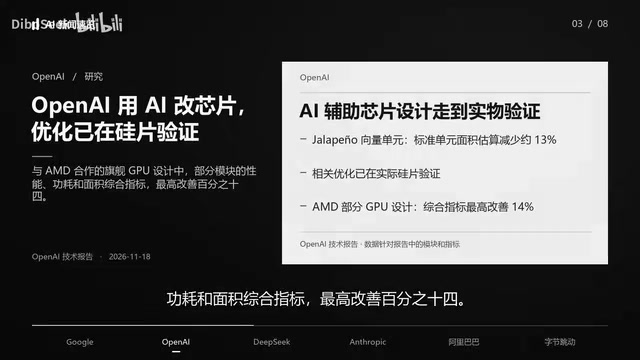
OpenAI disclosed progress in using AI to assist engineers in improving chip design. The team estimates that the vector compute unit and standard cell area of its self-developed inference chip were reduced by about 13%, and the related changes have been verified on actual silicon.
In the flagship GPU design in collaboration with IMD, the combined performance, power, and area metrics of some modules improved by up to 14%. This means AI is penetrating from the software layer into hardware design, helping engineers gain benefits in chip layout and cell-level optimization.
PPA, Standard Cells, and Vector Compute Units
The core evaluation metric in chip design is PPA: Performance, Power, and Area. The three constrain each other, and optimizing one often sacrifices another, so a composite metric is commonly used to measure improvement; "combined metrics improved by up to 14%" in the text refers to the weighted PPA result.
Standard cells are the basic building blocks of chip design, such as AND gates and flip-flops, and their area directly determines the overall chip size and cost. Vector compute units handle parallel processing of multiple data sets and are a key module in AI inference chips; their area and energy efficiency directly affect matrix operation throughput. Using AI to assist cell-level layout and sizing optimization can compress area and reduce power consumption without changing the architecture, which is why this progress is seen as AI penetrating hardware design.
OpenAI Safety Statement Discloses Deferred Models, GPT 6.2 Sparks Discussion
The video mentions that there had previously been discussion of GPT 6.2, and some wondered where the earlier 6.1 Soul and 6.1 Astra went. In a newly released safety statement, OpenAI lists these models as models that were "once deferred from release," citing the need for more time to meet its own safety standards.
The statement also describes how model behavior is monitored and operational permissions are restricted throughout the process from training to deployment. This reflects the ongoing tradeoff top model vendors make between release cadence and safety evaluation.
Alibaba Cloud and Compute Service Revenue Grows, Anthropic Advances IPO
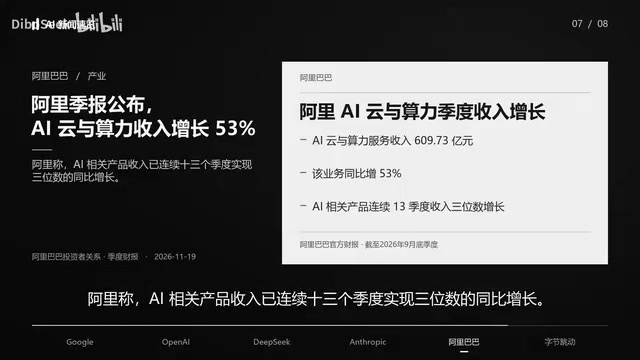
Alibaba announced quarterly results for the period ended at the end of September, with AI cloud and compute service revenue exceeding 60 billion yuan, up 53% year over year. Alibaba said AI-related product revenue has achieved triple-digit year-over-year growth for 13 consecutive quarters. This cloud and compute business scope includes Alibaba Cloud and Pingtouge.
Anthropic set its initial public offering price at $83 per share, for a total of 980 million shares, amounting to about $81.3 billion, including shares sold by existing shareholders. According to the announcement, the stock is expected to begin trading on Nasdaq in the United States on November 19 under the ticker ANT. At the time of collection, the market had not yet reached the listing time.
IPO Pricing and "Existing Shareholders Selling Shares"
The IPO offer price is the per-share price determined by the company and underwriters based on institutional subscription demand; multiplied by the total number of shares offered, it gives the fundraising size. The $81.3 billion in the text includes shares sold by existing shareholders, meaning part of the proceeds goes to existing investors cashing out rather than all entering the company's accounts; this portion is usually called a secondary offering.
First-day trading prices often deviate from the offer price, which more reflects primary-market consensus on valuation. For AI companies, an IPO also means increased financial disclosure obligations, making revenue structure, compute procurement costs, and losses more transparent and turning them into public indicators for observing industry conditions.
ByteDance in Talks with Microsoft on Azure Procurement
According to The Information, citing people familiar with the matter, ByteDance is in talks with Microsoft to purchase about $500 million more in Azure cloud services, mainly to call OpenAI models. Reuters subsequently reported that a U.S. House committee has asked Microsoft to explain the amount and purpose. The outcome of the deal remains unconfirmed; the above comes from media reports.
Editor's Observation
This round of information centers on three layers: billing rules, model capabilities, and infrastructure. DeepSeek's inclusion of search calls in Token billing shows that model vendors are exploring pricing that is closer to actual consumption; Google's new model sells long context and complex tasks as highlights while using Project Genie to showcase interactive generative experiences; OpenAI's chip design progress and Alibaba Cloud's compute revenue show that AI competition is extending toward hardware and cloud infrastructure.
For developers, paying attention to changes in billing scope and differences in API pricing is more practically meaningful than simply chasing model parameters. Several deals and IPO developments remain uncertain and should be subject to official announcements.
Related articles

Gemini 4 Neon's Comeback: How Google's 'American Doubao' Shipped Five Models in Two Weeks
Google shipped five models in two weeks. Gemini 4 Neon ranks third globally and first on the coding agent leaderboard, at half the cost of Opus 5.5. A Bilibili creator breaks down the three-layer comeback story: regulatory relief, sparse MoE architecture, and in-house TPUs—plus Carbon promo savings tips and AntiGravity quota rules.

What Is Hermes Agent? An Always-On AI Agent That Grows With You
Hermes Agent is an always-on AI agent running on a VPS, reachable via WhatsApp, Telegram, and Discord. It manages lists, calendars, and scheduled tasks and grows with use.

Building AI Animated Videos with Claude Code: A Hands-On Local Toolchain Guide
A hands-on demo of using Claude Code with local open-source tools like Kokoro and Remotion to generate AI videos with narration, animation, and music in minutes. Workflow, efficiency gains, and limitations analyzed.