DeepSeek and Huawei Open-Source an AI Computing Stack: How TileLang Challenges CUDA's Empire

DeepSeek and Huawei open-source a full AI stack with hardware-neutral TileLang to challenge NVIDIA's CUDA moat.
DeepSeek and Huawei have jointly open-sourced a full-stack AI computing infrastructure built on Ascend chips, with the core innovation being TileLang — a hardware-neutral language that compiles to both NVIDIA PTX and Ascend native instructions while cutting kernel code by ~80%. The move signals a strategic shift from CUDA compatibility layers to a higher-level abstraction that bypasses CUDA's rules entirely. Huawei opened Ascend's low-level instruction sets; DeepSeek open-sourced six toolkits refined on V4 models. The business logic mirrors Linux: free tooling attracts global developers, while Ascend hardware and cloud services capture the commercial upside.
An Open-Source Release Without a Launch Event — Why Is Silicon Valley Nervous?
In the past 24 hours, an open-source project rapidly climbed to the top of GitHub's trending list, drawing the attention of AI developers worldwide. No grand launch event. No Jensen Huang in his signature leather jacket. Just a concise README and source files for six low-level software modules. Chinese open-source AI team DeepSeekAd, in collaboration with Huawei, announced the global open-sourcing of a full-stack AI computing infrastructure built on Huawei's homegrown Ascend chip architecture.
At first glance, this might seem like routine domestic-chip ecosystem promotion. But developers who actually read the source code quickly realized this is no simple gesture of goodwill — DeepSeek and Huawei are aiming squarely at the competitive moat NVIDIA has spent nearly 20 years building: the CUDA ecosystem.
The backdrop is equally noteworthy: DeepSeek's annualized revenue is reportedly surpassing $1 billion USD, its valuation is racing toward 500 billion RMB, and it plans to deploy over 160,000 Huawei Ascend AI accelerator chips in its Inner Mongolia data center. With models, compute, and cash flow all in place, the decision to freely open-source its most critical low-level software is what makes this truly interesting.
The Real Barrier Isn't the GPU — It's CUDA
A long-standing misconception holds that the strongest card in chip export restrictions is the high-end GPU hardware itself. But hardware is just the tip of the iceberg. The CUDA software ecosystem beneath the surface — one that has captured millions of developers worldwide — is the far harder thing to displace.
Rewind to 2004: Stanford PhD student Ian Buck launched a project called Brook, attempting to use graphics cards for general-purpose parallel computing. Jensen Huang saw the potential, recruited Buck to NVIDIA in 2006, and CUDA was born.
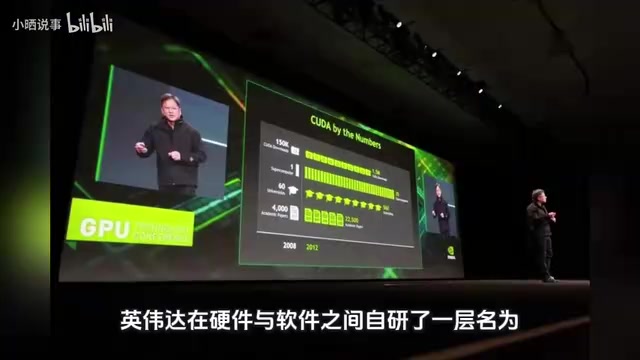
To promote CUDA, Huang made a bold bet: he required every NVIDIA GPU to embed CUDA modules at the hardware level. This directly raised costs, compressed margins, and caused the stock to tumble at the time. From 2006 until the deep learning revolution ignited by AlexNet in 2012, NVIDIA poured hundreds of millions of dollars annually into sustaining the CUDA ecosystem.
The key strategic move: NVIDIA built a proprietary intermediate layer called PTX between hardware and software — a "black box" of their own design. Countless lab codes written over more than a decade are all bound to CUDA's APIs, creating a brutal reality: even if a domestic chip matches NVIDIA's hardware performance, replacing NVIDIA means rewriting hundreds of thousands of lines of low-level code from scratch.
Why the "Translator" Approach Is a Losing Game
Domestic chips have generally taken the "CUDA compatibility layer" route — essentially translating CUDA instructions into native instructions. This strategy is inherently disadvantaged: you're fighting on the battlefield NVIDIA defined. Any time NVIDIA updates its underlying mappings, your translator could break, and hardware performance is already taking a 30–50% hit in translation. As long as you follow CUDA's logic, you're a perpetual underdog in chains.
A note on CUDA and PTX: CUDA (Compute Unified Device Architecture) is essentially a programming model that lets developers use GPUs as general-purpose parallel processors, encompassing a compiler, runtime libraries, and math acceleration libraries (such as cuDNN and cuBLAS) across dozens of components. PTX (Parallel Thread Execution) is NVIDIA's virtual instruction set architecture, serving as an intermediate layer between high-level code and actual GPU hardware instructions. This design is strategically brilliant: NVIDIA can iterate on hardware microarchitecture without breaking existing code compatibility, while keeping the PTX-to-silicon mapping entirely closed to competitors. After nearly 20 years of accumulation, the CUDA ecosystem spans deep learning frameworks (PyTorch, TensorFlow), scientific computing, graphics rendering, quantitative finance, and nearly every high-performance computing domain. The global active CUDA developer base is estimated at over 4 million — a lock-in effect that far exceeds any simple hardware performance gap.
TileLang: From Fighting in the Trenches to Changing the Terrain
Faced with this wall, DeepSeek and Huawei chose not to wrestle at the CUDA API level, but to "change the game entirely." The breakthrough is called TileLang — an open-source programming language originally led by a team at Peking University's School of Computer Science, with deep involvement from both DeepSeek and Huawei.
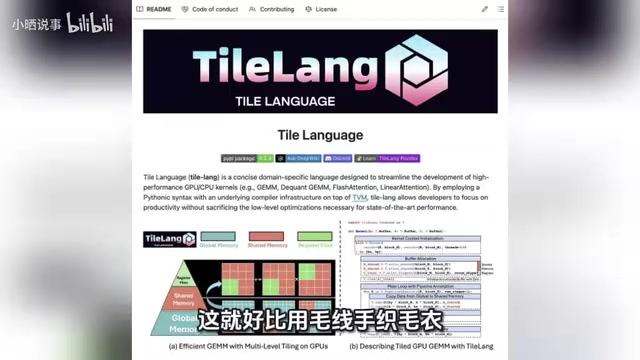
What it does can be understood through an analogy: traditional CUDA programming is like hand-knitting a sweater stitch by stitch. Developers must write hundreds of lines of extremely complex low-level code, precisely controlling which memory addresses each thread fetches data from. One mistake and the entire program crashes. TileLang lets developers declare computational intent in a Python-like syntax close to mathematical notation, leaving thread scheduling and memory mapping entirely to the compiler.
The results are striking: code volume drops by roughly 80%. The Flash Attention kernel that previously required over 500 lines of CUDA C++ reportedly takes around 80 lines in TileLang, while performance approaches the physical limits of the hardware.
More critically, TileLang is hardware-neutral — the same TileLang code can be compiled to NVIDIA's PTX instructions or directly to Huawei Ascend's native instructions. Developers don't need to learn a new language every time they switch chips, effectively weakening CUDA's role as a migration barrier.
Why Flash Attention matters here: Flash Attention is the key reference point for understanding TileLang's value. Proposed by Stanford PhD student Tri Dao in 2022, it reduces the memory footprint of the Transformer attention mechanism from O(N²) to linear by carefully controlling data movement between the GPU's fast on-chip memory (SRAM) and slower video memory (HBM), while dramatically improving real-world computational speed. Its CUDA implementation requires hundreds of lines of highly optimized low-level code precisely because data flow between registers, shared memory, and L2 cache must be manually orchestrated. These "kernels" are at the core of performance bottlenecks in large model training and inference, and represent the highest compatibility bar for any computing platform — any chip that cannot run Flash Attention efficiently is virtually useless in LLM scenarios. By dramatically lowering the barrier to writing such kernels, TileLang means more research teams can contribute high-quality implementations for non-NVIDIA platforms.
Hardware-Software Co-Design: A Full Open-Source "Arsenal"
If TileLang is the blade that cuts the chains, what's been released this time is an entire matching toolkit. Previously, chip makers didn't know what kernels large models needed, and model teams didn't understand how chip registers were scheduled — both sides were essentially shooting in the dark. This time, the algorithm lab and the hardware giant have achieved a deep collaboration.
Huawei has opened up the lowest-level instruction sets and interfaces of its Ascend chips, effectively making certain architectural details public. DeepSeek, in turn, has open-sourced all six low-level toolkits refined during development of the V4 model series — including distributed communication libraries, memory management, Flash MLA, and others — all rewritten and optimized using TileLang.
On the performance side, the two parties have established a network topology supporting single-layer switching across 128 cards on Ascend hardware, reportedly scalable to larger clusters. According to the source material, under specific deployment strategies targeting the DeepSeek V4.1 Flash model, with single-token latency controlled to around 10 milliseconds, per-card output throughput can reach thousands of tokens per second. The planned 160,000-card Ascend cluster in Inner Mongolia will be the real-world proving ground for this full-stack infrastructure.
Note: The performance figures above are transcribed from a single video source and may contain speech recognition errors. For precise metrics, refer to the official open-source documentation.
The Grand Strategy: AI Computing's "Linux Moment"
A natural question arises: if DeepSeek reportedly earns $1 billion annually from its API and Huawei is doing strong business selling chips, why give away painstakingly developed low-level software for free?
The answer echoes a pattern the open-source world has played out repeatedly — using an open ecosystem to counter a closed one. Just as Linux once eroded the server market through free openness, the core of this strategy isn't to profit from the software itself. It's to lower the migration barrier, gather global developers, and make the domestic computing stack a platform worth investing in. Once the ecosystem is large enough, hardware sales, cloud services, and model APIs all naturally benefit.
For developers, the real value lies in the emergence of a genuine alternative: previously, binding to CUDA was virtually the only option. If a hardware-neutral, lower-code toolchain can be proven stable and reliable, migration costs drop significantly. Whether this can truly shake CUDA's dominance still depends on ecosystem maturity, toolchain stability, and real-world performance — all of which require time and extensive third-party validation.
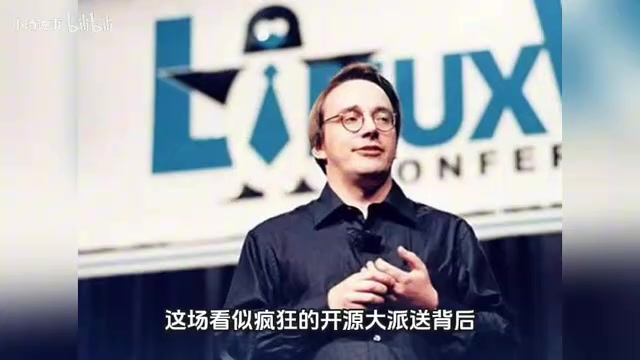
The Linux precedent: Linux offers a compelling historical parallel. In 1991, Linus Torvalds released the Linux kernel freely and openly, at a time when commercial Unix systems had mature ecosystems and established enterprise customers — the situation seemed unassailable. Yet by the 2010s, Linux dominated servers, supercomputers, and mobile (Android) — virtually every computing context — and the biggest beneficiaries were companies like Red Hat, IBM, Google, and Amazon that built commercial services around Linux. The key mechanism: open-source lowered trial costs for individual developers, a growing base of contributors accelerated ecosystem maturity, and a positive feedback loop formed. DeepSeek and Huawei's open-source logic closely mirrors this — Ascend hardware and cloud services are the ultimate monetization points, while the open software stack is the entry ticket to earning global developer trust and contributions. Of course, Linux's success took roughly a decade to reach scale. Whether a hardware-neutral toolchain can replicate this path in a rapidly evolving AI computing landscape remains genuinely uncertain.
Conclusion
Whether this open-source release will "deal a critical blow to NVIDIA," as some have claimed, is too early to say. The inertia of CUDA's nearly 20-year ecosystem is enormous — a single language and toolkit suite cannot overturn it in the short term. But the strategic direction itself is worth watching: shifting from "translation compatibility" to "changing the terrain entirely," from chasing hardware performance to opening up software ecosystems — this represents a meaningful pivot in how domestic computing platforms are competing. For global developers, the emergence of an open, hardware-neutral alternative is itself a meaningful development, regardless of how the larger story unfolds.
Related articles

Free Unlimited Claude Code Solution: Agnes AI + CC Switch Setup Guide
No paid subscription needed — pair the free AI platform Agnes AI with the open-source tool CC Switch to provide a backend for Claude Code, enabling unlimited free calls to text, image, and video models. This guide covers the full setup, test results, and usage boundaries.

A Complete Zero-Cost Guide to Getting Started with Claude Code for Beginners in China
A beginner's guide to Claude Code for users in China: two installation methods (command line and IDE plugin), full configuration steps for replacing the official API with the free domestic LongCat model, and a hands-on demo of building a small tool with natural language, plus tips.

When the NSA Gets Involved: The AI Supply Chain Crisis Behind Open-Source CVEs and API Key Hijacking
Multiple open-source projects disclosed severe CVEs in one day, PHP flaws alarmed the FBI, and Railway and OpenCode were breached with API keys stolen. This article breaks down the vulnerability window, AI-accelerated exploitation, and the AI supply chain crisis behind the API key black market, with a developer defense checklist.