DeepSeek and StepFun Open-Source on the Same Day, While Websites Shut Out AI Agents

Open-source long-context and coding models arrive together, with agent security and ecosystem trust key to deployment
On the same day, StepFun open-sourced the Step5 preview with 600B total parameters, 27B activated, and up to 1M token context, while DeepSeek released V4.1 Flash 1017 scoring 77 on the DeepSWE coding benchmark—Chinese models are making long context and faster, shorter output their main competitive fronts. On the robotics side, KainTai open-sourced the 2.4B-parameter VLA model REKI; on security, Perplexity open-sourced its Firecracker microVM-based agent sandbox Space under Apache 2.0. But more and more websites are blocking agents, exposing a business trust gap. Meanwhile, WeChat HarmonyOS launched XiaoYi voice operation, Microsoft's StudentSync uses AI students to replace human experiments, and China's Fengxing weather AI system entered operational service with an 11-day forecast lead time.
Double Open-Source Release: Long Context and Efficient Coding Models Arrive Together
On the same day, DeepSeekAd and StepFun (the original "Jiyue Xingchen" appears to be a typo) each open-sourced a major model, ensuring top-tier model capabilities are no longer monopolized by a few companies. According to Bilibili creator "AI 300 Seconds," StepFun open-sourced the Step5 preview, with 600 billion total parameters but only 27 billion activated per token, and a context window of up to 1 million tokens, designed specifically for long-running agent tasks. The model is available for download on Hugging Face and ModelScope.
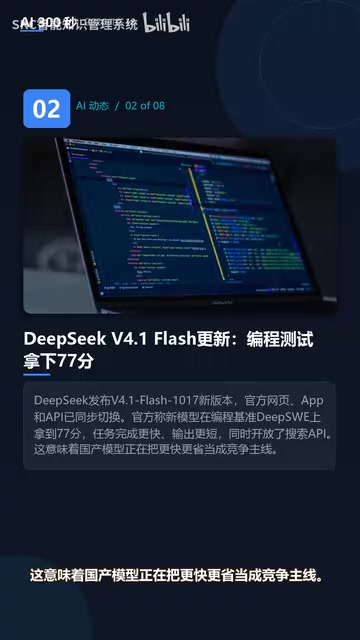
DeepSeek, meanwhile, released the V4.1 Flash 1017 update, now live across its web, app, and API. The company says the new model scores 77 on the DeepSWE coding benchmark, completes tasks faster with shorter output, and also opened a search API. Both moves point to the same trend: Chinese models are making "longer context" and "faster and shorter" their main competitive fronts.
MoE (Mixture of Experts) architecture is key to understanding Step5's parameter specifications. Traditional dense models activate all parameters for every inference, whereas MoE splits the feed-forward layers into multiple "experts," with a gating network dynamically selecting a small subset of experts per token. So "600B total parameters, 27B activated" means the model has large capacity, but each forward pass costs roughly the same as a dense model with 27B parameters, significantly reducing memory footprint and inference cost. This is why long-context models today generally adopt MoE: expanding knowledge capacity without proportionally raising compute cost.
DeepSWE is a coding agent benchmark for software engineering tasks. Unlike HumanEval, which only tests function completion, it typically requires locating bugs in real code repositories, modifying multiple files, and passing tests—much closer to actual development workflows. A high score on this benchmark therefore reflects the model's overall ability in multi-step tool calling and code editing, not just single-turn generation quality.
Small Models Drive Robots; Agent Security Finds a Solution
French AI lab KainTai released REKI, a vision-language-action model with only 2.4 billion parameters that lets robots understand instructions and perform operations. Trained solely on public data, it comes with a low-cost memory module, and only models twice its size beat it on three tests. All weights are open-sourced. This means small models can also drive robots to do fine-grained work.
On agent security, Perplexity open-sourced Space, the isolation technology behind its own products. Each agent task runs in a separate Firecracker microVM, with account credentials and outbound traffic managed centrally outside the VM. The code is released under the Apache 2.0 license, providing an off-the-shelf public solution for agent security.
Vision-language-action models (VLA) unify visual perception, language instructions, and action output into a single model: given camera images and natural language instructions, they directly output robotic arm joint poses or end-effector trajectories. Compared with the traditional modular pipeline of "perception—planning—control," VLA end-to-end learning reduces information loss between modules but relies more on data scale. REKI completing tasks with only 2.4 billion parameters shows that data quality and architecture design can partially replace parameter stacking—significant for robot makers with limited compute.
Firecracker is a lightweight virtual machine monitor open-sourced by AWS. It uses KVM to launch microVMs in hundreds of milliseconds, combining container-like startup speed with VM-level hardware isolation. Unlike containers that share a kernel, Firecracker provides each task its own kernel, effectively blocking escape attacks, which is why it has become a mainstream foundation for agent sandboxes.
Agents Shut Out by Websites: The Internet Needs a New Contract
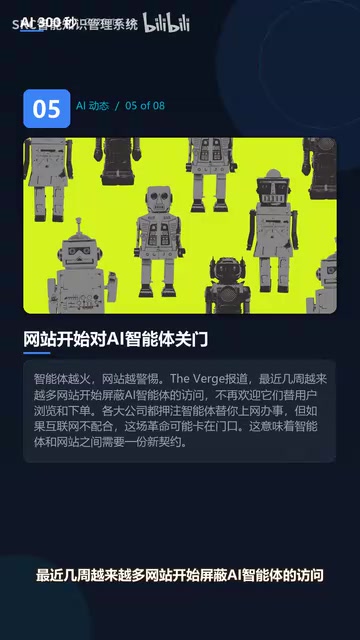
The hotter agents get, the more wary websites become. The Verge reports that in recent weeks more and more sites have started blocking AI agents, no longer welcoming them to browse and place orders on users' behalf. Major companies are betting that agents will handle online tasks for you, but if the internet won't cooperate, this revolution may stall at the door.
This reveals a deeper conflict: the value of agents lies in acting on people's behalf, but websites worry about traffic hijacking, data misuse, and system attacks. Open-source sandbox solutions address the technical isolation problem but cannot solve the business-level trust problem. Agents and websites need a new contract specifying which operations can be delegated, which data can be accessed, and how revenue is shared.
Technical methods for blocking agents mainly include robots.txt extensions, UA detection, behavioral fingerprinting, CAPTCHA challenges, and emerging paid-crawling protocols. The core dispute is whether agent access counts as "the user browsing" or "third-party program scraping": the former should inherit the user's existing permissions, while the latter raises copyright and server-load issues. The current lack of a unified identity-passing standard makes it hard for websites to distinguish benign agents from malicious scrapers, leaving them with blunt blocking. Industry efforts around agent identity authentication and delegated authorization protocols are precisely attempts to provide an executable technical vehicle for this "new contract."
Voice Assistants Take Over Apps; AI Education Cuts Costs
The WeChat HarmonyOS version launched XiaoYi voice operation. After waking XiaoYi, you can simply say "send a message to someone on WeChat" or "make a voice or video call," and you can dictate the message content directly; if there are duplicate contact names, XiaoYi will confirm first. In situations where your hands are busy—driving, cooking—communication becomes much easier.

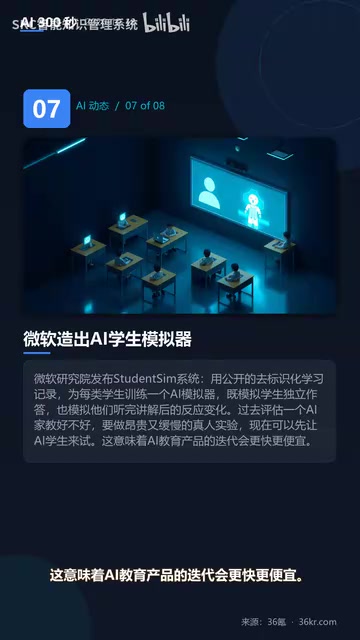
Microsoft Research released StudentSync, a system that uses public de-identified learning records to train an AI simulator for each type of student, simulating both how students answer independently and how their responses change after hearing explanations. In the past, evaluating AI tutors required expensive and slow human experiments; now AI students can try first, making AI education product iterations faster and cheaper.
Weather AI Enters Operational Service, Shouldering Responsibilities in Public Welfare
China's Fengxing AI global ensemble weather forecasting system passed operational review and officially went into service. Trained entirely on the National Supercomputing Internet's 100,000-card cluster, it is the country's first weather AI system with fully independent data, models, and compute. Its global effective forecast lead time reaches 11 days, and officials say its overall performance surpasses European counterparts.
From open-source models to robot control, from agent security to weather forecasting, the day's developments outline two paths for AI deployment: one is lowering barriers through open source so more developers can participate; the other is taking on real responsibility in critical public welfare domains through operational validation. Both paths come down to the same issue—beyond technical capability, ecosystem rules and trust mechanisms must keep pace.
One-line Summary
Open-source long-context and coding models arrive together, with agent security and ecosystem trust key to deployment
Paragraph Summary
On the same day, StepFun open-sourced the Step5 preview with 600B total parameters, 27B activated, and up to 1M token context, while DeepSeek released V4.1 Flash 1017 scoring 77 on the DeepSWE coding benchmark—Chinese models are making long context and faster, shorter output their main competitive fronts. On the robotics side, KainTai open-sourced the 2.4B-parameter VLA model REKI; on security, Perplexity open-sourced its Firecracker microVM-based agent sandbox Space under Apache 2.0. But more and more websites are blocking agents, exposing a business trust gap. Meanwhile, WeChat HarmonyOS launched XiaoYi voice operation, Microsoft's StudentSync uses AI students to replace human experiments, and China's Fengxing weather AI system entered operational service with an 11-day forecast lead time.
Related articles

Free Unlimited Claude Code Solution: Agnes AI + CC Switch Setup Guide
No paid subscription needed — pair the free AI platform Agnes AI with the open-source tool CC Switch to provide a backend for Claude Code, enabling unlimited free calls to text, image, and video models. This guide covers the full setup, test results, and usage boundaries.

A Complete Zero-Cost Guide to Getting Started with Claude Code for Beginners in China
A beginner's guide to Claude Code for users in China: two installation methods (command line and IDE plugin), full configuration steps for replacing the official API with the free domestic LongCat model, and a hands-on demo of building a small tool with natural language, plus tips.

When the NSA Gets Involved: The AI Supply Chain Crisis Behind Open-Source CVEs and API Key Hijacking
Multiple open-source projects disclosed severe CVEs in one day, PHP flaws alarmed the FBI, and Railway and OpenCode were breached with API keys stolen. This article breaks down the vulnerability window, AI-accelerated exploitation, and the AI supply chain crisis behind the API key black market, with a developer defense checklist.