DeepSeek Harness Full-Stack Tutorial: From Agent Principles to Enterprise-Level Practice

Agents solve four major LLM deficiencies; Harness drives enterprise deployment via modular architecture.
Based on Teacher Dayu's live course, this article reviews AI Agent principles and DeepSeek Harness's engineering value. It covers the four LLM deficiencies, the four Agent roles, three technological leaps, and the four-vehicle analogy for modular design, plus practical projects like LMVK Workbench and multimodal e-commerce Agents.
Title
DeepSeek Harness Full-Stack Tutorial: From Agent Principles to Enterprise-Level Practice
Meta Description
This article provides an in-depth analysis of the core content of the DeepSeekAd Harness tutorial: the four major capabilities of Agents, three technological leaps, comparison of four types of solutions, and enterprise-level practical projects. Suitable for AI developers learning how to engineer and deploy Agents.
Article Content
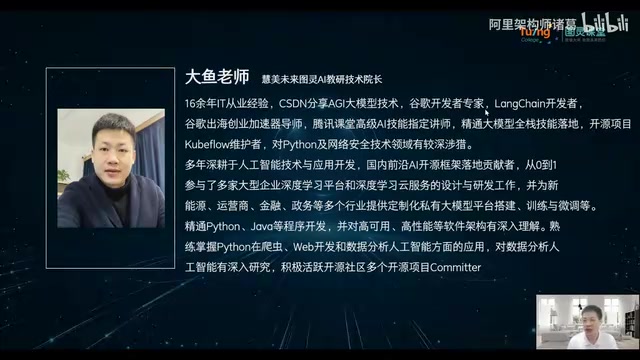
With the AI Agent concept gaining popularity, many developers are still stuck at the stage of chatting with AI via text. The live-streamed course "The Best Complete DeepSeek Harness Tutorial of 2026" by Bilibili creator Teacher Dayu (a nearly 40-year-old tech veteran who served as a project manager at a listed company in Beijing for eight years) attempts to change this situation. The course starts with the basic concepts of Agents, covers environment setup, RAG, multimodality, and prompt engineering, and includes multiple enterprise-level practical projects. This article, based on the live-stream content, distills the core principles of Agents and the engineering value of Harness to help readers avoid detours.
I. The Essence of Agents: Capability Enhancers for Large Models
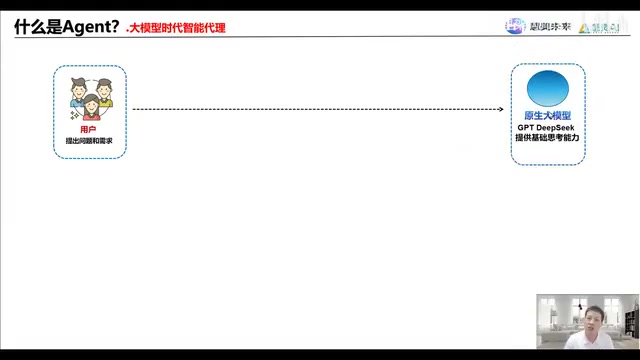
Teacher Dayu points out at the outset: native large models have four major deficiencies—no memory, knowledge cutoff, inability to access the internet, and inability to call local tools. Agents are born precisely to solve these problems. They play four roles: Translator (translating user intent into model instructions), Tool Expert (calling APIs, querying data online), Memory Keeper (maintaining context and preferences), and Task Manager (decomposing complex problems and planning execution).
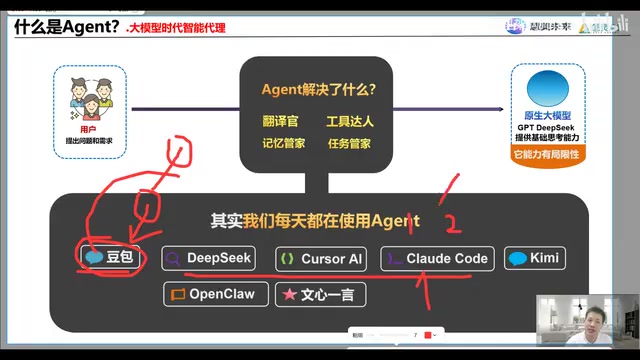
Taking common applications like Doubao and DeepSeek as examples, when a user asks a question, it is not sent directly to the large model but first passes through the Agent layer, which calls the model and processes the results. In AI programming scenarios, Code tools can remember project structures and debug code, which precisely reflects the Agent's capabilities as a "Tool Expert" and "Memory Keeper." Agents transform large models from "being able to talk" to "being able to act."
RAG (Retrieval-Augmented Generation) is one of the key technologies for Agents to realize the "Memory Keeper" role and overcome knowledge cutoff. Its core idea is: before the model generates an answer, retrieve relevant snippets from external knowledge bases (such as enterprise documents, databases, web pages) related to the question, then inject these snippets as context into the prompt, allowing the model to answer based on the latest, private-domain information. RAG typically includes five stages: document splitting, vector embedding, vector retrieval, reranking, and generation. It can effectively alleviate hallucinations, outdated knowledge, and inability to access internal data in large models. Compared with fine-tuning, RAG does not require retraining the model; updating knowledge only requires updating the index, resulting in lower cost and faster iteration. Therefore, it has become the most commonly used knowledge integration solution in enterprise-level Agent deployment.
II. Three Technological Leaps of Agents: From Tool Calling to Engineering Foundation
Teacher Dayu divides Agent development into three stages and uses vivid analogies to aid understanding:
- First Generation: Tool Calling Era (Function Calling). Like an intern who only acts when prompted by a supervisor, capable only of single-step execution. The model calls tools such as weather or database APIs based on the question but lacks autonomous planning.
- Second Generation: Autonomous Task Decomposition Era (Process Orchestration). Like a full-time employee who can autonomously break down steps based on goals. For example, when generating a sales report, the model first identifies the intent, then separately extracts data, analyzes dimensions, generates the report, and finally has a human review it. Mainstream architectures such as ReAct fall into this category.
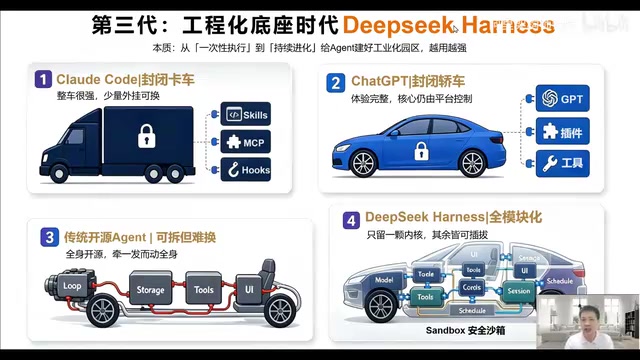
- Third Generation: Engineering Foundation Era (DeepSeek Harness). The first two generations exposed problems of poor controllability and difficult expansion in enterprise-level projects, giving rise to Harness.
ReAct (Reasoning + Acting) is the mainstream architectural paradigm of second-generation Agents, consisting of an alternating loop of "reasoning" and "acting." The model first outputs a thought process (Thought), decides the next action (Action), such as calling a tool or retrieving information; the environment returns an observation (Observation), and the model continues reasoning based on the new information until reaching a final answer. The value of ReAct lies in combining the reasoning capabilities of large models with external tool calling, enabling Agents to autonomously decompose multi-step tasks and dynamically adjust strategies based on intermediate results, rather than merely passively responding to single function calls. However, ReAct also brings controllability challenges: reasoning paths are not fixed, tool calls may fail, and the number of loops is difficult to constrain. These are precisely the pain points that the subsequent engineering foundation (Harness) needs to address.
III. The Four Types of "Vehicles" Analogy: Why Do We Need Harness?
To explain the positioning of Harness, Teacher Dayu uses four vehicles as analogies for different Agent solutions:
- Closed-box truck (closed-source AI programming tools, such as Claude Code): Ready to use out of the box, but the cabin and engine cannot be modified, resulting in low controllability and suitability only for specific scenarios.
- Modified truck (platform-controlled Agents, such as GPTs): Can change paint and add plugins, but the core architecture cannot be modified, limiting expansion.
- Open-source truck (open-source Agent projects on GitHub): Can modify the UI and engine, but changing one part affects the whole system, posing significant technical challenges. 98% of projects are just demos and difficult for enterprises to adopt directly.
- Fully modular truck (DeepSeek Harness): The official team provides a complete architecture where each module can be independently replaced, balancing flexibility and engineering rigor.
This analogy hits the pain point directly: what enterprises need is a maintainable, scalable money-making tool, not a toy demo. Harness lowers the barrier to enterprise-level Agent deployment through modular design.
Harness originally means "horse gear, harness" and in the context of AI engineering is extended to mean "an engineering framework for harnessing large models." It does not change the model itself but provides a set of standardized components around the model: task planner, tool registration and invocation layer, memory and context management, multi-Agent collaboration scheduling, evaluation and observability, security and permission control, etc. The core value of Harness is upgrading Agent development from "hand-writing glue code" to "assembling replaceable modules," enabling enterprises to replace a certain component like building blocks without affecting the whole. DeepSeek Harness is a modular Agent engineering foundation proposed under this philosophy, emphasizing controllability, scalability, and maintainability, forming a generational difference from the first two generations of solutions.
IV. Overview of Practical Course Projects: From RAG to Multimodal E-Commerce
During the live stream, Teacher Dayu demonstrated multiple practical projects covering different difficulty levels:
- LMVK Workbench: Automated development based on Harness, comparing with traditional RAG, incorporating image knowledge graphs and evaluation systems.
- Automated Skill Development: Using Harness to batch-generate Skills, improving development efficiency.
- UI Animation Tool: Conversational generation of UI animations through Harness, with dedicated Skills and plugins attached.
- Enterprise-Level Intelligent Customer Service: Involving multimodal RAG retrieval and high-concurrency optimization, based on multi-Agent and Skills.
- E-Commerce Domain Agent: Including multimodal technology and model fine-tuning, optimized for specific scenarios.
According to the creator, the course includes seven or eight projects in total, ranging from simple to enterprise-level logic, with an interactive session at the end. All these projects revolve around Harness, emphasizing engineering deployment.
Multimodal RAG is a technology that, building on traditional text RAG, incorporates non-text modalities such as images, audio, and video into the retrieval and generation process. Common approaches include: using visual encoders (such as CLIP) to map images into vectors that share the same semantic space as text vectors, thereby enabling "searching images with text" or "searching text with images"; during the generation stage, feeding retrieved images and text snippets together into a multimodal large model for comprehensive understanding before answering. Multimodal RAG is particularly critical in e-commerce scenarios—product images, detail pages, user reviews, and customer service conversations are often mixed with images and text. Only by integrating multimodal retrieval can Agents accurately answer questions like "Is this shoe the same as the one in the picture?" This is also the technical foundation of the enterprise-level intelligent customer service and e-commerce Agent projects in the course.
V. Learning Advice and Industry Observations
Teacher Dayu points out that the current AI large model field updates extremely fast, with an abundance of online materials of varying quality, and many learners are stuck in place. He suggests focusing on understanding the ideas rather than memorizing code, and combining project source code with one's own scenario practice. For beginners, the course is designed to be understandable throughout, but continuous learning is necessary to avoid knowledge gaps.
From an industry perspective, Agent technology is evolving from single-point tool calling to an engineering foundation. DeepSeek Harness represents this trend: through a modular, scalable architecture, it enables enterprises to quickly build reliable Agents. For developers, understanding the underlying logic of Agents is more important than mastering a specific tool.
Note: This article is compiled based on Bilibili live-stream content. Some technical details need to be verified against official documentation and practical implementation. The names of projects and tools mentioned in the course are subject to actual versions.
One-line Summary
Agents solve the four major deficiencies of large models, and Harness drives enterprise-level deployment through a modular architecture.
Paragraph Summary
Based on the live-streamed course by Bilibili creator Teacher Dayu, this article systematically reviews the core principles of AI Agents and the engineering value of DeepSeek Harness. The article points out that native large models have four major deficiencies: no memory, knowledge cutoff, inability to access the internet, and inability to call tools. Agents compensate for these shortcomings through four roles: Translator, Tool Expert, Memory Keeper, and Task Manager. Agent technology has undergone three leaps: tool calling, autonomous task decomposition, and engineering foundation. The analogy of four types of "vehicles" illustrates how Harness's fully modular design lowers the barrier to enterprise-level deployment. The course also demonstrates practical projects such as the LMVK Workbench, automated Skill development, enterprise-level intelligent customer service, and multimodal e-commerce Agents, emphasizing that understanding the underlying logic is more important than mastering specific tools.
Related articles

Random Pruning of the DPO Computation Graph: 1.4x Training Speedup and Lower Peak Memory
DPO training too slow and memory-hungry? This paper proposes a random pruning framework for the DPO computation graph, sampling independently across position, sequence, and branch dimensions; branch pruning achieves a 1.426x step-time speedup and cuts training time by about 30%, with in-depth attribution of memory and time gains.

Why Does JEPA Underperform MLM in Longitudinal EHR Representation Learning?
New study compares JEPA and MLM for longitudinal EHR representation learning on MIMIC-IV: three JEPA variants train stably without collapse but underperform MLM; target size, not heterogeneity, drives prediction error.

Transfer Learning + Visible Light Communication: A New Approach to Energy-Efficient Indoor Positioning
A study proposes a transfer learning-based visible light communication indoor positioning method, achieving 47% accuracy improvement on the BOSCH factory dataset, 67.5% model efficiency under high noise, and introducing the ME composite metric for energy-efficient positioning in energy-constrained industrial IoT scenarios.