DeepSeek Harness One-Month Retrospective: Highlights, Risks, and the Road Ahead
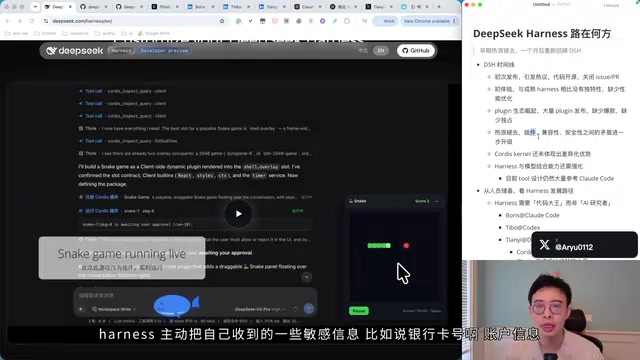
DSH at one month: strong vision, weak plugin exclusivity, with cloud Agent as the likely commercial breakthrough.
One month into its developer preview, DeepSeek Harness (DSH) has a clear agent = model + harness vision but still lags behind Claude Code and Codex in token efficiency and genuine differentiation. Its Plugin ecosystem — the intended differentiator — lacks both breakout hits and exclusivity, while open plugins introduce unresolved supply chain security risks. The Codex Kernel framework shows research-lab sensibilities and frequent breaking changes. The creator's core thesis: Harness success depends on hiring "code kings" with production engineering experience, not AI researchers. Lead contributor Cui Tianyi's Jane Street background fits that profile. Hiring signals strongly suggest DSH is heading toward a Cloud Agent + Agent API model as its commercial path.
DeepSeek Harness One-Month Retrospective: Highlights, Risks, and the Road Ahead
DeepSeek's proprietary Harness (referred to as DSH throughout this article) has been out for one month. Waiting until the initial hype dies down before taking stock usually yields clearer insights. As a project still in "developer preview," many of DSH's design choices will continue to evolve — but a month of community development is already enough to assess its positioning, weaknesses, and commercial direction.
This article draws on analysis from Bilibili creator "技术杂谈" and examines the project's real progress across three dimensions: commercial evolution, talent strategy, and future roadmap.
Agent = Model + Harness: Clear Positioning, But Not Enough Differentiation
DSH's positioning is stated plainly — it argues that an agent should unify model and harness, expressed as agent = model + harness. This aligns with industry consensus: it makes sense for model providers to bundle model and harness together to improve user retention and performance. But Claude Code and Codex already got there first and have captured significant market share. Latecomers need a genuine edge.
DSH's main differentiator is its Plugin ecosystem, paired with a design philosophy called Codex that emphasizes composability. The vision is compelling; the execution, however, still feels thin.
Timeline: From Viral Buzz to Cooling Off
The project exploded out of the gate, with the repository now accumulating over 220,000 stars — a number that has long since lost most of its signal value, but one that underscores its standing as a community darling. One notable move: DSH closed both issues and PRs on the repository. Some critics called this "not truly open source," but given DeepSeek's current ecosystem position, the ratio of genuinely useful contributions to noise in a flood of incoming issues and PRs is probably less than one in a thousand. Prioritizing fast internal iteration makes more sense at this stage.
Hands-on feedback since version 0.1.2 has been mixed to negative: compared to mature Harnesses, DSH lacks distinctiveness and basic performance optimizations. For example, when mounting a large number of MCP tools, mature Harnesses typically offer Lazy Tool Discovery — avoiding the need to include every tool's full schema in every request, which would otherwise burn tokens for no reason. Early DSH lacked this capability. For identical tasks, DSH offered no advantage in token efficiency.
Background: MCP (Model Context Protocol) is an open protocol proposed by Anthropic to standardize interactions between AI models and external tools and data sources. Lazy Tool Discovery is an optimization strategy used by mature Harnesses when many MCP tools are connected: rather than stuffing every registered tool's full schema into the context on every request, the Harness dynamically selects relevant tools based on task intent. This dramatically reduces the number of tokens sent per API call. Since most major LLM APIs charge by token, carrying full tool schemas inflates costs significantly — especially when the tool count reaches dozens or even hundreds. This is why token efficiency has become a key metric for evaluating Harness maturity.
The Plugin Ecosystem: No Breakout Hits, No Exclusivity
Since the Harness itself offers no standout differentiation, that differentiation has to come from plugins — which is why there's been a wave of commentary and land-grabbing attempts around the Plugin system. But after one month, two problems are obvious:
- No breakout hits: No plugin has emerged that users feel compelled to install, that delivers a clear improvement, and that is deeply integrated with DSH in ways that matter.
- No exclusivity: Even the more capable plugins can almost all be ported to Claude Code or Codex — nothing is truly DSH-only.
The official launch demo scenarios were relatively modest: adding a floating whale to a UI, building a small game plugin, creating a code review mode. None of these are breakout hits, and none are exclusive — running the same functionality inside versus outside a Harness currently shows no meaningful difference.
Security Concerns from an Open Plugin System
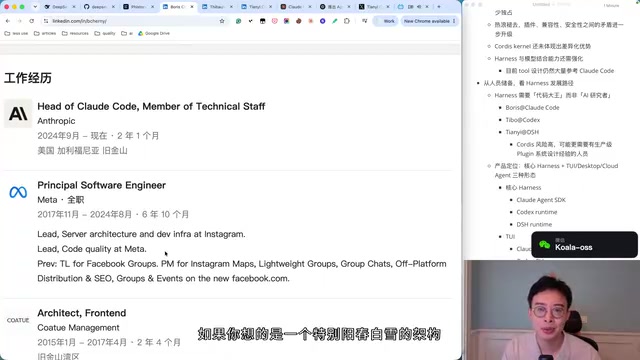
As the hype faded, the community turned its attention to vulnerabilities — and the sharpest concern is security. When the plugin system is this open and agents can modify themselves, there's an inherent tension between flexibility and safety.
The dominant real-world scenario is professional developers building powerful plugins that get distributed to large numbers of end users — developers and users are naturally two distinct groups. The question is: how do users audit the security of a plugin and its supply chain? Imagine a popular plugin that, in a later version, has a prompt injected into it that instructs the Harness to silently exfiltrate sensitive data — bank account numbers, credentials — to a remote address. That's a textbook supply chain attack.
The creator's assessment is that current DSH — and frankly most Harnesses — has not solved this auditing problem. Aggressively pushing a plugin ecosystem before security standards mature risks earning a reputation for "providing an insecure foundation." The silver lining is that without any breakout plugins yet, there's been no large-scale security incident to trigger.
Background: Supply chain attacks are a classic threat model in software security: rather than attacking the target system directly, attackers compromise an upstream dependency — an open-source library, a plugin, or a build tool. Traditional package ecosystems like npm and PyPI have seen multiple malicious package incidents. AI Harness plugin ecosystems face similar risks, but with higher stakes: plugins can directly influence an LLM's system prompt and tool-calling logic. An attacker only needs to inject instructions into a plugin's prompt to silently manipulate model behavior and steal sensitive information from context — all without the user noticing. Compared to traditional code audits, prompt-level malicious injection is harder to detect with automated scanning tools, placing much higher demands on plugin marketplace governance.
Codex Kernel: An Abstraction with Research-Lab Sensibilities
DSH's plugin system is built around a mechanism called Codex Kernel, but it hasn't yet demonstrated real differentiation. It comes with an accompanying paper emphasizing abstractions like lifecycle, Effect, Service, and Invent — describing itself as "a programming paradigm as spatiotemporal and organizational structure."
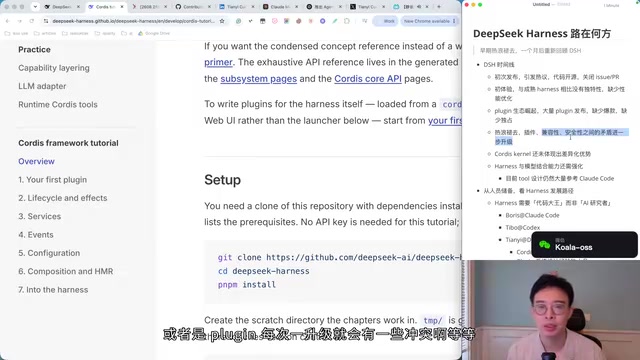
The creator argues that this kind of conceptual framework work was extremely common before the LLM era (React is, in some sense, the culmination of exactly this type of thinking). The real challenge isn't how elegant or precise the framework is — it's whether it can accommodate as much Dirty Work as possible. And that kind of Dirty Work can't be designed away through pure reasoning; you have to encounter enough real plugins to understand it. The frequent breaking changes and plugin upgrade conflicts that have appeared since Codex launched are evidence that maturity isn't there yet.
Built-in tool design is also critical for any Harness — it's the core of the model-harness integration. But DSH's built-in tools draw heavily from Claude Code. Take the classic file editing tool: the filePath / oldString / newString / replaceAll parameter design is essentially identical to Claude Code's. The idea of using a unique oldString match to prevent unintended edits is a sensible design that Claude Code introduced early on. At the tooling layer, DSH is still catching up to mature Harnesses. Whether it can develop highly efficient tools that are deeply bound to its own model remains to be seen.
The Talent Question: Harnesses Need "Code Kings"
"The answer is sometimes right there in the question." The creator's central thesis is: a Harness is a code product, and its trajectory depends on who is writing the code. A Harness needs "code kings" — engineers with extensive production-grade engineering experience — not AI researchers. Researcher-led Harnesses are likely to be frustrating to use, and this explains why many model providers' Harnesses have failed.
Three case studies support this:
- Boris of Claude Code: Before joining Anthropic, his background was firmly on the engineering side — nearly seven years at Meta/Facebook working on server-side architecture, developer infrastructure, and code quality projects, plus a stint as PM for Instagram. Strong engineering instincts combined with product sense gave him the ability to elegantly handle real-world Dirty Work.
- Tibo of Codex: Three years as a senior engineer at Google, then leading a 20+ person SWE team at DeepMind focused on AI/ML infrastructure. More research-adjacent, but with solid engineering fundamentals — which is why the Codex he shipped feels grounded.
- Cui Tianyi of DSH: Graduated from Zhejiang University and joined Jane Street — a firm renowned for the difficulty and quality standards of its codebase — as a quantitative researcher. This background fits the "code king" profile perfectly, and his quantitative background also resonates with DeepSeek's Hunfang origins. He is by far the top contributor to DSH by code volume.
From this angle, DeepSeek's hiring judgment looks sound. The risk, however, is that DSH has given a relatively prominent position to the research-flavored Codex system. To truly build out the Plugin system, DSH needs people with production-grade plugin design experience — ideally from ecosystems like VS Code that have processed enormous amounts of Dirty Work — rather than relying on researchers.
WorkBuddy (a Tencent product) is also a positive example on the domestic side. Its team started out building CodeBuddy, accumulating engineering experience before the LLM era, and is fundamentally composed of code kings — which is why it produces a solid Harness. By contrast, another internal Tencent track following the OpenCode logic (with a name featuring "Code") is characterized by the creator as short-sighted and lacking taste.
Background: Jane Street is one of the world's top quantitative trading firms, renowned for its extreme standards of code quality and engineering rigor. It uses OCaml — a functional programming language relatively uncommon in industry — internally at scale, with near-academic requirements for type systems and program correctness. Engineers at Jane Street spend their careers building production systems that demand high concurrency, low latency, and strong consistency, all under the zero-tolerance-for-bugs pressure of financial environments. This background produces engineers who combine a researcher's capacity for abstraction with a pragmatic engineer's ability to ship — capable of designing elegant system abstractions while having the patience and experience to deal with real-world Dirty Work. That composite profile is exactly what Harness development requires.
The Complete Harness Shape: One Core, Three Forms
A complete Harness ecosystem should be "one core, three forms":
- Core: A runtime library that can be called programmatically. Anthropic has the Claude Agent SDK, OpenAI has the Codex Runtime, and DeepSeek has the DSH Runtime. A Harness that ships only a TUI or desktop app with no core library has limited long-term prospects.
- Three forms: An interactive TUI accessed via CLI, a desktop app, and a cloud Agent. All three sharing the same core is what enables competitive iteration speed.
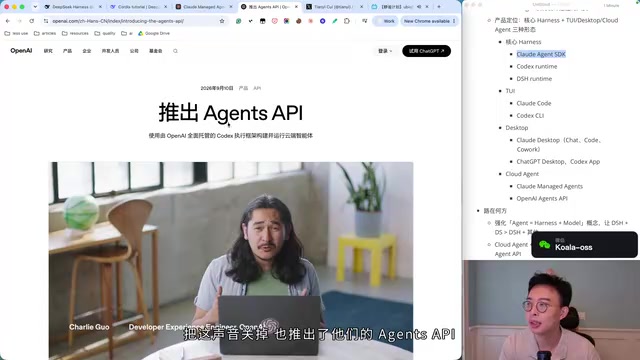
Cloud Agents are now a certainty: Anthropic launched Claude Managed Agents (built on the Claude Agent SDK) in the first half of the year, and OpenAI launched an Agent API built on Codex. What DSH has shipped today is best understood as a Runtime; the TUI and desktop app haven't really been productized yet, and a cloud Agent hasn't launched either.
Reading the Hiring Signals
Cui Tianyi recently posted a hiring push for over 150 roles, with a focus on server-side engineers, Agent framework/component engineers, and Agent elastic compute engineers. Hiring server-side engineers to build an Agent framework, with a need for elastic compute and Sandbox infrastructure — this practically announces that DSH will move to the cloud and adopt an Agent API form. The target profile of engineers with two to ten years of experience also reinforces the "find code kings, not AI researchers" logic.
Background: TUI (Terminal User Interface) refers to programs that run in a command-line terminal with an interactive interface, distinct from pure command-line tools (CLI). Claude Code, Codex CLI, and similar Harnesses all use TUI as their primary interaction layer, letting users have conversations, review diffs, and confirm file changes without leaving the terminal. A Runtime library is the core logic layer that can be called directly by other programs — it's the "engine" of the Harness. The upper layers can be a TUI, a desktop GUI, or a cloud service, but sharing the same underlying Runtime ensures behavioral consistency and reduces maintenance costs. A Harness that only has a TUI and no Runtime library can't support a cloud Agent form, which limits its commercial runway.
Conclusion: Three Possible Paths
Taking stock of everything, three paths forward deserve attention:
- Double down on Model + Harness integration. The success metric here is a simple formula:
DSH + DeepSeek model > DSH + any other model. Even if DSH can't beat Claude Code + Claude for now, if no model — however expensive or powerful — outperforms DeepSeek's own models when paired with DSH, that means the Harness has achieved genuine exclusivity. - Go deep on Cloud Agents combined with the Plugin ecosystem, delivering killer vertical solutions for finance, healthcare, and research via an Agent API. With plugins hidden behind the cloud layer, deep optimization and elastic infrastructure create cost moats and strong user lock-in.
- Let TUI and desktop develop at their own pace. End users care most about these surfaces, but a server-side team isn't best positioned to build them — it will take time for the right product-minded talent to emerge.
For a developer preview that's one month old, these gaps are all acceptable. The real story is what comes next — whether DSH can grow genuine exclusivity of its own. The answer may be hidden in its talent pipeline and cloud ambitions.
Related articles
AI Programming at Xiamen University: A Full Breakdown from Textbook to Teaching
Xiamen University's Lin Ziyu shares how he built an AI programming course — covering three coding eras, Claude Code's production-ready milestone, three methodologies, and a fully free, reproducible curriculum design.

A DeepSeek Researcher's Confession: The AI He Trained Is About to Replace Him
DeepSeek V4.1 kernel engineer Liu Shengyu admits the AI he trained will surpass his own skills within a year—yet he keeps pushing forward. Here's why.
n8n Automation in Practice: How AI Workflows Help SMBs Cut Costs and Boost Efficiency
Learn how SMBs use n8n and AI tools to automate multi-platform messaging, AI customer service replies, and bulk exam data entry — real-world workflows for cutting costs.