DeepSeek Harness Private Deployment Review: Open-Source Multi-User Setup Saves 25% on Tokens

DeepSeek Harness enables low-barrier private multi-user deployment via PanelAI, potentially replacing closed-source API solutions.
DeepSeek Harness is an open-source AI coding tool supporting local private deployment in both desktop (single-user) and server (team) forms. Its official server build lacks multi-user isolation by default, but PanelAI enables deployment in ~5 minutes with per-user container sandboxing. User benchmarks suggest its minimal mode saves ~25% in token consumption vs. Claude, while private deployment converts variable API costs into a one-time hardware investment. It supports Ollama and vLLM locally plus cloud APIs, with PanelAI providing unified API aggregation. Best suited for teams with data compliance needs and available server resources, though broader real-world validation is still needed.
Open-source AI coding tools are emerging as a new option for teams looking to cut costs and boost productivity. DeepSeek Harness, an open-source solution that supports local private deployment, recently released both a desktop client and a server-side build. In a hands-on test, Bilibili creator "Bear Bro" moved it from a "desktop toy" onto a production server and used PanelAI to enable multi-user sharing. The experiment points to a core question: can open-source private deployment truly match closed-source APIs in both cost and experience?
Desktop vs. Server: Two Deployment Modes, Two Different Goals
DeepSeekAd Harness currently offers two deployment paths — desktop and server — each with a clearly distinct purpose.
The desktop client is a recently released build that's extremely easy to install: just double-click and run. Once bound to a local GPU or CPU, it can directly access local files and invoke local toolchains without uploading any data. However, because it was released recently, the testing found a number of bugs and the experience hasn't been fully polished. Its positioning is clear — single-machine, single-user use.
The server build targets team scenarios. The official standard installation requires just one command to deploy, but by default it's still single-user with no multi-user or data isolation mechanism. Teams that want true "N-user sharing" will need additional operational tooling to fill that gap.
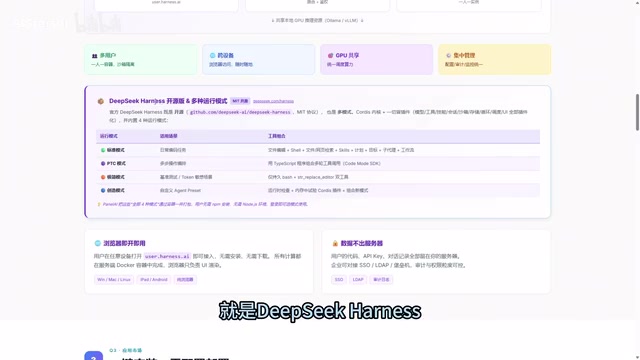
PanelAI One-Click Deployment: Lowering the Multi-User Ops Bar
The official self-hosted installation docs involve five steps, plus ongoing concerns around maintenance, upgrades, migration, and enterprise compliance — the barrier is not trivial. The approach covered in the video is to use PanelAI for a "no-brainer deployment" that compresses the entire process to roughly five minutes.
The workflow is: copy a command from the PanelAI website, paste and run it, then click through "Next" repeatedly to complete installation. This generates a backend URL, a frontend URL, and login credentials. From there, search for DeepSeek Harness in the app marketplace, click install, select a deployment node, and once done you can launch it, open it, and configure your LLM.
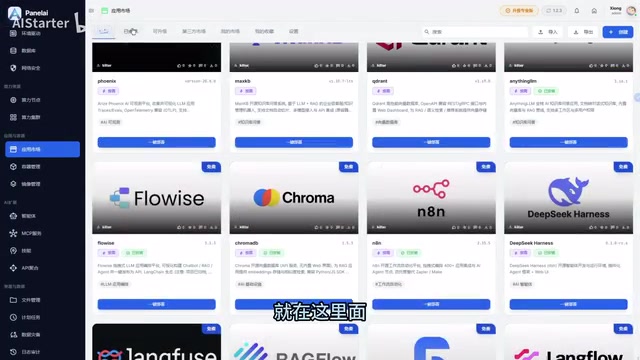
PanelAI offers two deployment modes: in on-demand mode, each user gets a new independent container — sandbox isolation, one container per person; in global mode, it behaves like a standard deployment with a shared environment. Multi-user support combined with container isolation is exactly the capability that the official server build lacks, yet is essential for team use cases.
One operational detail worth noting: PanelAI's system settings include network proxy and accelerated mirror features, which can be enabled and speed-tested in environments without direct internet access. That said, the free mirror may fail on large projects or unstable networks; in such cases, you can use the floating action button to check installation task progress and feed the failure logs to an LLM for diagnosis.
What is container isolation (sandbox isolation)? Container isolation uses technologies like Docker to create independent runtime environments for each user. Containers share the host kernel but have their own isolated filesystems, process spaces, and network namespaces. In a multi-user AI coding tool scenario, this means User A's code repository, config files, and model context are completely invisible to User B, and a crashed container won't affect others. This is especially important for teams with data compliance requirements — code and prompt history from different project groups never mix in the same process, satisfying basic data isolation and audit needs. By contrast, a shared environment (global mode) has lower resource overhead but puts all users in the same process and file space, creating risks of data leakage and cross-user interference.
Cost and Performance: The Case for 25% Token Savings
The biggest appeal of open-source private deployment lies in a fundamentally different cost structure.
According to user benchmark data cited in the video, DeepSeek Harness's "minimal mode" can save approximately 25% in token consumption compared to closed-source solutions like Claude. More importantly, local private deployment means there is no per-token billing — as long as you have your own server, you can "run it freely," converting variable API spending into a one-time hardware investment.
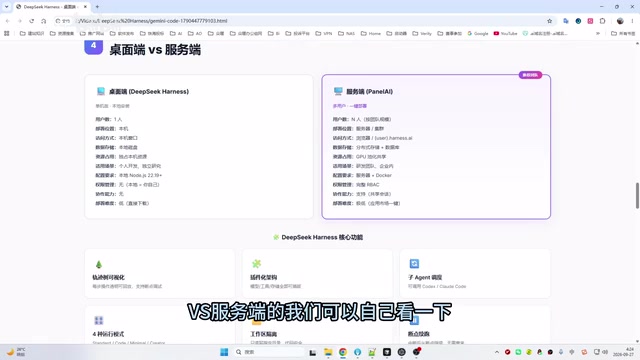
In a side-by-side comparison with similar products, the video stacks DeepSeek Harness against mainstream tools like Claude Code and OpenAI Codex. The conclusion is that the open-source solution has clear advantages in privacy, data isolation, and cost predictability — at the cost of requiring your own server and some operational know-how. For server-side hardware, the video suggests a personal setup in the range of 20,000–30,000 RMB is sufficient.
A note of caution: The 25% figure comes from a single user's test and has not been independently verified at scale. Readers should treat it as a directional reference, not a definitive conclusion.
Model Integration: Combining Local and Cloud APIs
DeepSeek Harness maintains the flexibility expected of an open-source tool when it comes to model integration. Local deployment can run via Ollama, vLLM, and similar solutions — all of which can be deployed with one click inside PanelAI — while cloud API access is also supported.
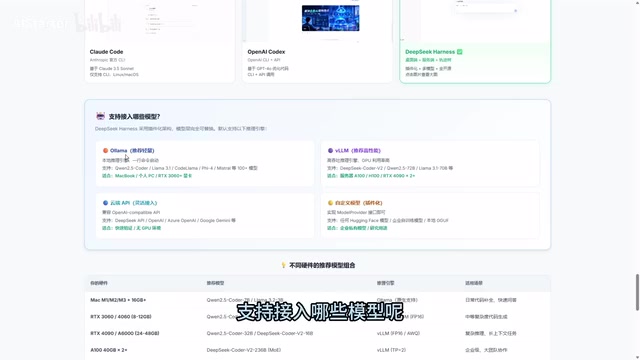
Going further, PanelAI has a built-in API aggregation feature that connects both local models and commercial APIs simultaneously, then generates distribution tokens for the team to use. The system supports automatic model switching or manual model selection, enabling unified scheduling across local and cloud resources. The video also provides recommended model combinations and best practices for different hardware configurations, which teams can use to match their own needs.
What are Ollama and vLLM? Ollama is an open-source runtime designed for running large language models locally. It supports pulling and launching mainstream open-source models like LLaMA, Mistral, and DeepSeek with a single command, automatically handling quantized formats (such as GGUF) and hardware acceleration — abstracting away the underlying configuration complexity for general users. vLLM is a Python framework for high-throughput inference, using PagedAttention technology to dramatically improve GPU memory utilization and concurrent processing capacity, making it better suited for team server scenarios with multiple simultaneous requests. The two serve different niches: Ollama wins on ease of use and quick setup; vLLM wins on production-grade concurrency. The API aggregation layer abstracts both local runtimes and external commercial APIs (such as the official DeepSeek API, OpenAI, etc.) into a unified interface — team members don't need to care whether the underlying call is hitting a local GPU or cloud compute, as the system can route automatically based on load, cost, or availability.
Who Should Consider This
Overall, DeepSeek Harness's value proposition centers on the combination of open-source + private deployment + multi-user sharing. For teams with data compliance requirements, a desire to escape per-token billing, and available server resources, it's a solution worth seriously evaluating. For individual light users, the desktop client is easy to install but still buggy enough that it's better to wait for further iterations.
With panel tools like PanelAI, the previously high barrier to self-hosted operations is meaningfully lowered — a key step in making open-source tools viable for real team deployments. As for whether it can truly "crush closed-source APIs," more real-world project data is needed to make that case. For now, the hands-on testing offers a compelling directional reference, but not yet a definitive verdict.
Related articles

Amphibious Transforming Drone: Beyond 100x Power Savings, What Are the Real Needs?
Is the amphibious transforming drone just a gimmick? Starting from the 100x power difference of the M4 Morphobot, explore real application scenarios and thesis topic ideas, analyzing boundary conditions where pure drones and pure ground robots both fail.

Warhound Raises $200 Million: Genetically Engineered "War Dogs" Paired with Anduril Gear
Warhound raises $200M, backed by Ben Lamm and Palmer Luckey, to genetically engineer dogs for military and law enforcement use and equip them with Anduril gear. This article analyzes its technology direction, funding logic, and ethical controversy.

Claude API Comes to Google Cloud: IAM Integration and SDK Access Guide
Anthropic hosts the full Claude API on Google Cloud with IAM-controlled permissions and unified billing. This guide covers the Vertex AI and Anthropic-hosted entry points, IAM role configuration, and SDK access.