DeepSeek Harness rc.8 Released: Major Upgrades to Multimodal Image Understanding and Sub-Agent System

DeepSeek Harness rc.8 adds multimodal image understanding, sub-agent system, and Windows terminal persistence.
DeepSeek Harness rc.8 introduces multimodal capabilities enabling Agents to understand images, a sub-agent system allowing on-demand installation of Claude Code and Codex as Profile Bundles, persistent PowerShell terminal support for Windows, and SQLite performance optimizations. With over 170K GitHub stars and just two days between rc.7 and rc.8, this plugin-based Agent framework demonstrates extraordinary community momentum and iteration speed, though it remains in developer preview with breaking changes expected.
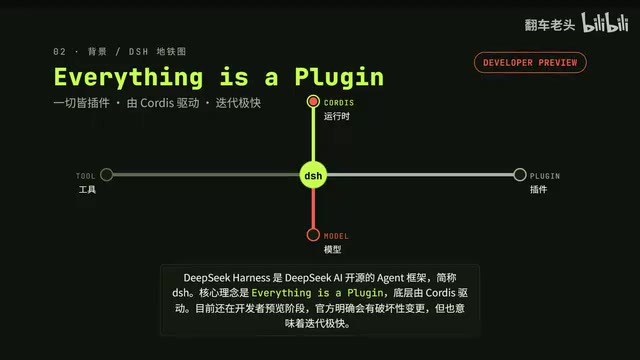
DeepSeek Harness: An Agent Framework Where Everything is a Plugin
DeepSeekAd Harness (DSH) is an open-source Agent framework released by DeepSeek AI, built around the core design philosophy of "Everything is a Plugin." The entire framework is powered by Core Ads at its foundation, using a plugin-based architecture that allows developers to flexibly extend various Agent capabilities.
This "Everything is a Plugin" design philosophy originates from the Microkernel architecture concept in software engineering. In this architecture, the system core provides only the most basic runtime environment and plugin lifecycle management, while all business functionality—including model invocation, tool execution, memory management, etc.—is dynamically loaded as plugins. The advantage of this design lies in its extremely high extensibility and decoupling: developers can add new capabilities by writing plugins without modifying the framework's core code. Similar design philosophies have been successfully implemented in VSCode's Extension system and Webpack's Plugin mechanism, proving to be an effective paradigm for addressing complex functional requirements.
Interestingly, the project is still in a developer preview stage. The team has explicitly stated that breaking changes will occur, meaning it's not yet suitable for deployment in stable production environments. From another perspective, however, frequent breaking changes are precisely indicative of the project's rapid iteration speed and highly active feature evolution.
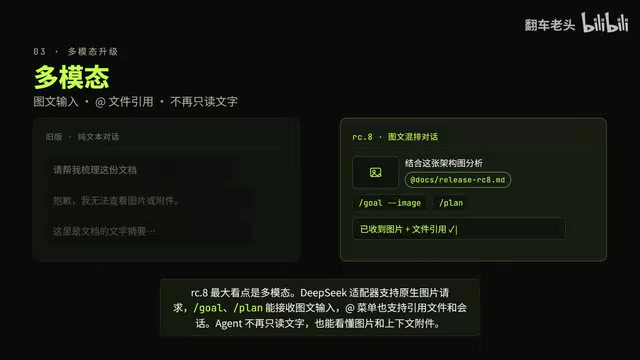
rc.8 Core Update: The Multimodal Leap from "Reading Text Only" to "Understanding Images"
The biggest highlight of the rc.8 release is the introduction of multimodal capabilities. The DeepSeek adapter now supports native image requests, Bondi Go and Bondi Plan can both accept mixed text-and-image inputs, and the Bondi CE menu supports file references and drawing functionality.
Multimodal refers to an AI system's ability to simultaneously process and understand multiple types of input data, such as text, images, audio, and video. In the large language model space, the evolution from pure text to multimodal has gone through several key stages: early approaches used models like CLIP to achieve image-text alignment, and later models like GPT-4V and Gemini integrated visual encoders directly into language models for end-to-end multimodal understanding. For Agent frameworks, multimodal support means Agents can receive screenshots, parse charts, and understand UI layouts—critical for use cases like automated testing, design review, and data analysis.
The significance of this upgrade is that Agents are no longer limited to pure text processing; they can truly "see and understand" images and contextual attachments. For automated tasks that need to handle interface screenshots, charts, design mockups, and other visual information, multimodal support represents a critical leap forward.
Sub-Agent System: On-Demand Capability Extension Modules
Another major update is the sub-agent mechanism. In rc.8, Claude Code and Codex can be installed on-demand as Profile Bundles, allowing developers to combine different agent capabilities based on their actual needs.
The sub-agent mechanism is one of the core components of Multi-Agent Systems (MAS). In complex tasks, a single Agent often cannot handle all stages alone, so tasks need to be decomposed and delegated to sub-agents with specific capabilities. This is similar to microservices architecture in software development—each sub-agent focuses on a specific domain, communicating and collaborating through protocols. Claude Code excels at code generation and debugging, while Codex provides efficient code execution capabilities. By making them available as installable Profile Bundles, developers can assemble Agent workflows suited to their scenarios like building blocks.
Notably, Codex supports non-interactive permission modes and allows the creation of multiple named instances, providing foundational support for parallelized, multi-task Agent workflows. Non-interactive permission mode allows sub-agents to autonomously execute operations without human supervision—a prerequisite for achieving fully automated pipelines. Users can configure independent sub-agent instances for different scenarios, enabling more granular task division.
Windows Terminal Persistence and SQLite Performance Optimization
For Windows platform users, rc.8 also brings substantial improvements. The framework adds persistent PowerShell terminal support (PTY) and sets the Minimal preset as enabled by default.
PTY (Pseudo-Terminal) is a virtual terminal interface provided by the operating system that simulates physical terminal behavior, allowing programs to perform input/output as if interacting with a real terminal. Introducing persistent PTY in an Agent framework means the Agent can maintain a long-running Shell session, executing multiple commands while preserving environment variables and working directory state, rather than spawning a new process for every command. This is particularly important for development tasks requiring consecutive multi-step operations (such as compiling, testing, and deploying), avoiding the overhead of repeatedly initializing the environment.
This means Windows users can now enjoy a terminal interaction experience comparable to Unix-like systems, with Agents executing command-line operations in persistent sessions.
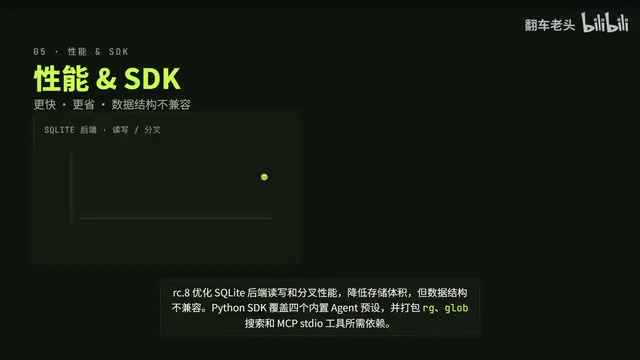
On the underlying performance front, rc.8 optimizes the SQLite backend, improving read/write and fork performance while reducing storage size. SQLite is a lightweight embedded relational database that requires no separate server process and stores data in a single file. In Agent frameworks, SQLite is typically used to store conversation history, task states, plugin configurations, memory context, and other structured data. The "fork" performance optimization relates to Agent conversation branch management—when a user creates a new branch from a conversation node, the framework needs to efficiently copy or reference historical data. Compared to databases like Redis or PostgreSQL that require additional deployment, SQLite's zero-configuration nature makes it the ideal choice for local-first Agent tools.
However, it's important to note: the new version's data structure is incompatible with older versions, so be sure to plan for data backup and migration before upgrading.
Additionally, the Python SDK has been enhanced to cover four built-in Agent presets and bundle the dependencies required for Glob search and MCP STDIO tools, further lowering the barrier to entry for developers. It's worth mentioning that MCP (Model Context Protocol) is an open standard proposed by Anthropic, designed to establish a unified communication interface between AI models and external tools/data sources. STDIO is one of MCP's supported transport methods, enabling inter-process communication through standard input/output streams, suitable for local tool integration. The emergence of the MCP protocol addresses the previous incompatibility between tool-calling interfaces across different Agent frameworks, similar to how USB unified the connection method for various peripherals. DSH's built-in MCP STDIO support means developers can directly reuse existing tool plugins from the entire MCP ecosystem.
Community Momentum and Iteration Speed: Over 170K GitHub Stars
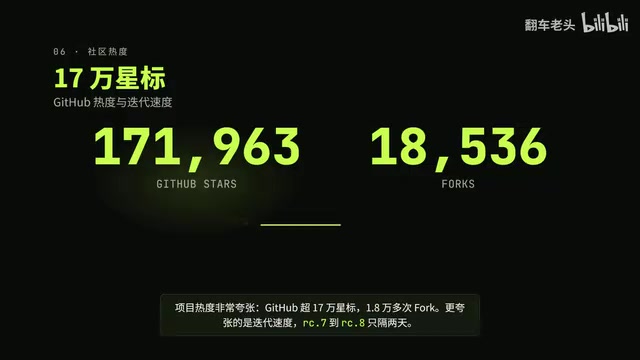
From a community perspective, DeepSeek Harness's popularity can only be described as "extraordinary." The project has garnered over 170,000 stars and more than 18,000 forks on GitHub—numbers that are exceptionally rare among open-source Agent frameworks.
Even more impressive is its iteration pace—only two days elapsed between rc.7 and rc.8. Behind this high-frequency release schedule is active development investment and the ability to rapidly respond to community feedback.
How to Quickly Get Started with DeepSeek Harness
If you want to experience this Agent workstation locally with a single command, you can try running the relevant command via MPX to launch DeepSeek AMH. DSH Web opens by default on port 3080, making it convenient to access and operate directly through a browser.
Once again, since it's still a preview version with breaking changes, it's recommended to position it for technical exploration and learning experiments only—it's not yet recommended for stable production workloads.
Summary
The DeepSeek Harness rc.8 update delivers comprehensive upgrades across three major directions: multimodal capabilities, sub-agents, and Windows terminal support, demonstrating the framework's continuous expansion of Agent capability boundaries. For developers following the open-source Agent ecosystem, this is a project worth tracking closely—despite being in preview stage, its plugin-based architecture, rapid iteration, and active community all signal its potential in the future Agent toolchain.
Related articles

Free Unlimited Claude Code Solution: Agnes AI + CC Switch Setup Guide
No paid subscription needed — pair the free AI platform Agnes AI with the open-source tool CC Switch to provide a backend for Claude Code, enabling unlimited free calls to text, image, and video models. This guide covers the full setup, test results, and usage boundaries.

A Complete Zero-Cost Guide to Getting Started with Claude Code for Beginners in China
A beginner's guide to Claude Code for users in China: two installation methods (command line and IDE plugin), full configuration steps for replacing the official API with the free domestic LongCat model, and a hands-on demo of building a small tool with natural language, plus tips.

When the NSA Gets Involved: The AI Supply Chain Crisis Behind Open-Source CVEs and API Key Hijacking
Multiple open-source projects disclosed severe CVEs in one day, PHP flaws alarmed the FBI, and Railway and OpenCode were breached with API keys stolen. This article breaks down the vulnerability window, AI-accelerated exploitation, and the AI supply chain crisis behind the API key black market, with a developer defense checklist.