DeepSeek Launches Search API, Zhipu's Open-Source Legal LLM Tops Charts

DeepSeek, Zhipu, Tsinghua密集 release models and agent tools; Claude old version sunset; platforms restrict AI access.
This news flash covers models, tools, and ecosystem. DeepSeek pushes V4.1 Flash 1017 with reduced latency and bundled web search/scraping APIs, but benchmarks and pricing remain undisclosed; Zhipu open-sources legal model GLM-Legal, ranking first among open weights on VALS AI's Harvey Lab and Legal Bench; Tsinghua and partners open-source agent OS Pilotech 2.0, natively supporting MCP and cutting task costs 83% via project isolation, white-box memory, background execution, and smart routing. Claude Haiku 4.5 retires October 29; Haiku 5.5 is cheaper with adjustable reasoning; Anthropic also highlights Claude's quantum circuit design and cryptography breakthroughs. Codex data shows 87% faster connector development, while Citibank, Bank of America, and multiple sites restrict AI agent access, narrowing brute-force automation.
1. DeepSeek 1017 Release: Search and Scraping APIs Bundled In
Developers who frequently write code and build agents have likely noticed that after open-sourcing the 552B-parameter, million-token-context V4.1 Flash, DeepSeekAd has pushed a new version: V4.1 Flash 1017. The core of this update is just two things: further reduced inference latency for the model itself, emphasizing a "wish-driven programming" experience where a single sentence generates a complete project; and the simultaneous launch of web search and scraping APIs, along with the release of Harness V0.2.1-RCE.
Previously, building agents with DeepSeek required developers to separately configure third-party search interfaces and web cleaning pipelines. Now the official team has bundled search, scraping, and underlying model upgrades together. However, according to the original Bilibili news flash, detailed benchmark comparison tables and search API pricing tiers have not yet been disclosed. Developers currently using DeepSeek for coding or web-connected retrieval workflows can switch to the 1017 snapshot in the backend to test generation speed directly.
Wish-driven programming (vibe coding / wish-driven coding) refers to developers describing goals in natural language only, with the model generating a complete runnable project in one shot, rather than line-by-line code completion. This experience places high demands on the model's context length, instruction following, and multi-file consistency, typically requiring million-level token context to accommodate project structure, dependencies, and historical conversation. The difference from traditional code completion lies in delivery granularity: the former outputs runnable artifacts, the latter outputs code snippets. Therefore, when evaluating this capability, beyond generation speed, attention should also be paid to one-shot success rate, subsequent maintainability, and whether the model "forgets" early constraints in long contexts—which is also why the official benchmark table is worth waiting for.
2. Zhipu GLM-Legal: Open-Source Benchmark in the Legal Vertical
Domestic models are positioning themselves more aggressively in vertical professional domains. Zhipu has officially launched a legal-specific open-source large model, GLM-Legal, which directly handles contract review, evidence linking, cross-border compliance research, and other practical work, delivering work products that can be directly used, not just a Q&A machine reciting legal statutes.

In the latest legal evaluation published by authoritative assessment agency VALS AI, GLM-Legal achieved a 19.2% full task pass rate and 86.23% accuracy, simultaneously taking first place among open-weight models on both the Harvey Lab and Legal Bench leaderboards. After general-purpose foundation models have exhausted code, high-ticket industry-specific tasks such as contract review, cross-border compliance, and privately deployed legal assistants may be the most easily implemented scenarios.
VALS AI is a third-party AI evaluation agency for the legal industry, whose leaderboards use real law firm tasks as question banks rather than multiple-choice-style legal Q&A. Among them, Harvey Lab originates from the research benchmark of legal AI company Harvey, focusing on practical processes such as contract review and due diligence; Legal Bench focuses more on the accuracy of legal reasoning and statutory application. The two metrics have different meanings: "full task pass rate" measures whether end-to-end delivery is directly usable, typically lower; "accuracy" measures the correct proportion of single-point judgments. GLM-Legal's 19.2% full pass rate combined with 86.23% accuracy indicates solid performance on step-by-step tasks, but the stability of complete workflows remains the main bottleneck for vertical model deployment.
3. Tsinghua Open-Sources Agent OS Pilotech 2.0: Costs Cut by 83%
With a good underlying model, managing a bunch of working agents is another headache. Cross-project file interference, tasks stalling when the user leaves the computer, and runaway bills are common pain points when using agents for complex projects daily. Tsinghua University's Sangdoupi Lab, together with ModelBest, OpenManB, and other teams, has open-sourced an agent operating system, Pilotech 2.0, with native MCP protocol support, offering four practical mechanisms:
- Project-level isolation: Files, memory, and tasks do not interfere across projects
- White-box long-term memory: AI remembers project background and work progress, viewable and manually editable at any time, no need to re-explain each time
- Long-cycle background execution: Automatically advances even when the user leaves the computer
- Intelligent routing: Complex reasoning goes to strong models, simple steps to cheaper models
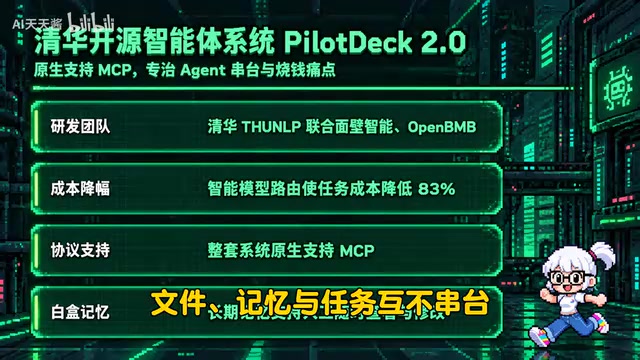
Official tests show that this mechanism set cuts overall task costs by 83%. Developers who heavily rely on multi-agent long workflows should install and try it.
4. Claude Old Version Sunset Countdown and Hardcore Research Achievements
If you still have older lightweight Claude models in your routing list, you must change your configuration now. Following the October 7 release of Claude Haiku 5.5, which reduces operating costs by about 75%, Anthropic has announced the retirement deadline for the old model: on October 29, the previous generation Claude Haiku 4.5 will be officially removed from model options.
The new Haiku 5.5 costs only $0.1 per million input tokens and $0.5 per million output tokens for prompts under 100K tokens, and for the first time supports adjusting reasoning effort, comprehensively outperforming the old version in both speed and billing. Less than two weeks remain to change code; developers who have hardcoded the Haiku 4.5 model name in production should switch API parameters to Haiku 5.5 this weekend to avoid online service errors at the end of the month.
Anthropic has also been densely showcasing Claude's achievements in hardcore research these past two days: the company announced that Claude autonomously designed quantum circuits surpassing current top human solutions; in another case akin to digital archaeology, Claude took less than 30 minutes to solve the mystery behind the source of NSA parameters that had puzzled the cryptography community for 26 years, proving that the academic community had collectively gone in the wrong direction for 20 years.

As a subtle contrast, OpenAI's previously hyped Navier-Stokes equation proof method has recently been pointed out by outsiders as inconsistent with the official narrative, with the agent's contribution remaining a mystery and full academic verification requiring years. In comparison, having large models work in narrow domains that can be quickly verified, such as cryptography restoration and circuit optimization, currently offers more tangible value.
5. Codex Deployment Data and Ecosystem Changes
On the programming tool ecosystem side, OpenAI released two sets of real deployment data for Codex. A new Stack Overflow product for agents launched by a well-known tech community saw two engineers use Codex to complete development from scratch in just a few weeks, compressing single connector build time from 3-6 weeks to 4 days, an 87% reduction; after integrating GPT plugins, new registrations tripled overnight and agent creation surged 10x. Financial institution Benefit Street Partners used Codex to develop credit analysis and valuation tools, getting a previously cumbersome tracking system running in one day and shortening credit agreement production time to about 20 minutes.
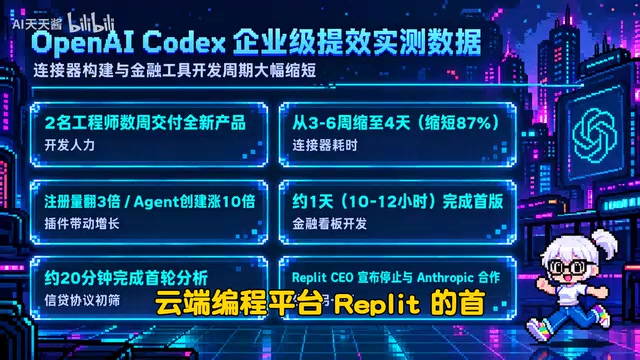
Some rejoice, some part ways. The CEO of cloud programming platform Ripleet stated externally that they no longer collaborate with Anthropic, but the report did not disclose specific business reasons. For frontline programmers, big company alignments are not a major concern; what's truly worth learning from is using agents like Codex to tackle dirty work such as internal connectors and data dashboards, with immediate efficiency gains.
Connector in this context refers to adapter components that allow AI agents to access external systems (such as CRM, ticketing systems, databases, internal APIs), typically including engineering details like authentication, field mapping, rate limiting, and error retry. It is time-consuming because each external system has different authentication methods and data models, and permission boundaries and sensitive data masking must be handled. Codex compressing single connector build time from 3-6 weeks to 4 days essentially automates boilerplate code, SDK calls, and debugging, shifting the engineer's role to defining interface contracts and acceptance tests. This also explains why "tackling dirty work like internal connectors and data dashboards" is currently the most certain scenario for agent efficiency gains: clear task boundaries and automatically verifiable results.
6. Agents Hit the Wall of the Real Internet
As AI agents capable of autonomously operating browsers become widespread, traditional financial institutions and content websites are starting to close doors together. To prevent automated scripts from frequently comparing prices and shifting funds, causing deposit outflows, Citibank and Bank of America have officially moved to restrict external AI agents from accessing customer accounts; multiple mainstream overseas websites are densely tightening doors to block AI automated access; Meta, under external concerns about data scraping and AI training, urgently deleted controversial wording in its terms that might allow it to scrape news websites.
The trend is clear: when agents move from chat boxes to customer-facing operations and全网 scraping, they touch the platforms' most core fund retention and data assets. Developers working on financial advisory assistants, automated price comparison, or cross-site operation agents must prepare to use official authorized interfaces; the path of brute-forcing third-party websites purely through simulated clicks will become increasingly narrow.
Background
MCP (Model Context Protocol) is an open standard proposed and open-sourced by Anthropic in late 2024 to unify the connection between large models and external tools and data sources. Previously, every agent framework had to write separate adapter layers for browsers, databases, file systems, and other tools, resulting in severe interface fragmentation. MCP decouples "tool providers" and "model callers": tools only need to implement an MCP Server once, and any model or agent platform supporting the protocol can call it directly, similar to a USB-C interface in the AI field. Pilotech 2.0's native MCP support means its built-in tools and third-party ecosystem can be plug-and-play, and it also facilitates developers in quickly exposing self-developed internal systems to agents—one of the key foundations for reducing integration and operational costs.
One-line Summary
DeepSeek, Zhipu, and Tsinghua密集 released models and agent tools, Claude old versions sunset, platforms begin restricting AI access.
Paragraph Summary
This news flash covers three lines: models, tools, and ecosystem. DeepSeek pushed V4.1 Flash 1017, reducing inference latency and bundling web search and scraping APIs, though benchmarks and pricing are not yet public; Zhipu open-sourced legal-specific model GLM-Legal, taking first place among open weights on VALS AI's Harvey Lab and Legal Bench; Tsinghua, together with ModelBest and others, open-sourced agent OS Pilotech 2.0, natively supporting MCP, cutting task costs by 83% through project isolation, white-box memory, background execution, and intelligent routing. On Claude, Haiku 4.5 will be retired on October 29, Haiku 5.5 is cheaper and supports adjustable reasoning effort; Anthropic also disclosed Claude's achievements in quantum circuit design and cryptography parameter tracing. Codex deployment data shows 87% efficiency gain in connector development, while Citibank, Bank of America, and multiple websites begin restricting AI agent access, tightening the brute-force automated script approach.
Related articles

When Did Paid Childcare Become the Norm? Working Mothers and the Evolution of Childcare
When did paid childcare become the norm? This article traces the evolution from the rise of childcare centers in the 1970s–80s and the 1990s linking of federal subsidies to work requirements, to declining stigma and rising costs, and explores advocates' 25-year effort to catch up with other countries on childcare and paid parental leave.

Red Flags for Product-Market Fit: A Practical Guide from Top VCs and the Superhuman Founder
Investors from Iconiq and Sapphire Ventures and Superhuman founder Rahul Vohra share PMF red flags and practical methods, including the 40% disappointment rule, retention curves, and acquisition costs.

What Task Should AI Agents Take Over Most? Heated Reddit Discussion
Reddit discussion: Which task do you most want AI agents to take over completely? Cross-app data migration, CRM updates, and report generation top the list, but insufficient reliability and the trust gap are the biggest obstacles to automation adoption.