DeepSeek Multi-Agent and Qwen Code Open-Source Preview: New Developments in AI Coding Tools
AI coding tools are recently focusing on multi-agent collaboration, open-source frameworks, and command-line efficiency optimization.
Several updates have recently appeared in the AI coding tools space: DeepSeek Harness 0.2.2 RC2 supports named sub-agents and multi-layer collaboration, and enhances GitHub review handling; the Qwen Code 1.0 preview combines Coder and agent capabilities, offering native installers and support for multiple model services; OpenAI Codex CLI 0.167.2 changes Vertex AI tool updates to incremental sending by default. These updates reflect a shift in AI coding tools from competing on individual capabilities to workflow integration—multi-agent systems emphasize collaboration and review, open-source frameworks emphasize installation convenience and interface compatibility, and command-line tools emphasize call efficiency. Developers need to weigh integration costs, task completion, and long-term maintenance risks, and the stability of release candidates and previews still needs time to be proven.
The AI coding tools space has seen a flurry of activity recently—from multi-agent collaboration frameworks to open-source code assistants and minor optimizations in command-line tools—leaving developers with an ever-growing array of choices. This article rounds up several recent updates worth watching and analyzes the design thinking and practical implications behind them.
DeepSeek Harness 0.2.2 RC2: Multi-Agent Collaboration Moves Toward Named Agents and Layering
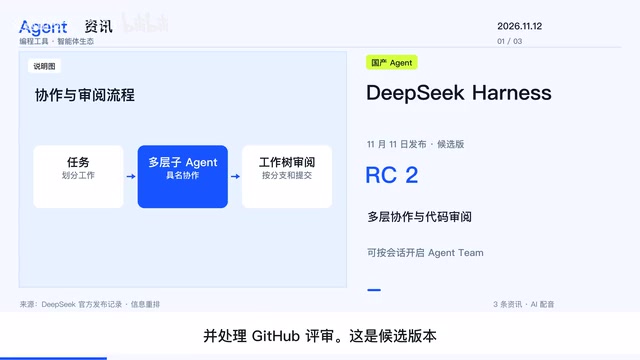
According to information published by a Bilibili creator, DeepSeekAd Harness has released the 0.2.2 RC2 release candidate. The core change is that sub-agents now support named identities and multi-layer collaboration. This means Agent Team can open shared members and a task panel by drawing, and the work count also supports reviewing changes by branch, commit, and file type, as well as handling GitHub reviews.
The value of multi-agent systems lies in division of labor, but the real difficulty is aggregation, review, and delivery. If more tasks mean more frequent human intervention, the efficiency gains get canceled out. This version is still a release candidate, so its actual experience and stability still need to be tested in real tasks.
A multi-agent system (Multi-Agent System) refers to an architecture in which multiple autonomous agents collaborate to complete complex tasks. In AI coding scenarios, an orchestrator typically decomposes a task and dispatches it to multiple sub-agents, each responsible for a specific subtask (such as code generation, testing, or review). Named sub-agents allow developers to explicitly specify an agent's role and responsibilities, making it easier to track and reuse; multi-layer collaboration supports hierarchical relationships between agents—for example, a main agent managing multiple sub-teams, each of which manages its own members. This layered structure is closer to how human development teams are organized, but it also increases coordination overhead and the complexity of state management.
Qwen Code 1.0 Preview: A New Choice for Open-Source Frameworks
Tongyi Qianwen released the Qwen Code 1.0 preview on November 11, combining the agent capabilities of Coder and Qwen Code for understanding, implementing, debugging, and testing code. The official release provides native installers for Apple, Linux, and Windows, with no separate Node.js installation required, and supports Tongyi and Coder accounts, multiple model services and compatible interfaces, as well as drawing continuation and non-interactive execution.
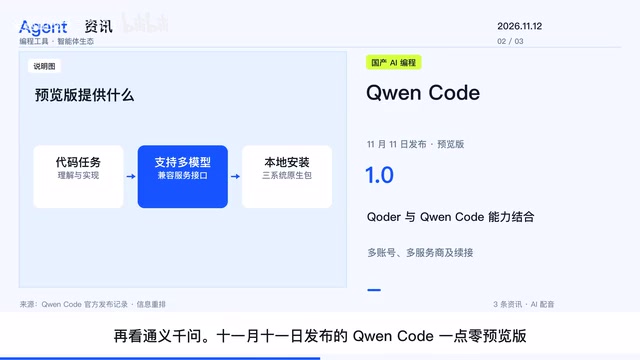
The version is currently in preview, and its interfaces, configuration, and behavior may continue to change.
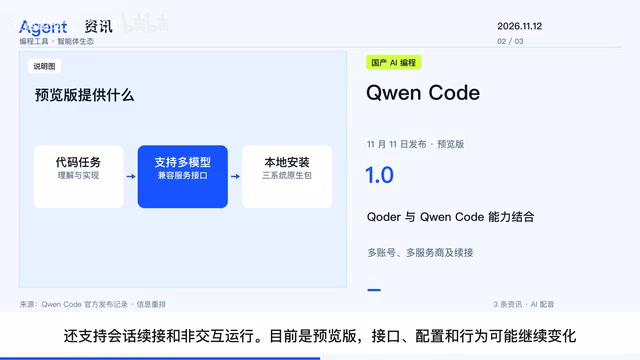
Having one more open-source framework option is good for developers, but whether it's worth migrating depends on integration costs and actual task completion.
Qwen Code is an open-source code agent framework launched by the Tongyi Qianwen team, and its 1.0 preview combines the original Coder model capabilities with the agent framework. So-called "agent capabilities" mean the model can not only generate code but also autonomously plan steps, call tools (such as executing commands and reading/writing files), observe results, and iteratively correct itself. Native installers mean users can directly download executable files without configuring runtime environments such as Node.js, lowering the barrier to entry. Support for multiple model services and compatible interfaces allows developers to flexibly switch underlying models (such as Tongyi, OpenAI, etc.), avoiding lock-in to a single vendor.
OpenAI Codex CLI 0.167.2: Incremental Sending Becomes the Default
OpenAI released version 0.167.2 of the Codex command-line tool, in which tool updates for Google Cloud Vertex AI default to incremental sending. This change targets developers using Vertex AI integration, and the official release also provides a configuration switch to opt out of this default behavior.
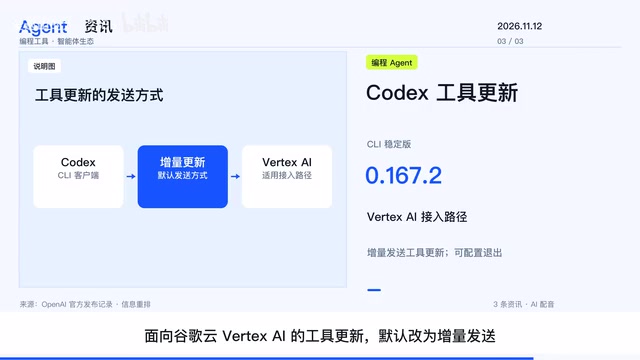
The version number itself is not the point; whether tool calls can be more stable and save waiting time is what's worth continued observation. Making incremental sending the default reflects a tendency to optimize interaction efficiency, but the actual effect still needs verification through developer feedback.
Incremental sending is a strategy for optimizing network transmission and model calls: in continuous interactions, only content that has changed since the last request (such as newly added code lines or tool call results) is sent, rather than sending the full context every time. This can reduce the amount of transmitted data, lower latency, and potentially save API call costs. For developers using Google Cloud Vertex AI integration, enabling incremental sending by default means tool updates (such as changes to function call descriptions) are pushed as diffs rather than full overwrites. The configuration switch allows developers to fall back to full-send mode when they encounter compatibility issues.
Multi-Source Cross-Verification and Industry Observations
The information above mainly comes from a Bilibili creator's compilation. The release information for DeepSeek Harness and Qwen Code has scattered discussion in multiple technical communities, which can be regarded as multi-source corroboration; the Codex CLI update relies mainly on official release notes.
From these developments, it's clear that AI coding tools are shifting from competing on individual capabilities to workflow integration: multi-agent systems emphasize collaboration and review, open-source frameworks emphasize installation convenience and interface compatibility, and command-line tools emphasize call efficiency. For developers, choosing a tool requires weighing integration costs, task completion, and long-term maintenance risks. The features in release candidates and previews may be attractive, but their stability still needs time to be proven.
One-line Summary
AI coding tools are recently focusing on multi-agent collaboration, open-source frameworks, and command-line efficiency optimization.
Paragraph Summary
Several updates have recently appeared in the AI coding tools space: DeepSeek Harness 0.2.2 RC2 supports named sub-agents and multi-layer collaboration, and enhances GitHub review handling; the Qwen Code 1.0 preview combines Coder and agent capabilities, offering native installers and support for multiple model services; OpenAI Codex CLI 0.167.2 changes Vertex AI tool updates to incremental sending by default. These updates reflect a shift in AI coding tools from competing on individual capabilities to workflow integration—multi-agent systems emphasize collaboration and review, open-source frameworks emphasize installation convenience and interface compatibility, and command-line tools emphasize call efficiency. Developers need to weigh integration costs, task completion, and long-term maintenance risks, and the stability of release candidates and previews still needs time to be proven.
Related articles

Average US New Car Price Tops $51,000: How AI and Software-Defined Vehicles Are Driving Up Costs
US average new car prices hit a record $51,000. This article analyzes how software-defined vehicles, central computing, pre-installed sensors, and in-vehicle AI inference costs drive up sticker prices—and what it means for consumers and automakers.
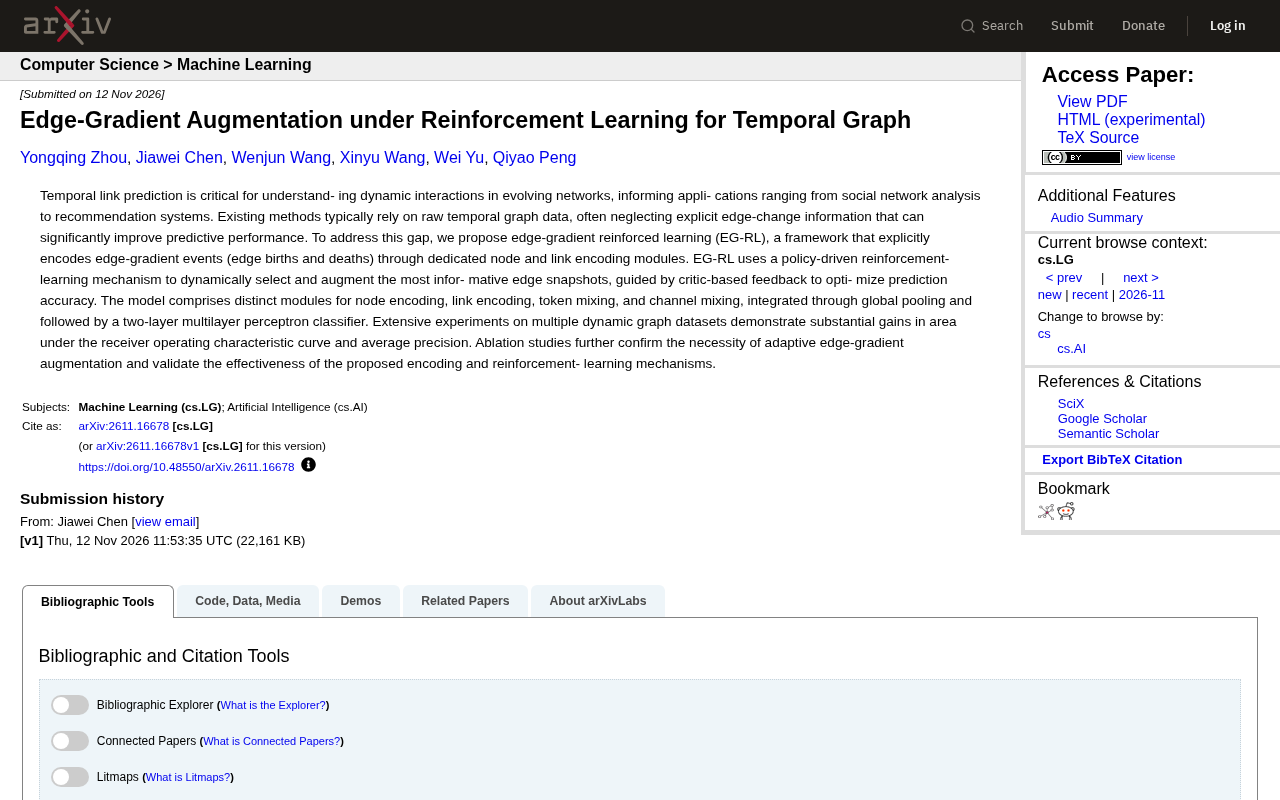
EG-RL: Edge-Gradient Augmentation + Reinforcement Learning for Temporal Graph Link Prediction
An in-depth look at EG-RL: explicitly encoding edge-gradient events (edge births and deaths) and using reinforcement learning to dynamically select the most informative snapshots, significantly improving AUC and AP for temporal link prediction on multiple dynamic graph datasets.
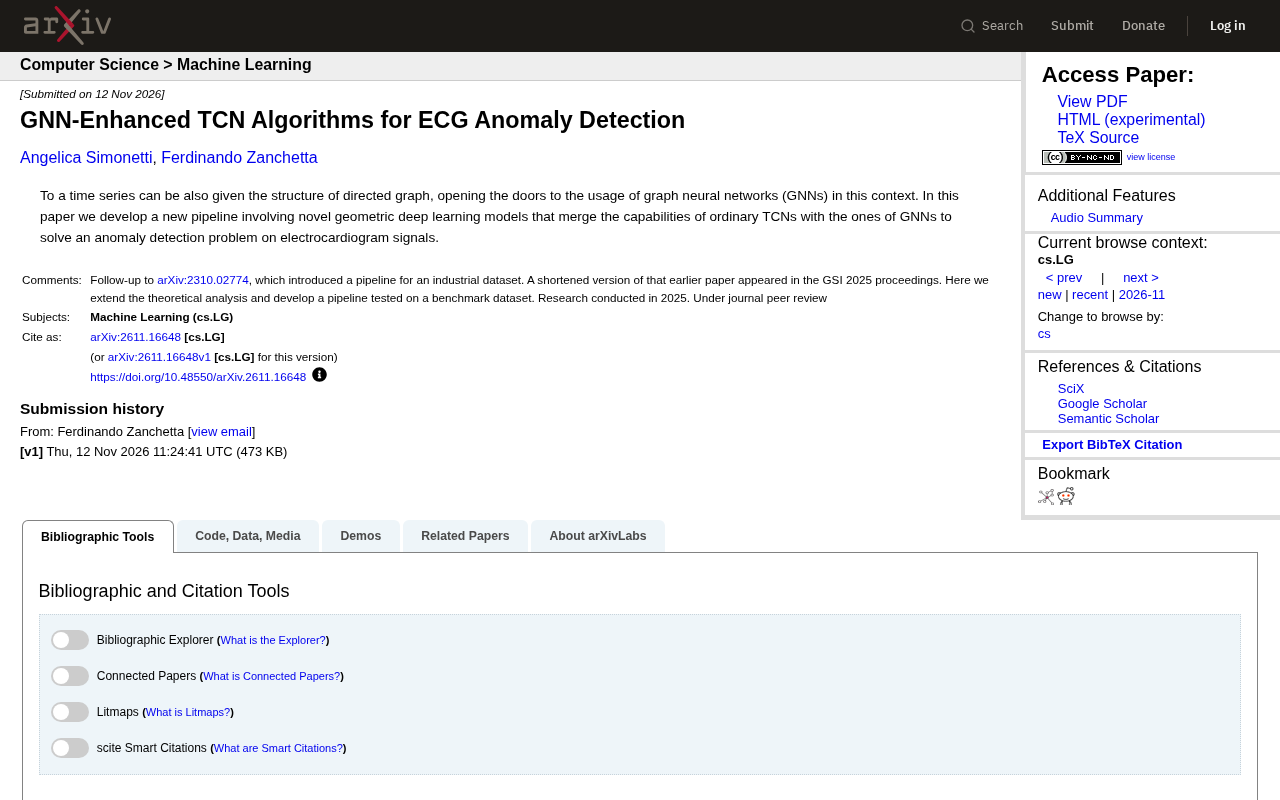
GNN+TCN Fusion Algorithm: A New Paradigm for ECG Anomaly Detection
Explore the innovative application of GNN and TCN fusion algorithms in ECG anomaly detection: transforming time series into directed graphs and using geometric deep learning to simultaneously capture local temporal features and global topological structures, offering a new paradigm for medical AI time-series analysis.