DeepSeek Open-Sources DeepInfer: A High-Performance LLM Inference Framework
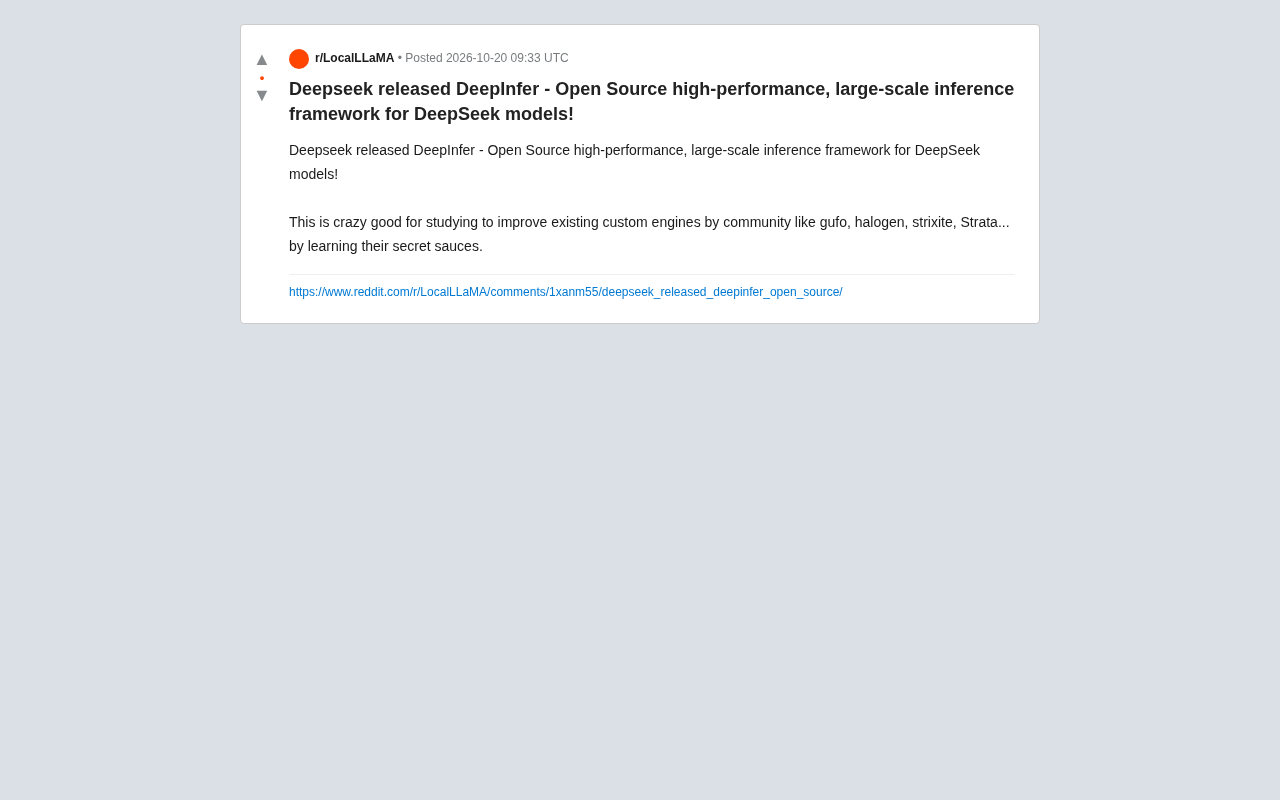
DeepSeek open-sources DeepInfer, advancing integrated model and inference solutions.
A Reddit post reports that DeepSeek released DeepInfer, an open-source high-performance, large-scale inference framework for DeepSeek models. The article argues inference cost directly affects LLM deployment feasibility, and an official open-source framework packages "model + inference" as a complete solution, lowering barriers to reproducing performance and private deployment. The community can learn engineering details from custom engines like gufo, halogen, strixite, and Strata. However, information comes only from community posts; performance numbers, hardware support, and documentation quality are undisclosed.
Open-Source Inference Frameworks Welcome a New Player
A post in the Reddit community drew attention: DeepSeekAd has released an open-source inference framework called DeepInfer, positioned as a "high-performance, large-scale" inference engine for DeepSeek models. The original post directly described it as "crazy good" and noted that the community can use it to learn the "secret sauce" behind existing custom engines (such as gufo, halogen, strixite, and Strata).
The actual information here is not much, but the direction is clear. DeepSeek previously gained fame for its model capabilities; now it is open-sourcing the infrastructure on the inference side as well, meaning it is no longer content with just "good models" — it also wants to provide an official answer on deployment efficiency. For teams working on local deployment and private inference, this is a signal worth following.
Why Inference Frameworks Matter More Than Models
When deploying LLMs, inference costs often affect business feasibility more directly than training costs. With the same model, switching to a different inference engine can change throughput by several times, and latency behavior can be completely different. By choosing to open-source its own inference framework, DeepSeek is effectively packaging "model + inference" into a complete solution, lowering the barrier for the community to reproduce its performance.
Looking at the community projects mentioned in the post, gufo, halogen, strixite, and Strata are all grassroots engines focused on inference optimization. The original poster believes that DeepInfer's open-source release gives the community a chance to "learn the secret sauce," which precisely shows that official implementations usually contain many engineering details — KV Cache management, batching strategies, quantization support, operator fusion — these are the real dividing lines in inference performance.
The "Secret Sauce" Value of Community Engines
The very existence of grassroots inference projects shows that official inference stacks are not sufficient in some scenarios. Community engines often optimize to the extreme for specific hardware or specific models: flexible, but expensive to maintain. If DeepInfer can find a balance between generality and performance, it will be both a reference and a competitor for community projects. The original post describes it as "studying to improve existing custom engines," with a tone closer to technical learning than replacement.
KV Cache is a core optimization mechanism in autoregressive LLM inference. When generating each new token, the model needs to recompute the Key and Value vectors of all previous tokens; without caching, computation and memory access grow linearly with sequence length, and latency rises sharply. KV Cache stores the K/V tensors of historical tokens in GPU memory and reuses them directly in subsequent decoding, reducing the per-step complexity from depending on sequence length to constant level. The cost is that memory usage grows with batch size and sequence length, which has led the industry to develop strategies such as PagedAttention (paged management of cache blocks), Prefix Caching (reusing common prefixes), and KV Cache quantization and eviction. Differences among inference frameworks in cache allocation granularity, fragmentation control, and prefix hit rate are often one of the main sources of throughput gaps.
Continuous Batching is a key scheduling technique that distinguishes inference engines from ordinary forward inference. Traditional static batching requires requests in the same batch to start and finish together, so short requests are held back by long ones and GPU utilization is low. Continuous batching dynamically schedules at token granularity: after each decoding step, completed sequences exit immediately and release resources, while newly arrived requests join the current batch right away. This can increase throughput several times under real traffic. Along with it comes chunked prefill, which splits the prefill computation of long prompts and mixes it with decoding requests to avoid long prompts blocking other requests. Batching strategies are tightly coupled with KV Cache management, and this is where the "secret sauce" of inference frameworks is concentrated.
Operator Fusion refers to merging multiple fine-grained computational operators into a single kernel for execution, reducing kernel launch overhead and memory read/write次数. Typical fusions in LLM inference include: LayerNorm fused with residual addition, QKV projection fusion, softmax and scaling fusion in attention, RoPE positional encoding fused with attention computation, and routing and grouped GEMM fusion in MoE layers. Fusion can significantly reduce memory bandwidth pressure, especially in the decode phase (low compute density, memory-bound), where the gains are obvious. Implementation usually relies on hand-written CUDA/CUTLASS kernels or automatic compiler fusion. The fusion coverage and kernel quality of different frameworks directly determine single-GPU efficiency, and this is also one of the engineering details that create the gap between official and community engines.
What High-Performance and Large-Scale Mean
The title contains two keywords: "high-performance, large-scale." High performance points to latency and throughput of a single inference, while large-scale points to scalability in multi-GPU and multi-node scenarios. The two often conflict in engineering: a framework with good single-machine optimization may not scale linearly in distributed settings; one with good distributed scheduling may compromise single-GPU efficiency.
By placing these two words side by side in its positioning, DeepSeek implies that DeepInfer was designed with production-grade deployment in mind from the start. For teams that need to run large-scale inference services, this is more attractive than merely topping benchmarks. However, the original information does not provide specific performance numbers, a supported hardware list, or deployment documentation. Actual capabilities still need to be further disclosed through the official repository and documentation.
The Intent Behind the Open-Source Strategy
DeepSeek's recent moves follow a clear pattern: open-source models, open weights, and now an open-source inference framework. The purpose of this combination is not hard to understand — expand ecosystem footprint and let more teams use DeepSeek models at the lowest cost. Once the inference framework is open-sourced, cloud providers and hardware vendors can adapt more quickly, and model distribution efficiency will improve further.
Distributed inference parallelism strategies are the technical foundation for "large-scale" deployment. Common combinations include: tensor parallelism (TP), which splits weights of a single layer across multiple GPUs and is suitable for high-bandwidth intra-node interconnect; pipeline parallelism (PP), which splits by layer across different devices to alleviate cross-node bandwidth bottlenecks; and expert parallelism (EP), which distributes different experts across different GPUs for MoE models. There is also PD separation (placing Prefill and Decode in different resource pools) to match the very different compute and memory characteristics of the two phases. These strategies need to be designed in coordination with KV Cache sharding and transfer, request routing, and load balancing. If a framework with good single-machine optimization scales to multiple machines with poor scheduling, communication overhead can easily erode gains and the scaling curve can become non-linear.
Practical Impact on Developers
In the short term, the most direct beneficiaries are teams doing private deployment. With an official inference framework, they no longer need to tune from scratch or rely entirely on the black-box optimizations of third-party engines. In the medium term, community projects will absorb DeepInfer's design ideas, which in turn will raise the level of the entire open-source inference ecosystem.
What needs to be viewed calmly is that the currently public information comes only from community posts. The framework's actual completeness, documentation quality, and community maintenance plans are still unclear. Open source does not equal usable. For an inference framework to be truly adopted, supporting deployment guides, hardware compatibility matrices, and issue response speed are equally critical. Developers who are interested are advised to first follow the official repository's updates before deciding whether to migrate their existing inference stacks.
Conclusion
The release of DeepInfer completes the open-source puzzle for DeepSeek on the inference side. Judging from community reactions alone, expectations for the "official secret sauce" are high. Competition among inference frameworks will ultimately come down to engineering details and ecosystem adaptation. Whether DeepInfer can become a mainstream choice beyond custom engines depends on the pace of subsequent documentation and version iteration.
One-line Summary
DeepSeek open-sources the DeepInfer inference framework, advancing the integration of models and inference solutions.
Paragraph Summary
A Reddit community post shows that DeepSeek has released an open-source inference framework called DeepInfer, positioned as a high-performance, large-scale inference engine for DeepSeek models. The article argues that inference costs directly affect the feasibility of LLM deployment, and that an official open-source inference framework means DeepSeek is packaging "model + inference" as a complete solution, lowering the barrier for the community to reproduce its performance and for private deployment. The community can use it to learn the engineering details of custom engines such as gufo, halogen, strixite, and Strata in KV Cache management, batching, quantization, and operator fusion. However, the current information comes only from community posts; performance numbers, hardware support, and documentation quality have not been disclosed, and actual usability still needs to be observed through progress in the official repository.
Related articles

One Person Producing 90 Episodes of AI Anime Shorts: The Complete Production Workflow in 10 Hours for 10 Yuan
No screenwriting experience needed for AI anime shorts: 10 hours and 10 yuan in costs, 4,200 yuan earnings per work on Hongguo. This article breaks down the complete six-step workflow from AI-generated scripts and storyboard scripts to the finished film, with a universal questioning formula and beginner pitfall guide.
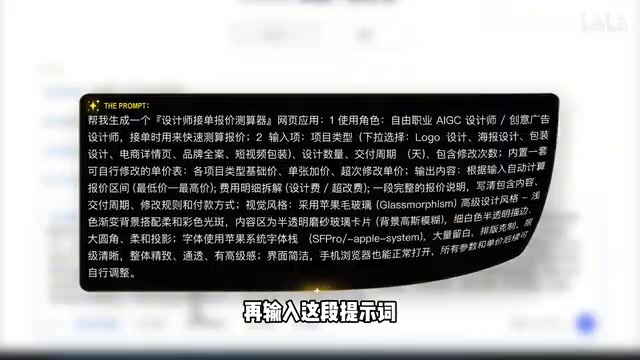
Build a Quote Calculator with Doubao Agent: Stop Guessing Your Freelance Rates
A Bilibili creator uses Doubao Agent to build a no-code quote calculator that auto-generates itemized quotes with rush and copyright buyout rates, one-click copy, and mobile quoting.

WorkBuddy Hands-On Tutorial: 10 Agent Projects from Beginner to Resume-Worthy
WorkBuddy tutorial: a Chinese-language AI work assistant with simpler setup than Codex or Claude Code. 10 hands-on Agent projects for beginners, resume-ready.