DeepSeek Open-Sources Inference Framework Deepinflow: The AI Price War Moves into the Back Kitchen

DeepSeek open-sources its inference framework Deepinflow, using open-source efficiency to break through the pricing logic of high-priced AI APIs.
Instead of releasing a new model, DeepSeek has open-sourced its internal large-scale online inference framework Deepinflow, revealing capabilities once hidden in big tech's "back kitchens": high-performance operators, parallelism strategies, speculative decoding, and asynchronous scheduling. The article argues that models determine what AI can do, but the inference system determines how much AI sells for—inference scheduling is the real profit center. Open-sourcing this framework amounts to a "distribution revolution": it doesn't directly steal customers, but makes customers question why they should pay 10x or 20x for the same model. DeepSeek's real target is the pricing logic of "AI is expensive, so you have to come to me," pushing AI from a luxury good rented out by a few giants toward public infrastructure, and turning inference costs from black-box pricing into an engineering problem that can be independently optimized.
DeepSeek didn't release a new model benchmark this time—instead, it's taking aim at the most lucrative part of the large model business: inference services. It has open-sourced its internal large-scale online inference framework, Deepinflow, laying bare its production experience on "how to run models more cheaply" directly to the market.
Inference Framework: The Hidden Profit Center of the AI Business
The model determines what AI can do; the inference system determines how much that AI ultimately sells for. Deepinflow is like a super central kitchen: how orders are queued, how GPUs avoid idling, how previously computed content is reused, and how performance holds up as more requests come in concurrently—these underlying scheduling capabilities are where AI companies' real profits come from.
In the past, OpenAI, Anthropic, and Google sold not just smarter models, but the scarcity of packaging expensive GPUs, complex scheduling, and stable service into high-priced APIs: only I can run it fast, stable, and reliably.
The difference between inference and training: Large model "inference" refers to the process of receiving user input and generating output after a model has been trained. Unlike "training," which involves a one-time investment of massive compute over weeks, inference is a long-running, continuous online service billed per request. For AI companies, training cost is a one-time capital expenditure, but inference cost is an operating expense that grows daily with traffic, directly determining gross margin. Therefore, an inference system's throughput, latency, and GPU utilization often influence an AI company's profitability more than model parameter count.
The core responsibilities of an inference framework: An inference framework is the software layer between model weights and the underlying GPU, responsible for request batching, memory management, operator scheduling, multi-card parallelism, and fault recovery. It doesn't change model capabilities, but it determines how many users the same model can serve on the same hardware, how fast it responds, and how low the unit cost is. Most of what the industry calls "inference optimization" happens at this layer.
Open-Sourcing the Back Kitchen, Breaking Price Expectations
Deepinflow has open-sourced high-performance operators, parallelism strategies, speculative decoding, asynchronous scheduling—things that were previously hidden in the "back kitchens" of big tech. Cloud providers can use it, startups can use it, and enterprises can use it themselves.
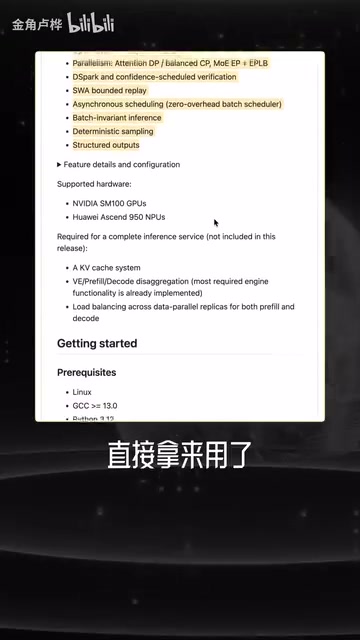
According to analysis by a Bilibili creator, this looks a lot like a "distribution revolution" in AI from the perspective of Silicon Valley companies: using sufficiently good capabilities, sufficiently low costs, and sufficiently open deployment methods to directly break through the market's existing price expectations. The fiercest part isn't taking away someone's customers today—it's making all customers start asking: if the same model can be deployed more cheaply, why pay 10x or 20x the price? If inference optimization is no longer a black box controlled by a few giants, why should only a few vendors get to decide the price of AI?
Key terms explained: High-performance operators refer to compute kernels hand-written or auto-tuned for specific hardware (such as GPUs)—the foundation of inference speed. Parallelism strategies refer to splitting a large model across multiple cards or machines for collaborative computation (such as tensor parallelism and pipeline parallelism). Speculative decoding lets a small model quickly draft several tokens first, then a large model verifies them in parallel, accelerating generation without losing output quality. Asynchronous scheduling overlaps computation with data transfer and request queuing to reduce GPU idling. These techniques previously existed mostly as papers or scattered open-source projects, but DeepSeekAd has integrated them into a complete framework that can be used directly for large-scale online services, lowering the engineering barrier.
The Real Attack: Challenging the Pricing Logic
DeepSeek isn't just competing with rivals on models—it's challenging a pricing logic: AI is expensive, so you have to come to me. DeepSeek says: not necessarily.
When models are open-sourced, inference frameworks are open-sourced, and deployment experience is also open-sourced, the efficiency dividends once monopolized by a few giants start to be shared by more people. Cutting-edge models can certainly still command high prices, but a large number of everyday tasks don't need the world's strongest AI—they need AI that's strong enough, stable enough, and cheap enough. And that layer is exactly the market Silicon Valley least wants to see driven down to commodity prices.
What makes up API pricing: Cloud vendors' model API prices typically include GPU depreciation, electricity, networking, operations labor, and redundant capacity reserved for peak traffic, plus brand premium and scarcity premium. An open-source inference framework doesn't directly lower hardware purchase prices, but it puts the variable cost item of scheduling efficiency into users' hands—double the utilization, and unit token cost can nearly halve. This is exactly the mechanism behind "price expectations being broken": it's not that models got cheaper, but that the same model no longer has to run through a few high-priced channels.
From Luxury Good to Public Infrastructure
DeepSeek may not have defeated OpenAI, Anthropic, or Google yet, but it's doing something more troublesome: pulling AI away from being a luxury good rented out at high prices by a few giants, toward something closer to public infrastructure.

One developer commented that while Silicon Valley hyperscalers burn billions of dollars defending "fake AI profits," DeepSeek is dragging the whole world into an unimaginable price war under the guise of a charitable company. Others say it's a textbook game of Go-style encirclement—free isn't necessarily charity; sometimes free is the fiercest competitive weapon: I'm not just competing with you over who's stronger, I'm making it increasingly difficult for you to sell your most profitable layer at the highest price.
For developers and enterprises, the signal is clear: inference costs are shifting from black-box pricing to an engineering problem that can be optimized independently. Whoever can put frameworks like Deepinflow to use can achieve lower unit costs under the same model capabilities.
One-line Summary
DeepSeek open-sources its inference framework Deepinflow, using open-source efficiency to break through the pricing logic of high-priced AI APIs.
Paragraph Summary
Rather than releasing a new model, DeepSeek has open-sourced its internal large-scale online inference framework Deepinflow, revealing capabilities once hidden in big tech's "back kitchens": high-performance operators, parallelism strategies, speculative decoding, and asynchronous scheduling. The article argues that models determine what AI can do, but the inference system determines how much AI sells for—inference scheduling is the real profit center for big tech. Open-sourcing this framework amounts to a "distribution revolution": it doesn't directly steal customers, but makes customers question why they should pay 10x or 20x for the same model. DeepSeek's real target is the pricing logic of "AI is expensive, so you have to come to me," pushing AI from a luxury good rented out at high prices by a few giants toward public infrastructure, and turning inference costs from black-box pricing into an engineering problem that can be independently optimized.
Related articles

LLaMA-Factory in Practice: A Complete No-Code Guide to Fine-Tuning Large Models
An introduction to LLaMA-Factory, the open-source fine-tuning tool: its 60.1K-star background, supported models and algorithms, local vs. cloud deployment, and CUDA setup steps.

Zeng Ming's Deep Retrospective: Why OpenAI May Not Be the Ultimate Winner — and Why the Corporate System Will Disappear
Zeng Ming's deep retrospective on the AI endgame: model companies are just infrastructure, OpenAI and Anthropic won't be the final winners; the next battle is the Agent entry point standard; the corporate system will disappear as AI restructures collaboration, and only mission-driven companies can survive the cycle.

OpenHands v1.28.0: OpenCode and PI Added as Built-in Agents, API Keys Requestable In-Conversation
OpenHands ships 5 releases in 21 days: v1.27.0 adds OpenCode and PI as built-in agents, v1.28.0 enables in-chat key requests. ACP integration, credential reuse, model list changes, and upgrade advice.