DeepSeek's New Model Head-to-Head: Who's Better at Generating Japanese Urban Clusters?

Creator head-to-head tests multiple models generating Japanese urban clusters; DeepSeek Flash's new checkpoint is second only to Opus 5.5.
A Bilibili creator used the same prompt to have multiple mainstream large models generate hyper-scale Japanese modern urban clusters and compared output quality. The new DeepSeek Flash (1017 checkpoint) thought for nearly an hour, and its output was rated "very stunning," with only a small overpass layout bug, making it the best-performing model aside from Opus 5.5; Opus 4.5 was near-perfect. Competitors generally stumbled: GLM 5.3 flickered and showed train clipping, Kimi K3 was suspected of quality degradation, Qwen 3.8 Flash and the old DeepSeek Flash were both half-finished, and Google Gemini 4 generated a copy-paste-style small scene that failed on scale. The author notes that a single-prompt test has a limited sample, and conclusions should be verified by re-testing yourself.
Title
DeepSeek's New Model Head-to-Head: Who's Better at Generating Japanese Urban Clusters?
Meta Description
A Bilibili creator put DeepSeekAd's new checkpoint Flash 1017 to the test: it delivered stunning results on Japanese modern urban cluster generation, second only to Opus 5.5, while GLM 5.3, Kimi K3, Qwen 3.8 Flash and others stumbled to varying degrees. This article breaks down the head-to-head results and key signals.
Article Content
After DeepSeek released a new checkpoint (internally called the 1017 version of Flash), a Bilibili creator immediately ran a head-to-head test: using the same prompt, they had several mainstream large models generate a "hyper-scale Japanese modern urban cluster," then compared the output quality and details one by one. The conclusion was straightforward — the new DeepSeek Flash was the best-performing model in this test aside from Opus 5.5, while several competitors stumbled to varying degrees.
Test Design: A "Truth Serum" for a Complex Scene
The test prompt asked for a hyper-scale Japanese modern urban cluster — a task that comprehensively challenges spatial layout, building density, road structure, and pedestrian and vehicle details. The creator noted that DeepSeek Flash spent a long time thinking on this one, taking nearly an hour in total, and the result was only obtained after urging it to deliver sooner.
This "slowness" is itself noteworthy: long thinking means the model did more structural planning before generation, and this kind of complex scene is precisely where you least want a model that "thinks little and draws fast." By contrast, some competitors generated images quickly but with low completion, forming a sharp contrast.
A "checkpoint" as mentioned here is an intermediate snapshot during model training. Large models periodically save weight states during training, and each checkpoint represents the model's capability level at a given moment. Vendors sometimes use new checkpoints for small-scale or canary updates between two official releases, so the actual performance under the same model name may fluctuate with checkpoint changes. This also explains why the article emphasizes the "1017 version" — it is the key identifier distinguishing old and new DeepSeek Flash, rather than a full version number upgrade.
"Screen flicker" usually refers to instability in brightness, texture, or structure between consecutive frames in video or frame-by-frame generation models, causing the image to flicker. It often stems from insufficient inter-frame consistency modeling, is especially pronounced when generating dynamic scenes, and is an intuitive metric for measuring video generation quality.
DeepSeek Flash's New Checkpoint: Stunning but Flawed
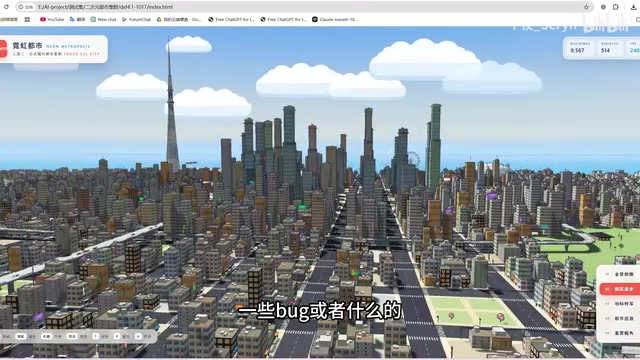
The creator rated the new DeepSeek Flash's output as "very stunning," with no obvious issues in style and effect, and both street and pedestrian handling on point. The only questionable point was an overpass stacked on the road surface — a small layout bug.
But the creator stressed that this flaw should be viewed in the comparative context — it was the strongest result in this test aside from Opus 5.5. In other words, the small bug exists, but the overall completion and aesthetic level clearly lead the other models in the same test.
Competitor Head-to-Head: Who Stumbled, Who Held Up
Mid-Tier: Watchable but Unremarkable
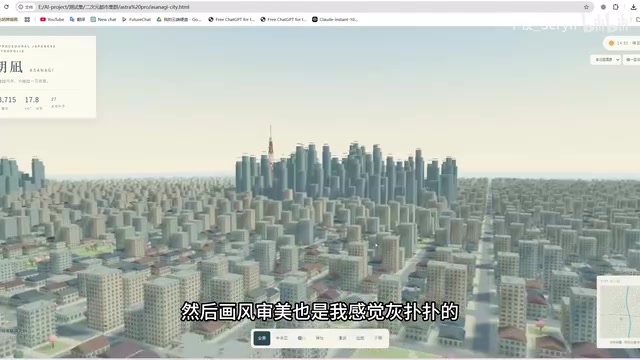
The scene generated by the 6.1 version model had almost no pedestrians or vehicles visible, little variation between buildings, and aesthetics inferior to the new DeepSeek Flash's 1017 checkpoint. Astra Pro showed screen flicker, with a grayish style and poor visual appeal.
Clear Stumbles: Half-Finished and Clipping
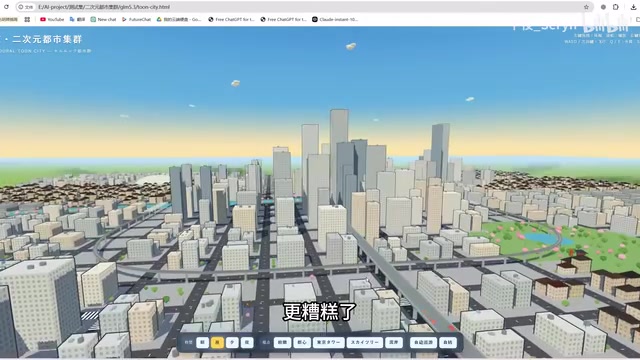
The old version of DeepSeek Flash (before 1017) was outright dismissed as "gone": vehicles moved incorrectly, the overall layout was poor, and it was a half-finished product. GLM 5.3's problems were more serious — not only screen flicker, but trains also showed lateral clipping, performing very badly.
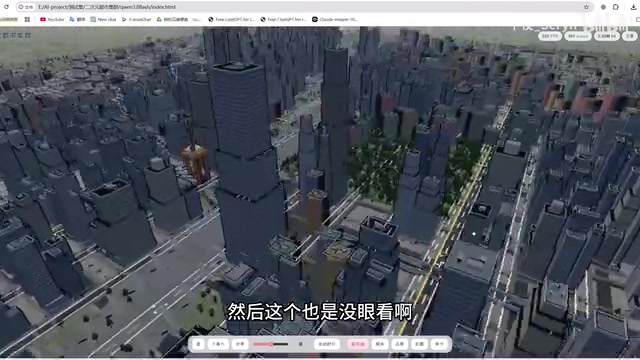
Kimi K3's performance led the creator to suspect recent quality degradation; the output was "completely gone" and skipped outright. Qwen 3.8 Flash was likewise half-finished and unwatchable. Google Gemini 4's problem was scale — it generated a copy-paste-style small scene that hardly qualified as a "standalone cluster."
"Clipping" is a common term in 3D graphics and generative visuals, referring to two objects that should be separate penetrating and overlapping each other in space — for example, a train passing directly through buildings or tracks as it moves laterally. It exposes the model's insufficient understanding of object spatial positions and physical constraints — the model has only learned the plausible local appearance of pixels but has not established a globally consistent 3D structural relationship. In complex urban scenes with many objects and complex occlusion relationships, clipping and layout misalignment are most likely to cluster.
The Ones That Held Up
Opus 4.5 was essentially a perfect answer, which the creator rated as "truly powerful." This also explains why the new DeepSeek Flash's positioning is "strongest aside from Opus 5.5" — it squeezed into the top tier but did not fully catch up to the strongest bracket.
What This Test Shows
A single-prompt test certainly cannot represent a model's all-around ability, but complex scene generation does expose gaps in spatial reasoning and detail consistency. This comparison reveals two signals:
First, DeepSeek Flash's new checkpoint has made substantive improvements on complex layout tasks, with aesthetics and completion both raised a notch; second, the "quality degradation" suspicions surrounding some models are worth watching — Kimi K3's performance was directly attributed by the creator to a recent quality decline, and such fluctuations significantly affect developers who rely on stable output.
It should be noted that the above conclusions come from a single test by a single Bilibili creator, with a limited sample, and details such as prompts and parameter settings were not fully disclosed. If you want to verify, it's best to run the same prompt yourself. The creator also said they will conduct tests in other areas later.
One-line Summary
A Bilibili creator's head-to-head test of multiple models generating Japanese urban clusters: DeepSeek Flash's new checkpoint is second only to Opus 5.5.
Paragraph Summary
A Bilibili creator used the same prompt to have several mainstream large models generate hyper-scale Japanese modern urban clusters and compared output quality head-to-head. The new DeepSeek Flash (1017 checkpoint) thought for nearly an hour, and its output was rated "very stunning," with only a small overpass layout bug on the road surface, making it the best-performing model aside from Opus 5.5; Opus 4.5 was near-perfect. Competitors generally stumbled: GLM 5.3 flickered and showed train clipping, Kimi K3 was suspected of quality degradation, Qwen 3.8 Flash and the old DeepSeek Flash were both half-finished, and Google Gemini 4 generated a copy-paste-style small scene that failed on scale. The author notes that a single-prompt test has a limited sample, and conclusions should be verified by re-testing yourself.
Related articles

AI Digital Twin in Action: Using DOT to Automatically Track Bugs and User Feedback
DOTS engineers demonstrate how AI digital twin DOT collects cross-platform user feedback, categorizes issue themes, opens threads to investigate bug root causes, and submits PRs—showcasing a complete AI agent workflow for defect triage with auditable design.

Why Transistors Are No Longer Flat: The Evolution from Planar to Gate-All-Around
Transistor evolution from planar to FinFET to gate-all-around: why gates went from three-sided to four-sided wrapping to suppress short-channel effects and leakage current, extending Moore's Law.

Swarm Intelligence = a Single RL Agent? A Proof of Multi-Armed Bandit Equivalence
A paper proves that collective decision-making through local imitation in swarms is mathematically equivalent to single-agent reinforcement learning: N blind imitators act as N parallel environment samples, with an effective learning rate of 1/N. This article explains the derivation and implications of the Maynard-Cross Learning algorithm.