DeepSeek's Voice Goes Viral: Where Does That "Imperial Officer Accent" in Chinese-Japanese Mixed Reading Come From?
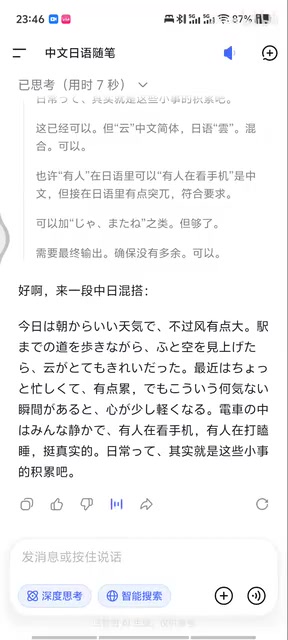
DeepSeek's cross-language prosody bleed produces a viral 'Imperial Officer accent,' exposing multilingual TTS limitations.
A demo of DeepSeek reading Chinese-Japanese mixed text went viral on Bilibili after the model produced Japanese with a pronounced Chinese accent, dubbed the "Imperial Officer accent." The root cause lies in the fundamental difference between Mandarin's syllable-level tones and Japanese's word-level pitch accent — when a TTS model switches rapidly between the two, prosodic momentum from one language bleeds into the other. Compounding this, most TTS models are trained on predominantly monolingual data, leaving them to fall back on dominant-language phonetic priors at language boundaries. Notably, the demo's virality itself reflects DeepSeek's strong overall naturalness — the accent became a charming detail rather than a dealbreaker, pointing to both the progress and the remaining challenges in multilingual speech synthesis.
A Chinese-Japanese Mixed Reading Demo That Caught Everyone's Attention
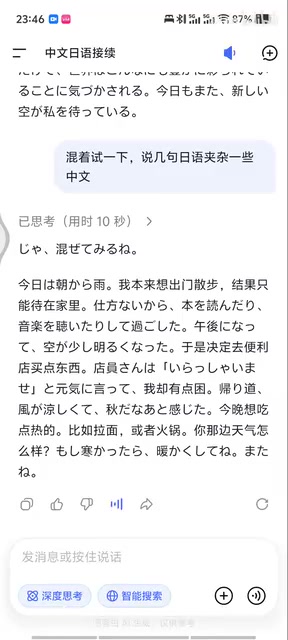
A demo showcasing DeepSeek's voice capabilities recently went viral on Bilibili: a user had the model read aloud a text mixing Chinese and Japanese, and the result was Japanese spoken with a distinctly unusual accent — affectionately dubbed the "Imperial Officer accent" or "Chinese-style Japanese" by netizens. The demo text itself was a typical Chinese-Japanese mixed-language everyday monologue, with sentences like "今日は朝からいい天気で,不过风有点大" and "駅までの道を歩きながら,ふと空を見上げたら,雲がとてもきれいだった" — alternating seamlessly between the two languages with coherent meaning throughout.
What made this content spark so much discussion is that it offered a vivid, real-world look at how a TTS (text-to-speech) model actually performs when handling cross-language mixed reading. When a piece of text contains both Chinese and Japanese, the model needs to rapidly switch between two entirely different phonetic systems — and those switching "seams" are precisely where the quirky accents emerge.
The Technical Mechanics Behind the "Imperial Officer Accent"
The so-called "Imperial Officer accent" or "Chinese-style Japanese" is fundamentally a boundary effect in the model's language identification and phoneme mapping. As the model determines language identity word by word or segment by segment, the tonal habits and syllable structures of Chinese "bleed" into the Japanese pronunciation, and vice versa.
The Challenge of Detecting Language Boundaries
The biggest challenge mixed-language text poses for TTS systems is determining language boundaries. In a sentence like "有点累,でもこういう何気ない瞬間があると,心が舒适", Chinese and Japanese alternate within the same sentence, requiring the model to determine in real time which set of pronunciation rules to apply to each segment. Even a slight misjudgment results in Japanese kana being read with a Chinese accent — producing that "awkward yet endearing" Chinese-style Japanese that listeners notice immediately.
Cross-Linguistic Prosodic Interference
Chinese is a tonal language while Japanese is a pitch-accent language — their prosodic patterns are fundamentally different. When a model switches rapidly between the two, the prosodic momentum of the previous language carries over into the next, and that carry-over is the acoustic source of the "Imperial Officer accent" — reading Japanese with Chinese stress habits naturally produces that stiff, theatrical cadence reminiscent of a dramatic war-film commander.
Pitch accent is the key concept for understanding this phenomenon. In Japanese's pitch accent system, each word has a specific syllable where pitch shifts between high and low — in the Tokyo dialect, for instance, "橋" (hashi, bridge) and "箸" (hashi, chopsticks) are distinguished purely by pitch. Mandarin's four tones, by contrast, assign an independent rising, falling, or level contour to each individual syllable. The fundamental difference: Japanese pitch changes operate at the word level to shape prosodic rhythm, while Mandarin tones are applied independently syllable by syllable. When a TTS model's prosody prediction module alternates between the two languages, its pitch predictions for upcoming syllables get "contaminated" by the prosodic habits of the preceding language. The result is Japanese vocabulary overlaid with Mandarin tonal contours — producing that exaggerated, staccato rhythm that defines the acoustic signature of the "Imperial Officer accent."
Why Mixed-Language Accents Are Common in Speech Synthesis
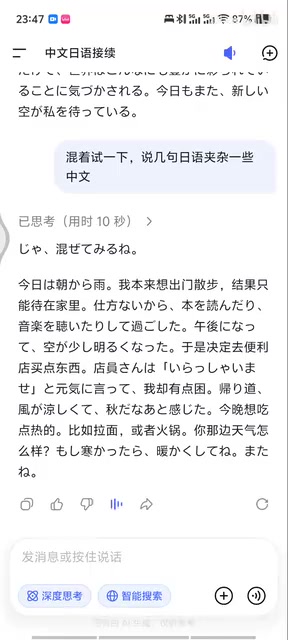
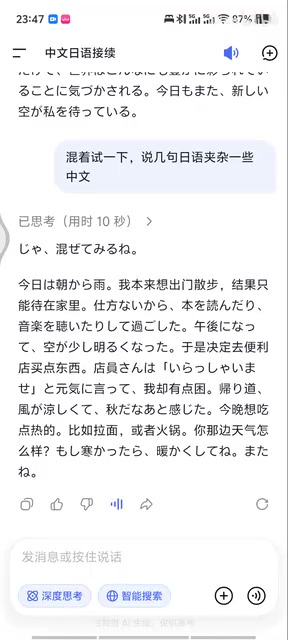
The Chinese-Japanese accent phenomenon is not unique to DeepSeek — it's a widespread challenge for multilingual TTS systems in general. The demo text also includes everyday scenes like "于是决定去便利店买点" and "店員さんは,いらっしゃいませと元気に言って" — precisely these colloquial, everyday-language passages that most readily expose how a model handles language transitions.
Most speech models are trained predominantly on monolingual data, and mixed-language corpora are comparatively scarce. When a model encounters Chinese-Japanese interleaved input — a pattern it saw relatively rarely during training — it falls back on the phonetic priors it learned for its dominant language to "guess" how to read the text. The result carries clear signs of first-language transfer. For users, this "imperfection" ends up creating unexpected entertainment value.
The technical architecture of multilingual TTS models typically comprises three core modules: language identification (LID), grapheme-to-phoneme conversion (G2P), and an acoustic model. In mixed-language scenarios, the LID module must determine language identity in real time at the character or even word level. But most G2P modules are designed for single languages — when the language label fed to G2P is ambiguous or the switch is detected too late, an incorrect phoneme sequence enters the acoustic model, producing results like "reading Japanese kana using Chinese phoneme rules." End-to-end speech synthesis models, while bypassing explicit G2P, implicitly learn language representations that are equally dependent on the language distribution of training data. The scarcity of mixed-language corpora leaves these models without reliable priors at language boundaries, forcing them to fall back on the dominant language's rules to fill the gaps.
What This Quirky Phenomenon Reveals About TTS Progress and Limitations
It's worth noting that this demo was widely shared precisely because DeepSeek's voice output has already reached a quite natural level overall — the pacing, pauses, and emotional expression are well-handled enough that the "accent" became the focal point of discussion, rather than some fundamental flaw in the overall listening experience. Even the casual, conversational closing line — "もし寒かったら,暖かくしてね。またね" — is rendered by the model with a warm, conversational quality.
Entertainment Value and Practical Value, Side by Side
For everyday users, having an AI read a Chinese-Japanese mixed monologue is its own form of entertainment, and the charming accent became the viral hook that drove social sharing. From a product perspective, though, this kind of phenomenon also reveals ongoing room for improvement in multilingual speech synthesis: maintaining authentic, native-sounding pronunciation for each language in mixed-reading scenarios is a problem TTS technology still needs to solve.
The Real-World Significance of Mixed-Language Capability
As cross-language communication scenarios become more common, Chinese-Japanese and Chinese-English code-switching is far from rare in practice — for instance, reading Chinese articles containing foreign-language vocabulary, or producing bilingual learning materials. A speech model capable of naturally handling mixed-language input has very real practical value. The current "accent" may be charming, but it signals that the ideal multilingual TTS still requires continued refinement in language identification accuracy and cross-linguistic prosody modeling.
The main technical pathways for improving mixed-language capability include: first, expanding mixed-language training corpora to cover more real-world cross-language spoken scenarios at the data level; second, introducing explicit language tags or code-switching annotations to help the model clearly perceive language boundaries during decoding; and third, incorporating cross-linguistic transfer constraints into prosody modeling to prevent source-language prosody from contaminating the target language's pitch trajectory. Academic research on code-switching speech synthesis is an active area, but compared to monolingual TTS, annotated corpora remain limited — and that scarcity is the root reason this problem hasn't been fully solved.
Conclusion
DeepSeek's Chinese-Japanese mixed-reading demo offered a lighthearted window into the current state of speech synthesis technology: overall naturalness is already quite good, while the accent at language-switching boundaries has become something that is simultaneously a flaw and an endearing quirk. In a way, this "charmingly imperfect" quality is itself a signal that AI is entering everyday life — and that people are genuinely playing with it.
Related articles
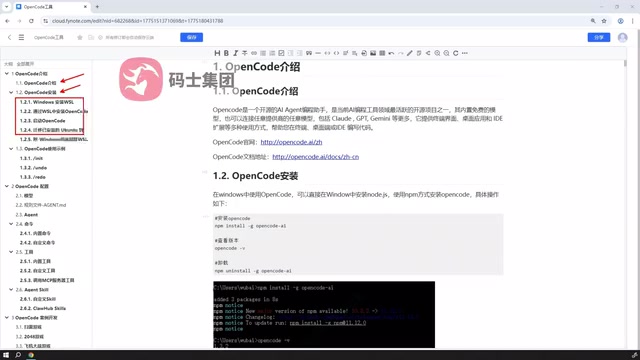
OpenCode Complete Guide: Installation, Configuration & Practical Usage
A complete guide to OpenCode, an open-source AI coding tool: desktop and WSL installation, model and rule configuration, agent types, custom commands, MCP integration, and Agent SQL reuse.
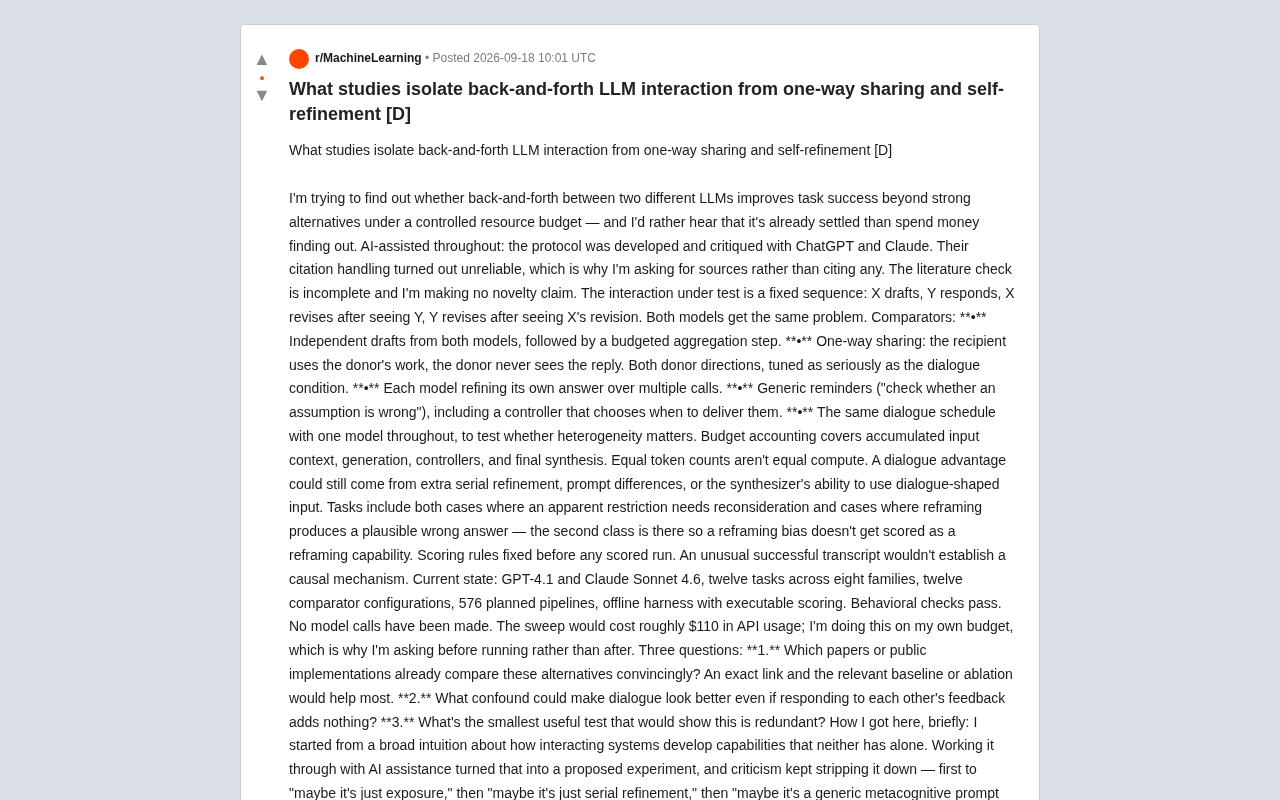
Can Multi-LLM Dialogue Really Improve Task Performance? Lessons from a Rigorous Experimental Design
A researcher designed rigorous controlled experiments to isolate whether multi-LLM back-and-forth dialogue genuinely outperforms simpler baselines like self-refinement and one-way sharing.
Which $10 AI Coding Plan Should You Choose? Go vs. Code Credit Breakdown
After DeepSeek's price hike, should you pick Go or Code for your $10 AI coding plan? We break down credit allocations for Mimo, Qwen, DeepSeek V4, Kimi, and more.