DeepSeek SuperAgent Hands-On Test: The New Standard for AI Coding Agents Is Minimizing Attention Overhead
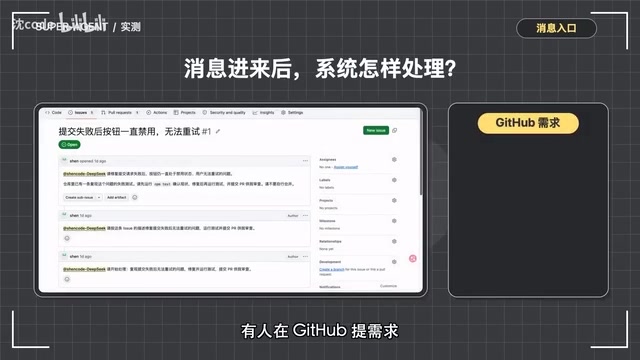
DeepSeek SuperAgent hands-on test: the Agent can automatically handle PR follow-ups and continue the original task, reducing attention overhead.
A Bilibili creator tested DeepSeek's open-source SuperAgent, a single-repo coding Agent prototype with a Router-Worker architecture. It automatically routes PR follow-ups back to the original task, enabling the Agent to add regression tests and push commits without humans copying context or rewriting prompts. The article argues that a good Agent should minimize attention overhead: execute quietly and sync only when stuck, finished, or a decision is needed. Human review remains essential, but the Agent frees people from the supervisor role.
Title
DeepSeek SuperAgent Hands-On Test: The New Standard for AI Coding Agents Is Minimizing Attention Overhead
Meta Description
DeepSeekAd SuperAgent hands-on test: a programming agent prototype for single repositories that uses a Router-Worker division of labor to automatically route PR follow-up questions back to the original task and add regression tests. The article explores the new standard for AI coding agents—minimizing the attention they demand from humans, freeing people from the roles of messenger and supervisor.
Article Content
AI can already write code on its own, so why are we still acting as its "messenger"? This is the soul-searching question raised by a Bilibili creator after hands-on testing DeepSeek's open-source SuperAgent. In the past, when AI asked a follow-up question in a PR, a human had to copy the comment to the AI and re-explain the context; now, the PR is submitted by the bot itself, humans ask follow-up questions directly underneath, and the Agent can automatically add regression tests along the original task. This experience of "no need to manually open a new window, no need to repeatedly rewrite prompts" points to a new standard: a good Agent should occupy as little of a human's attention as possible.
What Is SuperAgent: A Programming Agent Prototype for Single Repositories
According to the Bilibili creator, SuperAgent is an open-source research prototype from DeepSeek for a programming Agent that works on a single GitHub repository. When someone files a request on GitHub, it determines the source and permissions based on configuration, creates a task, and then lets an independent AI manage the related PR. When a new follow-up question appears under the PR, the system can route the comment back to the original task.
The difficulty here is that when messages keep pouring in, the system must figure out which task each message belongs to and then continue processing from there. This sounds simple, but it is the key to "bothering people less"—only when messages automatically return to their proper place do people no longer need to repeatedly carry context around.

Router-Worker architecture is a common distributed system design pattern that, in Agent systems, is used to decouple "task scheduling" from "task execution." The Router acts as the message hub, responsible for receiving events such as GitHub issues and PR comments, determining message ownership according to configured permissions and rules, and creating or waking up the corresponding task; the Worker is the actual execution unit, reading code, modifying files, and running tests. The advantage of this division is that the Router can handle message spikes lightweightly and with high concurrency, while Workers can be started on demand, scaled independently, and even process multiple tasks in parallel. In SuperAgent, it is precisely the Router that accurately routes follow-up questions under a PR back to the original task, enabling the experience of "continuing the original task" and avoiding the need for humans to manually carry context.
Two-Step Hands-On Test: From Bug Fix to Handling Follow-Up Questions
The Bilibili creator designed a two-step test. First, have the Agent fix a small bug: if a network error occurs when clicking submit, the button remains disabled and the user cannot continue operating. After it finishes the change and submits a PR, add a new question to see whether it can continue processing along the original task.
During the hands-on test, one pitfall was hit: after writing the requirement text in a GitHub issue and sending it, no task was generated immediately. The reason was that the switch for receiving new issues in the prototype's configuration items was not enabled. Only after turning on "receive repository comments" did a new comment formally trigger the task.
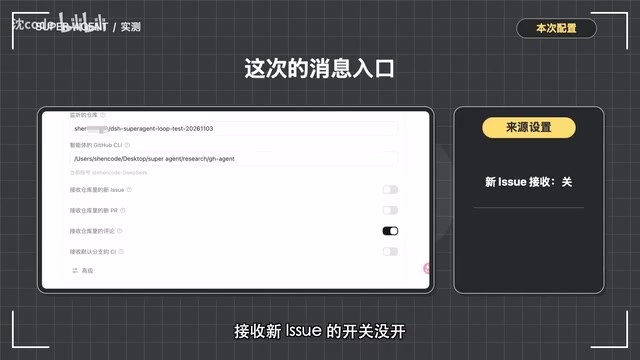
So who takes the order and who fixes the bug? This prototype divides the work into two parts: the Router (routing/order desk) is responsible for receiving messages and determining which task they should be assigned to; the Worker (work node) is responsible for reading code, making modifications, and running tests. This time, the Worker used try/finally to fix the button state, ensuring that the button can recover even after a request error, and finally created a PR; all three initial tests passed.
try/finally is a structure for exception handling in programming languages: code that may fail is placed in the try block, and code in the finally block is executed regardless of whether an exception occurs. In the bug scenario in this article, a network request is initiated after the button is clicked; if the request fails, the button's disabled state needs to be restored. Using try/finally ensures that even if the request throws an exception, the recovery logic in finally (such as re-enabling the button) will definitely run, thereby preventing the button from getting "stuck." Compared with restoring state only in the success callback, try/finally provides more reliable cleanup guarantees, which is why the Agent chose this approach to fix the button state.
Key Verification: Follow-Up Questions Can Continue the Original Task
What is more interesting is the subsequent verification. The Bilibili creator asked under the PR, "If you click twice in a row after a failure, will two requests be sent?" After the follow-up was sent, the system received this PR comment from GitHub. Because the PR was already associated with the original task, the system sent the follow-up back to the same task. The Worker then added a regression test, pushed the second commit to the original PR, and finally four tests passed, with the result synced back to the initial issue.

This is the key: it continued the original task. There is no need for humans to manually open a new window, repeatedly copy context, or rewrite prompts. In team collaboration, this链路 is very comfortable: someone files a requirement in an issue, the Agent produces a PR, reviewers add questions under the PR, and the Agent continues iterating, forming a closed-loop workflow. Messages automatically return to the corresponding task, saving the team a great deal of effort in carrying, following up, and chasing progress.

Regression testing refers to rerunning existing test cases after modifying code (such as fixing a bug or adding a feature) to ensure that the modification has not broken existing functionality. In this article, after fixing the button state, the Worker added a new test case for the follow-up question "whether clicking twice in a row after a failure sends two requests" to verify that scenario and added it to the test suite. This test is a regression test—it not only verifies the fix for the new issue but also prevents future changes from reintroducing similar defects. The regression test passing and being synced back to the issue means that the Agent's iteration result has been automatically verified, and human reviewers can directly see the test evidence.
Design Philosophy: Execute Quietly, Sync Only When Decisions Are Needed
Conversely, if the Agent pops up confirmation windows frantically after every two steps, people still have to stare at it. SuperAgent's design approach is clear: align on goals when taking on a task, stay quiet and non-intrusive during execution, and proactively sync only when stuck, finished, or when your decision is needed. The core idea in the official documentation is also to occupy as little of a person's attention as possible while delivering as much value as possible.
The Bilibili creator specifically mentioned that this PR is currently still open and has not been merged; whether the code can ultimately go live still has to be reviewed and approved by humans. This precisely confirms that "minimizing attention overhead" does not mean letting people completely let go, but rather pulling people out of the supervisor role and leaving their energy for decisions and deep thinking that truly require humans.
From "Can It Finish the Run" to "Can It Bother People Less"
In the past, when we looked at Agents, we only cared about whether they could finish a single task; now we add another layer of judgment: can it occupy less of a person's attention? Compared with simply running tasks concurrently, this is closer to how real teams collaborate. When an Agent can handle follow-up questions on its own and continue tasks on its own, people have a chance to gradually step out of the role of "AI supervisor"—this may be the new standard for AI coding agents becoming practical.
One-line Summary
DeepSeek SuperAgent hands-on test: the Agent can automatically handle PR follow-up questions and continue the original task, reducing the attention it demands from humans.
Paragraph Summary
This article introduces a Bilibili creator's hands-on test of DeepSeek's open-source programming Agent prototype SuperAgent. SuperAgent targets a single GitHub repository and uses a Router for order-taking and Workers for execution. It can automatically route follow-up questions under a PR back to the original task, allowing the Agent to add regression tests and push new commits without humans copying context or rewriting prompts. In the test, the Agent fixed a button-state bug and created a PR, then added tests in response to a follow-up question, with four tests passing. The article points out that a good Agent should occupy as little of a person's attention as possible: it executes quietly and syncs only when stuck, finished, or when a decision is needed. The PR still ultimately requires human review; the Agent's value lies in pulling people out of the supervisor role and focusing them on deep decision-making. The criterion for evaluating Agents is shifting from "whether it can finish a single task" to "whether it can bother people less."
Related articles
ClawDOS: Bringing AI Coding Capabilities to DOS
ClawDOS is an AI coding agent project for DOS, exploring the possibility of bringing AI coding assistance into resource-constrained retro computing environments. This article analyzes its positioning, use cases, and community response.

Baseten Releases Bison-1 and Groundhog-1, Topping the Decision Model Leaderboard
Baseten releases open-weight decision models bison-1 and groundhog-1 built on Gemma 4; bison-1 scores 76 on the AA Decision Index v2.1 to top the leaderboard. Both support 128k context and image input—here we analyze their capability combination, benchmark significance, and selection advice for developers.

Cline CLI v3.0.75 Released: Yolo Mode Now Default for One-Shot Runs
Cline CLI v3.0.75: one-shot runs now default to yolo mode, --timeout and Ctrl+C can interrupt the first round, read_files is no longer truncated to 8k chars, plus reasoning parameter fixes and 94 new providers.