DeepSeek V4.1 Flash 1017 Hands-On: Performance Gains and Controversy Behind a Low-Key Update

DeepSeek quietly shipped patch-level checkpoint 1017 on a Friday: big gains in coding agents, still behind on pure reasoning.
DeepSeek silently released V4.1-Flash-1017 under a patch-level version number. It's a post-training checkpoint built via RL with self-feedback, not a new architecture, with unchanged weights and pricing. Terminal-Bench 4.0 rose from 31.2 to 42.3 and DeepSWE beat Claude Opus 5, but tool-free HLE still lags at 42.6 versus 56.3. The bigger story is engineering: KV cache compressed to 890 bytes per token, a 95.2% cache hit rate lowering real bills, and an open search API for agents.
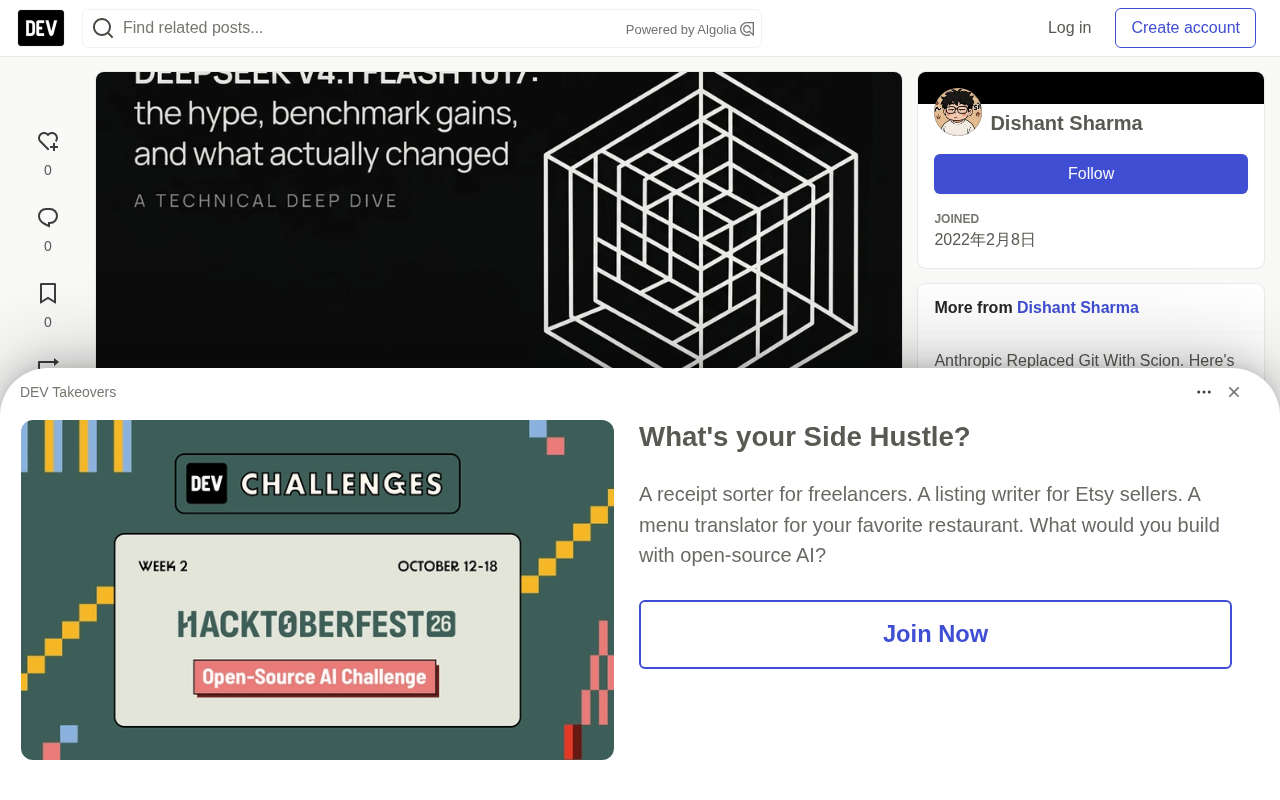
The hottest comment on Hacker News wasn't about the benchmark scores—it was about a single line on the model card: "DeepSeekAd-V4.1-Flash-1017 is a minor update to DeepSeek-V4.1-Flash, bringing significant improvements on reasoning, coding, agentic tasks, and vision benchmarks." One user called it hilarious, while another replied that it shows the team behaves more like engineers than marketers. Indeed: a patch-level version number, quietly pushed on a Friday, with no launch event, no livestream, no demo video. And yet Terminal-Bench 4.0 jumped from 31.2 to 42.3.
This isn't how anyone else ships a model. No countdown, no keynote, no carefully orchestrated leak. Just a checkpoint, a table, and a Friday.
What 1017 Actually Is: A Post-Training Checkpoint, Not a New Architecture
Let's start with the boring truth. 1017 is a post-training checkpoint, not a new architecture. The foundation is still the V4.1-Flash released in September: a 552B backbone, 196B Engram parameters, and a sparse MoE that activates 8B parameters on input and 16B on output. The version number corresponds to a date—October 17—and nothing more.
The change comes from the reinforcement learning process. DeepSeek says it used RL with self-feedback to drive end-to-end project work: game creation, 3D modeling, long agentic runs. Same weight structure, better behavior. Same model, same price, better scores.
Pricing is unchanged. deepseek-flash costs $0.15 per million cache-miss input tokens and $0.60 per million output tokens during off-peak hours, doubling at peak. The old names deepseek-v4-flash and deepseek-v4-flash-vision-exp also silently point to 1017.
Post-training checkpoint is a common concept in machine learning engineering: a model first undergoes large-scale pretraining to acquire general capabilities, then further shapes its behavior through post-training stages such as supervised fine-tuning and reinforcement learning. A "checkpoint" refers to a weight snapshot saved periodically during training. What DeepSeek did here was keep all the pretrained weights and architecture of September's V4.1-Flash, and only iterate the post-training stage to the state of October 17—hence the version number carries a date rather than a major version bump. This also explains why the weight structure, parameter count, and context window are completely identical, while the performance differences are concentrated in tasks requiring multi-step reasoning and tool use—exactly the areas where reinforcement learning has the most leverage.
Engram parameters are a class of sparse parameters DeepSeek introduced into its MoE architecture, with the name borrowed from the cognitive science concept of a "memory trace." Unlike the token-routed experts in conventional MoE, Engram parameters typically serve long-range memory or knowledge-retrieval-style activation patterns, occupying a substantial share of total parameters but not participating in dense computation on every forward pass. These 196B Engram parameters together with the 552B backbone make up a 763B total, while the parameter count actually activated per inference is kept at the 8B (input) to 16B (output) level—the key to how sparse MoE can deliver large-model capability at extremely low compute cost.
The Benchmark Table: A Mixed Bag of Truth
| Benchmark | 1017 | V4.1-Flash |
|---|---|---|
| Terminal-Bench 4.0 | 42.3 | 31.2 |
| DeepSWE v1.1 | 77.0 | 74.2 |
| ProgramBench | 29.1 | 20.3 |
| HLE (no tools) | 42.6 | 36.8 |
Every row improved, and Terminal-Bench rose 11.1 points in five weeks. But what bothers me: on DeepSWE, 1017 scores 77.0, beating Claude Opus 5's 74.0—a number that floated around Twitter all day. Yet on tool-free HLE, Opus 5 reaches 56.3 while DeepSeek only gets 42.6. In the same table, the model wins on agentic coding and lags far behind on hard reasoning. This isn't a scandal; it's what a cheap, fast model should look like. But the people retweeting 77.0 left out 42.6.
Terminal-Bench evaluates how well a model completes multi-step command-line tasks in real terminal environments—configuring services, debugging scripts, operating the filesystem—emphasizing error recovery within the agentic loop. DeepSWE targets software engineering scenarios, testing a model's ability to read a codebase, locate defects, and generate patches; ProgramBench focuses on generating runnable programs from natural-language specifications; and HLE (Humanity's Last Exam) is a high-difficulty, interdisciplinary closed-book question set written by domain experts and deliberately designed to avoid training-data contamination, so the "no tools" setting better reflects the model's own reasoning depth rather than retrieval ability. Only by understanding the differences among these benchmarks can you read the split performance in the table—leading on agentic coding, lagging on pure reasoning: the former rewards multi-round trial and error and tool use, while the latter demands a correct answer from a single forward pass.
The Cache Nobody Talks About: The Real Cost Killer
What's happening underneath is more interesting than the scores. V4.1-Flash uses a causal encoder-decoder setup, where the decoder's global KV cache is projected from the encoder's final hidden state. Combined with Compressed Sparse Attention 2 and an FP4 primary KV cache, this comes out to 890 bytes per token. For comparison: roughly a quarter of the previous-generation Flash's cache size, and persistent KV reduced to about one-eighth.
Why does it matter? Because agent frameworks constantly resend huge prompts: codebases, tool outputs, chat history. OpenRouter shows a cache hit rate as high as 95.2% on DeepSeek's own endpoint. That's where the real bill lives. The price list looks cheap per million tokens, but the invoice is really about how many tokens you pay full price for. For most people, most tokens are cached.
The first time I thought about this I got it backwards, assuming a smaller cache meant losing context. Not so: you keep the same 1M window, you just pay far less to maintain it.
KV cache stores the key-value vectors of historical tokens during Transformer autoregressive decoding, avoiding recomputation of the entire context for every new token generated. The longer the context and the higher the concurrency, the more VRAM and bandwidth the KV cache consumes, directly determining inference cost. Compressed Sparse Attention (CSA) reduces cache size by sparsifying and low-rank-compressing attention patterns, while an FP4 primary KV cache means storing these vectors in 4-bit floating point, saving roughly three-quarters of the space versus the common FP16—at the cost of quantization error that must be controlled through calibration and mixed-precision strategies. The "890 bytes per token" mentioned in the article is the result of stacking these techniques. For agentic workflows, the cache hit rate determines how many tokens in repeated prompts are billed at a discount, so a 95.2% hit rate explains actual spending better than the list price.
Community Reaction: Misplaced Expectations
Reactions are sharply divided. On Hacker News, one person said it had already met their bar for paying attention to a new model back in the DS4 era; another said the series' announcements feel like software patch releases obsessed with already-solved problems. On the other side, someone said $20 of DeepSeek API spend gets far more work done than a $20 ChatGPT Plus subscription, and another called it their favorite model.
Then there are the theories about why Chinese labs never bump their major version numbers. One commenter claimed certification rules push companies to label updates as minor versions; when asked for a source, the answer was a paid podcast. Take that with a grain of salt. The disagreement isn't about the model itself—it's about what people expect a release to feel like.
Open Source, But Only in Theory
Weights released on Hugging Face under the MIT license sounds like a headline, until you see the size: 763B parameters, FP8 tensor type, with 13 quantized versions and 2 fine-tunes already available. Someone in the discussion did the math: 2-bit quantization is about 175GB, leaving room for KV cache on a 256GB machine. So yes, technically you can run it; no, almost nobody will. Those who actually do will spend a weekend and then post a screenshot of 4 tokens per second. I respect the effort, but it's not a workflow. The real beneficiaries are the people calling deepseek-flash through the API without a care in the world.
FP8 tensor type means weights are stored in 8-bit floating point, roughly halving VRAM usage versus BF16 while preserving floating-point dynamic range, with precision loss typically smaller than INT8 symmetric quantization. Further 2-bit or 4-bit quantization on top is post-training quantization, requiring an additional calibration dataset and especially tricky for MoE models: different experts are activated at wildly different frequencies, and uniform quantization tends to degrade rare experts. A 256GB machine can fit the 2-bit quantized version, but the bandwidth bottleneck of CPU inference dictates the reality of single-digit tokens per second—which explains why there's still an engineering gulf between "MIT-licensed open source" and "actually usable."
The Search API: An Underrated Strategic Move
Buried below the benchmark table is the thing I kept thinking about. DeepSeek opened its internal search and scraping API to everyone: $0.75 per 1,000 successful calls, free for empty results. If called through DeepSeek Harness, Claude Code, or Codex, server-side tool calls are free until November 1. A cheap coding model plus a first-party web layer, sharing one key. That's an unusual step. $0.75 per thousand searches isn't the most interesting price on its own, but it means an agent can loop over web results without you wiring up a second vendor and a second bill.
Practical Advice: Who Should Upgrade and Who Should Skip
Most people don't need 1017. If you're writing cron scripts or summarizing email, last month's model is plenty. The jump from 31 to 42 on the terminal benchmark won't change your week. Nor is this model a reasoning champion: Opus 5 still wins on HLE, ProgramBench, and NL2Repo. If your job is one hard, ambiguous problem, pay for a smarter model. If you're on a machine that barely fits 200B parameters, stop reading—this isn't your version. The local story remains hard, and nobody should pretend otherwise.
Final Thoughts: What a Low-Key Release Signals
DeepSeek shipped this on a Friday, called its own major improvement "minor" on the model card, and skipped the launch event entirely. The score chart is real, the cache math is real, and the gap on pure reasoning is real too. I keep wondering what a launch would look like if they actually tried. Maybe that's the point: once a model is good enough and cheap enough, theatrics start to look like overhead. I still think the word "minor" is doing too much work. But I'd rather have an honest table than a choreographed one.
One-line Summary
DeepSeek quietly shipped patch-level checkpoint 1017 on a Friday: big gains in coding agents, still behind on pure reasoning.
Paragraph Summary
DeepSeek silently released V4.1-Flash-1017 under a patch-level version number on a Friday. It's not a new architecture but a post-training checkpoint iterated through RL with self-feedback, with the weight structure and pricing unchanged. Terminal-Bench 4.0 rose from 31.2 to 42.3, and DeepSWE surpassed Claude Opus 5, but tool-free HLE still lags far behind at 42.6 versus Opus 5's 56.3. The article argues the engineering side deserves more attention: the KV cache is compressed to 890 bytes per token, and together with a 95.2% cache hit rate it significantly lowers the actual bill; meanwhile the open search and scraping API lets agents avoid a second vendor. At 763B parameters, local deployment is only theoretical—the real beneficiaries are API users.
Related articles

GPT-Next Leak, Gemini 4 Argon Imminent: AI News Roundup
GPT-Next leak suggests extreme efficiency; OpenAI's 28-day shipping pledge boosts speed 50%; Gemini 4 Argon nears release; Anthropic subscription value report sparks debate.

GPT-Next Leaked, Gemini 4 Argon Speeds Up, Fable 5.5 May Launch Today
OpenAI's GPT-Next model leaks, expected to be extremely low-cost and possibly part of the 28-day release plan; Gemini 4 Argon internal testing accelerates, NanoBanana 2.1 is live; Semi Analysis tests show Claude Max's equivalent API value is about 5 times that of ChatGPT Pro; Fable 5.5 may launch today.

Gemini 4 Argon Launches Globally: Key Highlights from the AI Daily Brief
Google opens Gemini 4 Argon globally across Pro and Ultra subscriptions and the API, and demonstrates robot control. This article rounds up open-source models, Agent infrastructure, cost transparency, and safety governance updates.