DeepSeek V4.1 Flash 1017 Hands-On Test: Coding Upgraded, Ranking Jumps to Third

DeepSeek V4.1 Flash 1017 rises to third in practical combat ranking; coding improved but still behind OBOS 5.5/6.6.
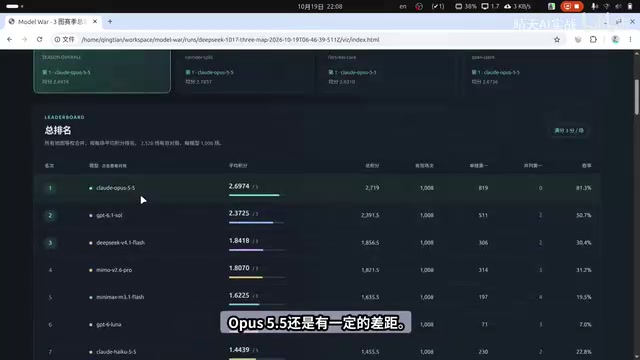
A Bilibili creator tested DeepSeek V4.1 Flash version 1017 through a "Model War" game, and its overall ranking rose from fifth to third. This version adopts an opening troop-hoarding strategy, which can gain late-strike advantages in certain situations but may also miss opportunities. A victory against OBOS 5.5 mainly benefited from accidental factors such as map position and opponent coordination, rather than absolute strength. Strategically, OBOS 5.5 has higher efficiency in converting economy into troops. In practical experience, coding ability has indeed improved, and the creator recommends this version, calling it the only choice among current mainstream models. However, a gap remains versus OBOS 5.5 and 6.6, and users pursuing extreme coding capability still need to weigh options by task.
After the release of DeepSeek V4.1 Flash version 1017, a Bilibili creator conducted actual combat testing through a "Model War" game. The test results show that this version's overall ranking in Spirit Land contest-type games rose from fifth to third place. Its coding ability has improved compared with the previous generation, but there is still a gap versus the advertised benchmark of OBOS 5.5 and 6.6.
Version Upgrade and Testing Method
According to the creator, the DeepSeekAd V4.1 version previously used to test Great Wall coding ability can already be upgraded, but the dataset appears to have been contaminated to some extent. The team used a self-built Benchmark to run scores and confirmed that the capability has indeed improved, though there is still a gap compared with 6.1SW and OBOS 5.5.
In game matches, the strategy of version 1017 shows a clear change: it tends to hoard troops at home at the opening. This strategy has pros and cons—when the other two sides are fighting, hoarding troops can create a "nomadic power" advantage by striking later; but if opponents capture points quickly, the hoarding side may miss opportunities.
Benchmark and Data Contamination
A Benchmark is a standardized evaluation set for measuring AI model capabilities, usually consisting of a set of fixed tasks and scoring rules, used for horizontal comparison of different models. The "dataset contamination" mentioned in the article refers to the model accidentally encountering evaluation set content during training, causing inflated scores that cannot reflect true generalization ability. This is also why the team switched to a self-built Benchmark—a self-built set is more controllable and can reduce the probability of contamination, but sample size and representativeness are limited, so conclusions should be treated with caution.
Key Match Analysis: How DeepSeek Defeated OBOS 5.5
In a match where DeepSeek V4.1 Flash faced OBOS 5.5, DeepSeek ultimately won. The creator analyzed that the key to victory lay in map position: JRM 5.3SW, adjacent to DeepSeek, was relatively weak, while OBOS 5.5 had stronger models on both its left and right sides, falling into a predicament of being attacked from front and rear.
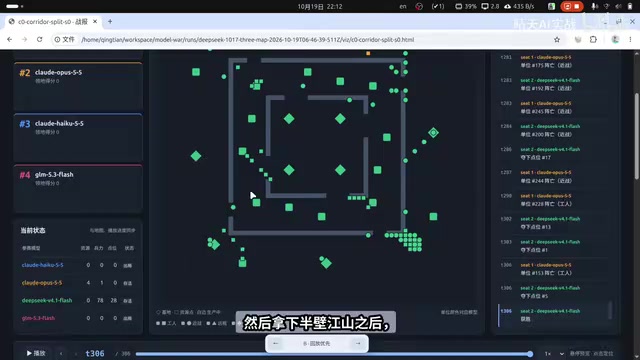
The specific process was: DeepSeek first hoarded troops, JRM 5.3SW occupied several points, and OBOS 5.5 once held the advantage. But the key turning point was a 2-on-1—DeepSeek cooperated with Heiku 5.5 to eliminate OBOS's vanguard forces. Subsequently, Heiku 5.5 pinned down OBOS 5.5, and DeepSeek took the opportunity to defeat JRM 5.3SW, then turned back to consume Heiku 5.5, and finally took down OBOS 5.5.
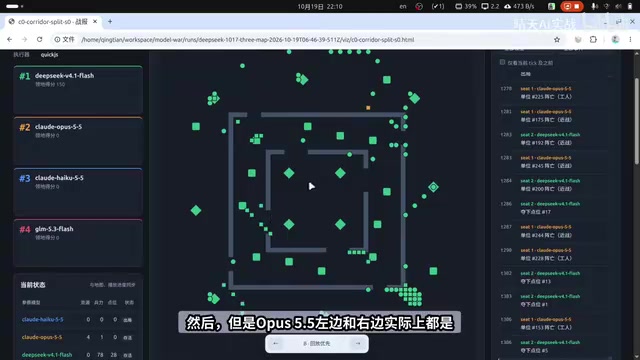
The creator admitted that DeepSeek's probability of beating OBOS 5.5 was actually low, and this match involved accidental factors from the map and opponent coordination. From the data, OBOS 5.5's troop curve led in the early stage, but DeepSeek overtook it in the mid-to-late game.
"2-on-1" and Multi-Agent Gameplay
This type of "Model War" game is essentially multi-agent gameplay: each model makes decisions independently, and they both compete and may temporarily ally. "2-on-1" means two sides simultaneously target a third party in a local battlefield to form a troop advantage, a typical strategy of alliance and maneuver. Because models cannot predict opponents' alliance intentions, victory or defeat often depends on initial map positions and the strength distribution of opponents. This is exactly why the creator emphasized the accidental nature of this match—a single match result cannot be directly equated with a model's overall capability ranking.
Strategic Differences: Hoarding Troops vs. Rapid Point Capture
In another match against GPT 6.1SW and MIMO V2.6 Pro, DeepSeek still hoarded troops at the opening. OBOS 5.5 quickly captured points and directly converted economy into troops. The creator pointed out that if OBOS 5.5's neighboring enemies had not engaged it from the start, its point-capture speed would have brought huge advantages.
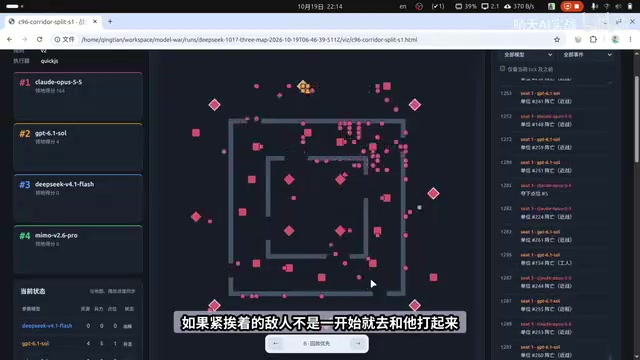
Overall, OBOS 5.5 is somewhat stronger strategically, with higher efficiency in converting economy into troops. But version 1017 of DeepSeek can gain late-strike advantages in certain situations through troop-hoarding strategy, although this strategy is not universally effective.
Economic Conversion Efficiency and the Trade-off of Hoarding Troops
"Rapid point capture and direct conversion of economy into troops" is an immediate resource conversion strategy. Its advantage is a strong snowball effect—the more points captured early and the greater the economic lead; its disadvantage is dispersed troops that are vulnerable to concentrated attacks. "Hoarding troops at the opening" is a delayed-gratification strategy, sacrificing early map control in exchange for a burst of troop advantage in the mid-to-late game. The strength of the two strategies depends heavily on opponent behavior: without external interference, the rapid point-capture side benefits more; if neighbors fight at the opening, the hoarding side can instead profit from their conflict. This explains why OBOS 5.5's strategy is better yet can still be overturned by DeepSeek in specific situations.
Practical Experience and Usage Recommendations
Although media promotion may be exaggerated, the creator still recommends using version 1017. Practical experience shows that coding ability has indeed improved. As a subsequent Flash-chain version, its parameters were not adjusted, but its capability has already surpassed MIMO V2.6 Pro. In many scenarios, users can directly choose the V4.1 Flash 1017 version, and the creator even called it "the only choice among current mainstream models."
However, compared with OBOS 5.5 and 6.6, a gap still exists. For users pursuing extreme coding capability, it is still necessary to weigh options based on specific tasks.
One-line Summary
DeepSeek V4.1 Flash 1017 rose to third in practical combat ranking; coding improved but still lags OBOS 5.5/6.6.
Paragraph Summary
A Bilibili creator tested DeepSeek V4.1 Flash version 1017 through a "Model War" game, and its overall ranking rose from fifth to third. This version adopts an opening troop-hoarding strategy, which can gain late-strike advantages in certain situations but may also miss opportunities. A victory against OBOS 5.5 mainly benefited from accidental factors such as map position and opponent coordination, rather than absolute strength. Strategically, OBOS 5.5 has higher efficiency in converting economy into troops. In practical experience, coding ability has indeed improved, and the creator recommends using this version and calls it the only choice among current mainstream models. However, a gap remains versus OBOS 5.5 and 6.6, and users pursuing extreme coding capability still need to weigh options by task.
Related articles

DeepSeek V4.1 Pro Enters Testing, Gemini 4 Pro Benchmark Leaked
DeepSeek V4.1 Pro enters early per-account testing and is hidden from the public selector; MiniMax M3.1 Flash preview hits TokenPlan; Gemini 4 Pro benchmarks leak with 2M token context and pricing.

Qwen 4 First Test Leaks: Performance Rivals Opus 5.5, DeepSeek V4 Series Surfaces
Early Qwen 4 test outputs leak, with front-end generation said to rival Opus 5.5; DeepSeek V4 Mini, Flash, and Pro names appear in a code repo; Ant Group's Ling-3.1-flash surfaces too. Here's the latest on model tiering and on-device lightweight models.

OpenCode Makes DeepSeek V4.1 Flash Free, AI Daily Roundup
AI daily roundup: OpenCode makes DeepSeek V4.1 Flash free, StepFun Step5 Preview and Ling 3.1 Flash open-sourced, Grok Voice 3.0 tops speech leaderboard, Matrix Game 4.0 open-sourced, and the EU opens its first AI Act enforcement probe into OpenAI and Anthropic.